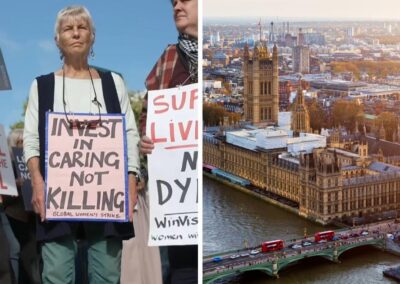





The actress and disability rights campaigner, Liz Carr, has spoken out against introducing assisted suicide to the UK.
Carr starred in BBC crime thriller series Silent Witness from 2013 to 2020. In 2019, she starred in The OA. In 2020 she appeared in the miniseries Devs. In March 2021, it was announced that Carr had joined the cast of Polish-American drama The Witcher.
Writing in The Sunday Times, which, only a week earlier had announced its support for legalising assisted suicide, Carr argues that since the issue was last brought before Parliament in 2015 nothing has changed and that MPs should reject any further attempts to change the law.
Pointing out that the majority of doctors who are most intimately involved in the care of patients at the end of their lives do not want a change in the law, Carr said: “[In 2015], as now, the majority of doctors who would be licensed to provide the lethal drugs did not want a bill passed. This included the Association for Palliative Medicine and the British Geriatric Society, the experts on end-of-life care”.
Carr, who herself has a disability, goes on to point out how frightening assisted suicide law is for people with disabilities.
“Then, as now, no organisation of disabled people supported assisted suicide. Many of us have degenerative conditions and the idea of an assisted suicide law terrifies us”.
The Sunday Times, in its statement in support of a change in the law on assisted suicide on 23 May, used the tragic case of a WWII veteran who took his own life in part because he was unable to socialise. Campaigners against a change in the law argue that ‘hard cases make bad law’ and Carr argues that the consequences of mistakes are so severe that a change in the law is not safe.
“Then, as now, supporters of assisted suicide said that the current law was broken. The current law is exactly where it needs to be when the consequences of abuse or mistakes are fatal”.
“Then, as now, the safety of the many had to overrule the desires of the few. MPs must again vote against legalising assisted suicide”.
Most doctors working in palliative care opposed assisted suicide
The majority of British doctors working in palliative care – the medical field that focuses on optimising quality of life for the seriously and terminally ill – continue to oppose the legalisation of assisted suicide. In 2020, the British Medical Association (BMA) surveyed its members asking whether it should change its stance on assisted suicide from ‘opposition’ to ‘neutral’. 70% of doctors working in palliative care stated they were opposed to changing their stance on assisted suicide. Only 7% were in favour of changing the law.
The Sunday Times chose to begin their public campaign for assisted suicide ahead of when Baroness Meacher’s private member’s bill to legalise assisted suicide had its First Reading in the House of Lords last Wednesday.
Assisted suicide in Britain
Assisted suicide remains a criminal offence in the UK under the Suicide Act 1961. If a doctor assists in the suicide of a patient, they could spend up to 14 years in prison.
Since their Bill’s resounding defeat in 2015, assisted suicide supporters have since attempted to pass assisted suicide legislation through the courts. All such attempts have so far failed. In 2019, the High Court said the courts were not the place to decide moral issues. In a ruling concerning a man with motor neurone disease who wanted to be assisted in suicide, the court said: “In our judgment the courts are not the venue for arguments that have failed to convince parliament”.
Right To Life UK spokesperson, Catherine Robinson, said: “The voices of disability rights groups and people with disabilities must be listened to. As Liz Carr points out, no disability rights group is advocating for the legalisation of assisted suicide. They recognise how dangerous such a law is for vulnerable people already in ill health”.
“In 2015, The Times itself argued against the legalisation of assisted suicide. The paper emphasised advances in palliative care and the psychological pressure that sick and dying people who think themselves a burden can experience. These were good arguments against assisted suicide in 2015, and they are still good arguments now”.