




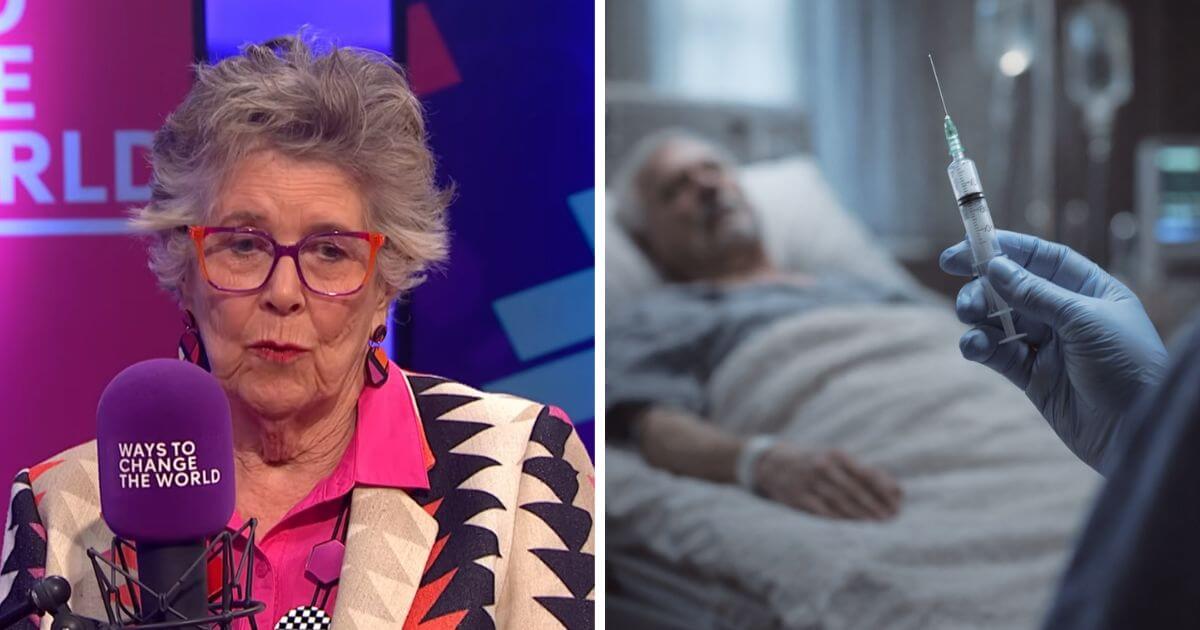
Prue Leith, the celebrity cooking show judge, has celebrated the expansive euthanasia and assisted suicide regime in Canada, stating that 4% of all deaths in the country being caused by euthanasia or assisted suicide is a “real success”.
Leith, a patron of the assisted suicide lobbying group, Dignity in Dying, celebrated the vast number of deaths in an article for Radio Times, saying, “Today four per cent of deaths in Canada are by euthanasia. Our opponents claim this is proof of the law not protecting people. But I see it as proof of real success, allowing those wanting to be done with life to get peace”.
“Canadians are proud of their law and on the whole, support it”, she added.
Leith underestimates the figures. According to the latest report on “medical assistance in dying” (MAiD) from Health Canada released at the end of November, a record 16,499 people died by euthanasia in Canada in 2024, accounting for 5.1% of all deaths in the country. This represents a 6.9% increase in state-assisted deaths in Canada from the previous year.
There have been a total of 76,475 instances of euthanasia and assisted suicide from when they were made legal in Canada in 2016 until the end of 2024.
Among the factors recorded by medical practitioners as part of a person’s application for euthanasia in 2024, 75.5% of people cited “loss of independence”. 48.5% of all those who died by euthanasia cited being a “perceived burden on family, friends or caregivers”. Additionally, 58.1% of those who died by euthanasia in Canada in 2024 cited emotional “distress/anxiety/fear/existential suffering”.
Over a fifth of people (22.9%) who died by euthanasia in Canada in 2024 had “isolation or loneliness” recorded by a medical practitioner in their application for euthanasia. Significantly, 44.7% of those on Track 2, whose deaths were not reasonably foreseeable, experienced isolation or loneliness.
High-profile assisted suicide and euthanasia scandals common in Canada, contrary to claims of “real success”
While Leith claims that Canada has been a success story for assisted suicide and euthanasia, there have been many recent high-profile scandals and controversies regarding the state-assisted death regime there.
In one recent case, a Canadian priest was twice offered an assisted death while recovering from a hip fracture, despite being known to be opposed to euthanasia.
According to reports, the 79-year-old priest, Father Larry Holland from Vancouver, British Columbia, Canada, said he was not dying then or now, but that medical professionals raised the prospect of ending his life by euthanasia on more than one occasion.
In another recent case, a Canadian man who was hospitalised due to repeated alcohol-related falls had his life ended by assisted dying the day after having virtual eligibility assessments, despite no clinical investigations and no terminal diagnosis.
An official report by the Chief Coroner of Ontario’s Medical Assistance in Dying Death Review Committee (MDRC) highlighted that the man, known as Mr A, had previously been found ineligible to end his life under Canada’s euthanasia and assisted suicide regime because he did not have a “grievous and irremediable condition”.
In one recent high-profile case, a Canadian man who had seasonal depression had his life ended by euthanasia by notorious doctor, Ellen Wiebe, who is personally responsible for ending the lives of over 400 of her patients.
The 26-year-old Canadian, Kiano Vafaeian, who had partial vision loss and lived with Type 1 diabetes, faced mental health struggles, which often became worse in the winter, as a result of a car accident when he was 17. After losing vision in one of his eyes in 2022, Vafaeian became “obsessed” with ending his life by assisted dying, according to his mother, Margaret Marsilla.
Vafaeian had previously attempted to end his life on Canada’s assisted suicide and euthanasia programme several times but had been rejected by several doctors, with one doctor saying, “This patient does not have terminal illness and/or reasonably foreseeable natural death”. Vafaeian had his life ended by euthanasia on 30 December 2025.
Spokesperson for Right To Life UK, Catherine Robinson, said “It is outrageous and entirely disingenuous for Prue Leith to suggest that Canada’s euthanasia and assisted suicide regime is a ‘real success’, let alone to attempt to use this as an argument for why assisted suicide should be forced on this country, without full scrutiny and approval from the House of Lords”.
“Canada is an example of precisely why assisted suicide should never be made legal. There are countless examples of scandals and controversies whereby individuals have had their lives ended, sometimes even against their own will”.