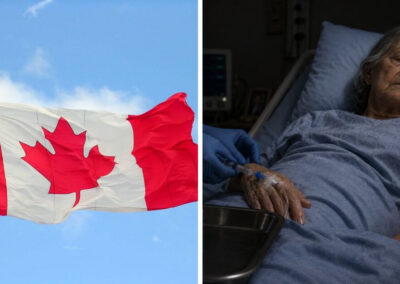





An 87-year-old Canadian man was not properly sedated before his life was ended by euthanasia, as he repeatedly cried out “help me” while dying.
The man from Ontario, known only as Mr D, had congestive heart failure and met the eligibility criteria to end his life under Canada’s assisted suicide and euthanasia regime, known as Medical Assistance in Dying (MAiD). Mr D was scheduled to have his life ended at home on the same day he was transferred there from the hospital.
The doctor first administered midazolam, a sedative, to relax the patient. However, the drug did not have its usual effects in Mr D’s case.
The case review stated, “During the first three minutes. Mr. D experienced signs of physical and psychological distress, including groaning, guarding (tensing muscles) and grimacing”, adding that “Mr. D did not experience expected sedation”.
“His behavioural signs of distress escalated to repeated verbalizations, including ‘help me’ that continued until sedation was achieved with propofol and a comatose state was confirmed”, the report continued.
Additionally, the report stated that Mr D’s family, who were present at the time of his euthanasia, experienced “profound distress” as they “witnessed their father suffering with physical and psychological distress”.
According to the case review, the family experienced “anguish regarding the decision to support their father through the MAID process and immense grief and sorrow regarding their final memories with their father”.
Dr Ramona Coelho, a member of the Chief Coroner of Ontario’s Medical Assistance in Dying Death Review Committee (MDRC), said that while “some MAID clinicians publicly portray MAID deaths as uniformly peaceful, beautiful and free of complications”, this “does not present an accurate picture of reality and risks influencing decisions about MAID”.
Numerous high-profile euthanasia scandals in Ontario have been reported recently
These revelations are just one of a number of controversial cases regarding Ontario’s MAiD regime that have come to light recently.
Last month, The Globe and Mail reported that euthanasia practitioner Dr James MacLean was the subject of two complaints relating to two cases involving Canada’s euthanasia and assisted suicide regime.
In one case, one of MacLean’s patients who wished to end their life resumed breathing after being declared dead due to the improper application of the fatal mix of substances. MacLean gave a 67-year-old cancer patient an anaesthetic, rather than the neuromuscular-blocking medication normally used in euthanasia cases, because he could not find where he had put it.
The doctor pronounced the patient, who has not been named, dead; however, shortly after he left the patient’s home, he resumed breathing. MacLean returned to the patient’s home, gave him additional substances, including the neuromuscular-blocking medication, and shortly thereafter pronounced him dead for the second time.
This is not the only controversial case undertaken by MacLean. The 45-year-old Thomas Dillon, who had Crohn’s disease, in addition to a history of alcohol abuse, depression and suicidal ideation, met with MacLean more than once outside of a Tim Hortons cafe for his euthanasia eligibility assessments.
After these meetings, they exchanged numerous text messages to plan the end of his life.
Two days later, they met again at the cafe, from where the doctor then drove the patient to the location where he would end his life. MacLean then ended Dillon’s life by euthanasia in an industrial unit where cadavers are prepared for transport to funeral homes.
Following these incidents, MacLean’s general conduct was reviewed by the College of Physicians and Surgeons of Ontario, and it was determined that MacLean displayed a lack of judgment in his decisions, dealt with patients in a way that “raised a risk of perceived coercion”, and kept inadequate records.
The College found that MacLean’s conduct “exposes or is likely to expose patients to harm or injury in five out of twenty [patient] charts reviewed”.
Regarding the man assessed outside of a Tim Hortons cafe, the College of Physicians and Surgeons of Ontario found that MacLean had crossed professional boundaries with his casual approach to ending Dillon’s life, and found that the venue for the eligibility assessment was inappropriate.
Spokesperson for Right To Life UK, Catherine Robinson, said “These sorts of cases show that assisted dying is not necessarily the pain-free death it is marketed as. The reality can be far more unpleasant. Such cases are yet another side-effect of the state facilitating suicide among a portion of the population, and we ought to remain grateful that the assisted dying Bills in Britain have failed”.