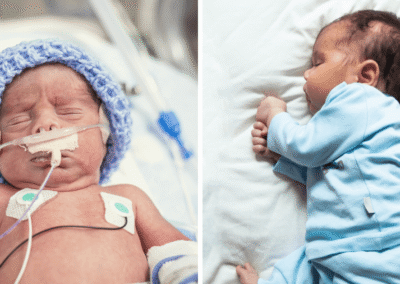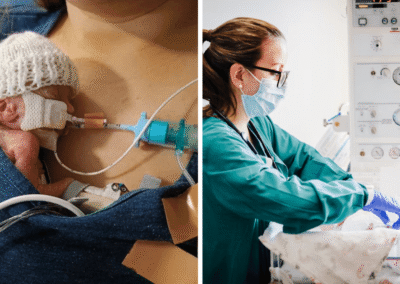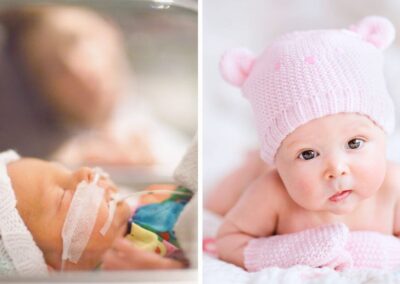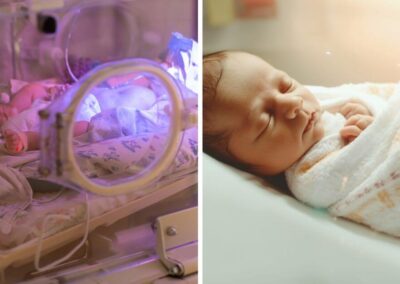




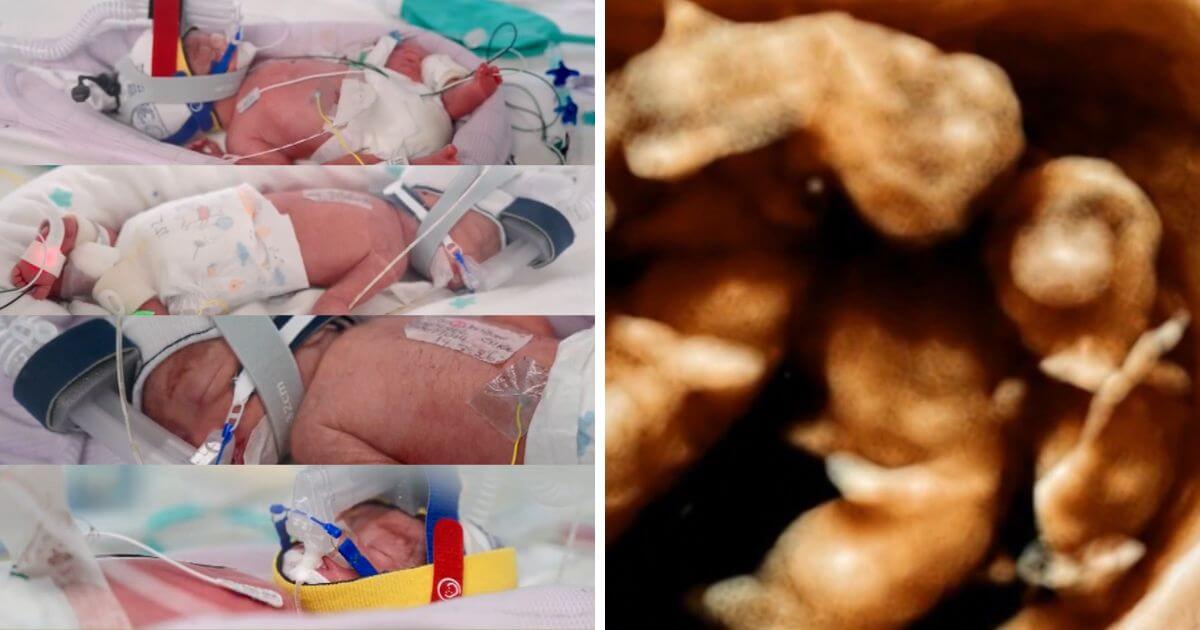
Extremely rare premature identical quadruplets are doing “extremely well” after being born at just 28 weeks gestation.
Babies Emily, Harriet, Alexa and Catherine were delivered earlier this month by caesarean section.
The four sisters are monozygotic quadruplets, meaning they are identical and developed after a single zygote divided into four embryos. They also shared the same placenta.
Dr Alexa Bendall, the maternal foetal medicine specialist and obstetrician who cared for mum Jenitar from the beginning of her pregnancy, estimated that identical quadruplets occur “at one in every 15 million pregnancies”.
“But to share the same placenta – this is unheard of,” she said.
Mum Jenitar and her husband Jortham already had four children, aged between one and 10, when they learnt that they were expecting quadruplets. The news came as an “immense surprise” to the family.
Because the pregnancy presented serious risks to both mum Jenitar and the four baby girls, she was admitted as an inpatient at 25 weeks so that they could be closely monitored.
“We always said that if we could get her to 28 weeks, we would be doing well”, Dr Bendall said. “So the fact that we’ve got four beautiful, healthy babies born at 28 weeks and four days is incredible and we’re very happy to be a part of it”, she added.
Despite the significant risks associated with the pregnancy, mum Jenitar avoided the complications doctors had feared.
“Jenitar has taken everything in her stride from day one… she has somehow dodged every complication and risk for both herself and her babies”, Dr Bendall said.
One of the newborn girls, baby Alexa, was named after Dr Bendall, who described the decision as “a beautiful tribute”.
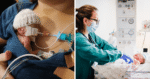
The four sisters will remain in neonatal intensive care until they reach full term. Dr Bendall said they were “currently doing extremely well”.
The births have increased the Jenitar and Jortham’s family from six members to 10. Mum Jenitar has launched an online fundraising campaign to help them purchase a van with at least 10 seats and meet the practical costs of caring for four newborn babies.
“Our four precious miracles have arrived safely, and while our hearts are overflowing with gratitude, the reality of caring for four newborns at once has brought challenges we never could have imagined”, mum Jenitar wrote alongside the appeal.
Naturally conceived quadruplets of any kind are estimated to occur in approximately one in 700,000 births, while identical quadruplets are estimated to occur in approximately one in 15 million pregnancies.
Spokesperson for Right To Life UK, Catherine Robinson, said “The safe arrival of babies Emily, Harriet, Alexa and Catherine is a remarkable reminder of the resilience of premature babies and the preciousness of every human life. Born so early following an exceptionally rare and high-risk pregnancy, it is wonderful to hear that all four sisters are doing extremely well. We wish them and their family every happiness as they continue to grow stronger”.