



Peers subjected the assisted suicide Bill to its twelfth day of Committee Stage scrutiny on Friday 20 March. Campaigners questioned the Government’s neutrality on the assisted suicide Bill, after it created seven additional sitting Fridays for the Bill in the House of Lords, in addition to the three sitting Fridays that had already been scheduled. The penultimate Committee stage session is scheduled for 27 March, followed by a final sitting after Easter recess.
Wales threatened into consenting to assisted suicide Bill
On Friday, Peers criticised the situation that led to the Senedd (Welsh Parliament), which opposes assisted suicide, narrowly voting for a Legislative Consent Motion (LCM), after significant pressure was placed on Members of the Senedd (MSs) by Kim Leadbeater and Lord Falconer.
The LCM was accompanied by the passing of a strongly worded amendment to the motion, outlining the Senedd’s concerns with scrutiny of the Leadbeater assisted suicide Bill and its implications.
An LCM is required under the devolution settlement where UK legislation would extend into devolved areas in Wales, since health services are a devolved matter.
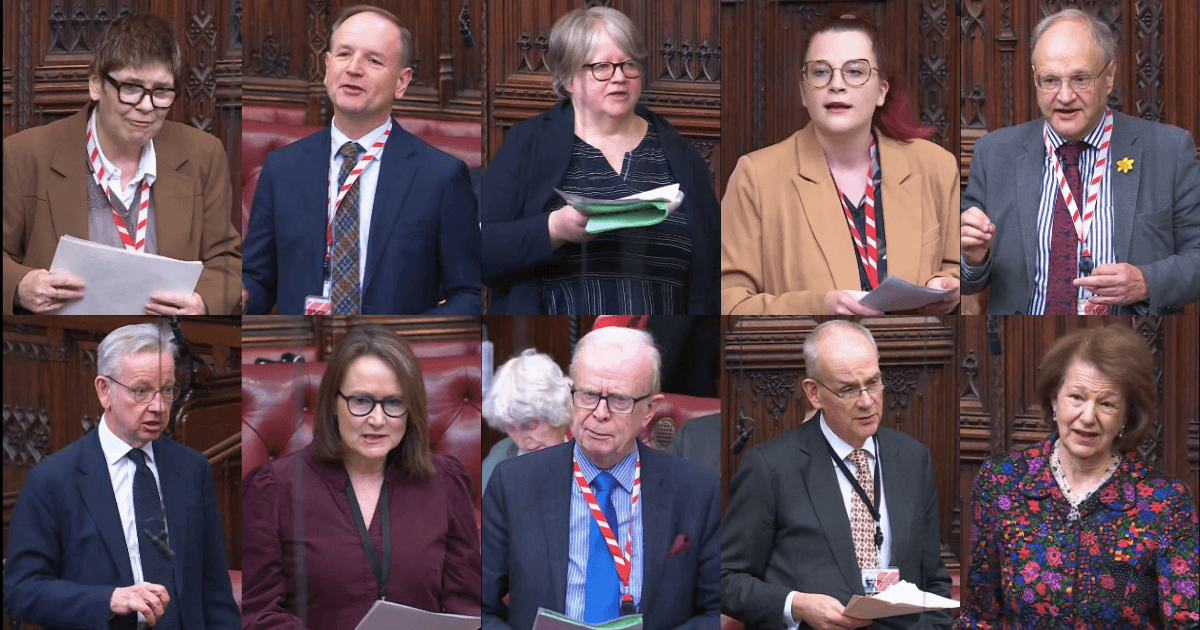
During the debate in the Lords, former Health Secretary Baroness Coffey informed the chamber that the Senedd supported a technical motion on the assisted suicide Bill’s implementation in Wales after they “perceived a threat” that Wales would lose any say over the Bill otherwise. Despite the threat, Baroness Coffey said, the Welsh First Minister and Health Minister voted against the motion, calling the Bill “unsafe”.
Baroness Smith of Llanfaes reiterated concerns from Members of the Senedd that, due to the inadequate consideration of the proposed legislation and its implications in Westminster, the Senedd was being asked to “vote in the dark”.
Baroness Fox of Buckley stated that it was “bad form” to threaten the Senedd into voting for the LCM, despite the Senedd also having voted against the principle of assisted suicide previously, adding that people in Wales were “completely confused” about what was actually being voted on by the Senedd, with many believing it was a vote on backing the assisted suicide Bill itself, rather than consent to future legislation.
Lord Weir of Ballyholme pointed out that the Senedd was put in an “impossible situation” by the threats pertaining to the LCM, arguing that it has been “misrepresented by some as the Welsh Senedd embracing a Bill on assisted dying”.
Lord Gove argued that the Senedd, in the same debate, voted decisively to say that the entirety of the assisted suicide Bill as it pertained to Wales had been “constitutionally mishandled” and was being used as a “Trojan horse” to fundamentally alter the provision of the NHS.
Accuracy of terminal prognoses called into questions
Peers once again raised concerns about the efficacy of six-month terminal prognoses as part of the eligibility criteria for assisted suicide.
Lord Moylan explained that research has shown that beyond 14 days, a clinician’s prognosis is almost always wrong, adding that he was diagnosed with oesophageal cancer three years ago, and that he was given a prognosis of 12-18 months to live. Lord Moylan is a testament to how incorrect these prognoses can be.
Baroness Fox of Buckley reiterated that a terminal prognosis is not given with “absolute scientific certainty”, but patients may not be aware of this when they are receiving it.
Lack of clarity in the Bill poses risks for people with disabilities
Baroness Hollins informed the House that there is a clear lack of understanding about how people with learning disabilities interpret health advice. She said that the mere act of a medical professional explaining that assisted suicide is an option could be interpreted as an endorsement or recommendation.
Baroness Grey-Thompson added that issues with communication or language barriers are more likely to be experienced by people with disabilities, and that this could impact their ability to have a real choice.
Baroness O’Loan argued that the phrasing of the Bill with regard to independent advocates leaves the door wide open for coercion to occur, as it would appear they “can do more than listen, explain and communicate”.
Lord Blencathra informed the house that the so-called independent advocates are neither independent nor empowered, explaining that this does not adequately safeguard against risks for people who may be seeking assisted suicide.
Lord Empey declared that many people have a rose-tinted view of the NHS that is misaligned with its current practical challenges, outlining that it would not be possible to safely introduce assisted suicide into the NHS as it currently is.
Baroness Fraser of Craigmaddie told the House that so much of communication with people who have complex needs is co-constructed, and that there would be no real way in discussions about assisted suicide to ensure that they are having their real views properly listened to.
Lord Polak said that it was “a real disgrace” that supporters of the legislation were trying to push it through without the requisite scrutiny that it requires, stating that the Bill should work for every individual, regardless of their difficulties in communicating.