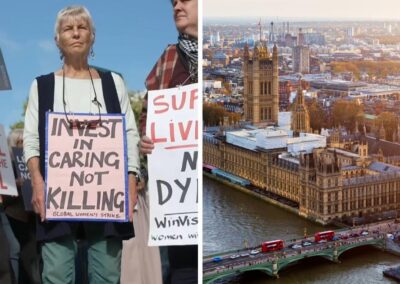





The Welsh Health Secretary, Jeremy Miles, has said that the assisted suicide Bill does not “provide sufficient safeguards for patients” after voting against a motion in the Senedd (Welsh Parliament) to consent to the Bill.
Speaking to the BBC the day after the vote, Miles said that he was “clear in my own mind that the fundamentals of the bill, as it’s going through Westminster, don’t provide sufficient safeguards for patients”.
“Although the vote yesterday was on the devolved areas… the net effect is to give powers in Wales to deliver a service that I don’t think I would support if I was operating over the border”, he added.
Speaking during the debate, Miles expressed concern about giving consent to what would be an unfinished version of the assisted suicide Bill, stating that they have found themselves in an “unusual position”.
The debate centred on a Legislative Consent Motion (LCM) pertaining to the assisted suicide Bill. An LCM is required under the devolution settlement where UK legislation would extend into devolved areas in Wales, since health services are a devolved matter.
While the Senedd decisively voted against legalising assisted suicide in principle in October 2024, only weeks before the Second Reading of the Leadbeater assisted suicide Bill in Westminster, it narrowly voted in favour of the LCM on Tuesday.
As supporters of the motion made clear, the vote was not on whether assisted suicide should be made legal in Wales. Rather, it was a vote on a narrowly worded motion regarding the implementation of assisted suicide in Wales, should it become law.
Assisted suicide Bill sponsors “blackmail” Senedd into voting in favour
Tactics employed on Tuesday by the Bill sponsors, Kim Leadbeater and Lord Falconer, seemingly “blackmailing” Labour Senedd Members to support the motion with threats about forcing a private assisted suicide service on Wales, have been heavily criticised online.
David Deans, reporter for BBC Wales Politics, said that the two sponsors of the Bill told the Welsh First Minister, Eluned Morgan, that if the LCM were rejected, they would seek to remove clauses that would allow the Welsh government to set up assisted dying services in the NHS. In effect, this was said in order to blackmail MSs under the threat of privatisation of a possible future assisted suicide law.
Jeremy Miles reiterated this during the LCM debate, highlighting that if the assisted suicide Bill were to pass, and the sponsors carried through their threats, failing to pass the LCM would leave Welsh ministers without the ability to implement assisted suicide services in Wales or to oversee or regulate such services.
Commentator Lois McLatchie Miller said such threats were “foul play”, adding that they have “threatened the [Senedd]” with the provision of privatised assisted suicide in Wales if they did not vote in favour of the LCM, while Fleur Meston called these tactics “bullying”, adding that “London politicians [were] threatening Wales with privatisation”.
Former special adviser in the Wales Office, Lauren McEvatt, who recently wrote a strongly worded piece that sets the record straight on the misinformation that is being circulated by assisted suicide campaigners about the motion, said the threats amounted to “political blackmail”, while Adam James Pollock said it was “a new low” for the Bill’s sponsors.
In reality, rejecting the LCM would not have determined how any future possible assisted suicide service would ultimately be delivered in Wales. Rather, it would have appropriately withheld consent to Westminster legislating on devolved policy matters.
The Senedd already has all the powers it needs to legislate during the Bill’s four-year implementation period to provide any future service through NHS Wales / the public sector, where the Senedd could decide on a Welsh approach to implementing the service.
Assisted suicide Bill still unlikely to become law, not expected to pass all stages in the House of Lords
For assisted suicide to be implemented in Wales, Kim Leadbeater’s assisted suicide Bill still needs to become law, however, this is very unlikely; it will “almost certainly” run out of time in the House of Lords and will not become law after the Government Chief Whip in the Lords confirmed that the Government will not be committing any further time to the Bill.
Private Members’ Bills, like the Terminally Ill Adults (End of Life) Bill, are only debated on Fridays, and despite seven additional sitting Fridays being granted for the Bill before Christmas on top of the seven that had already been scheduled, even the team behind the Bill now expect it to fail.
Spokesperson for Right To Life UK, Catherine Robinson, said “The comments made by the Welsh Health Secretary, Jeremy Miles, are welcome, but highlight the extent to which people remain incredibly concerned about the lack of safeguards within the assisted suicide Bill”.
“It is very unlikely that the assisted suicide Bill will become law in this parliamentary session, and it is mortally wounded beyond it. The Bill is failing because it is a badly drafted piece of legislation and, after appropriate and necessary scrutiny, Peers have rightly determined that the Bill would not be safe or workable”.
“Parliament now has the opportunity to drop this divisive and flawed Bill for good, and instead to come together to work collectively to ensure better quality palliative and end-of-life care is available for all”.