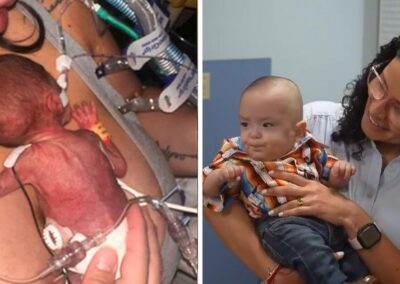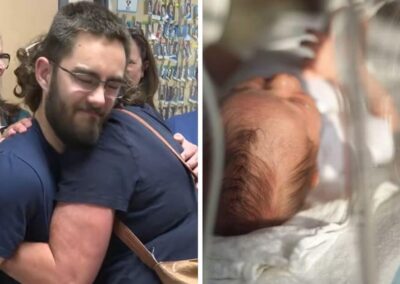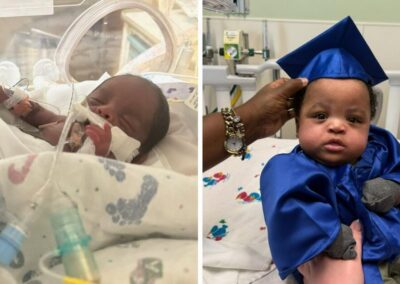




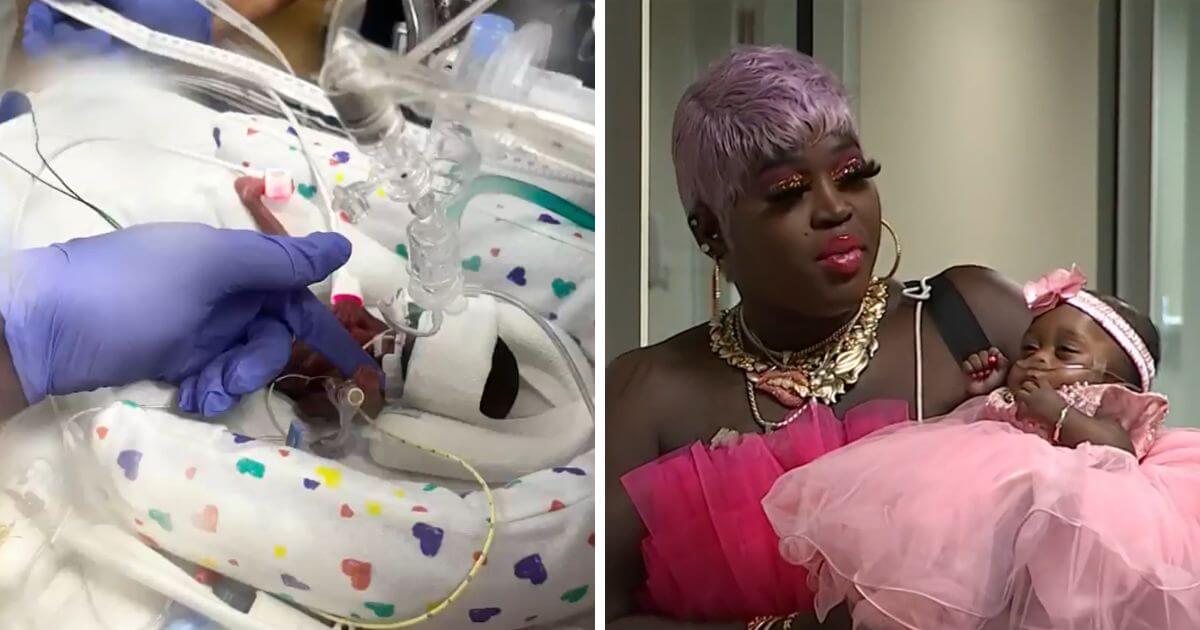
Born at just 23 weeks gestation and weighing only 301g, baby Bi’Laynie has defied the odds and finally gone home from the hospital seven months after her birth.
When baby Bi’Laynie Myna Daucima was born, she measured just 25cm long.
Her mother, Jeamyna Jean Charles, went to the hospital when she was 22 weeks pregnant as her blood pressure was abnormally high.
“I was diagnosed with preeclampsia”, she explained.
“That was in March, and they told me that I was going to have to stay until I deliver the baby, which they were going to try to push me up to 34 weeks”, she added.
However, only a week later, in a serious complication, Bi’Laynie’s blood started flowing backwards, meaning she would have to be delivered immediately.
“[W]e took a leap of faith and we delivered her. And when she came out, she came out with one eye open like, I’m ready, I’m here”, Jeamyna said. “So, this is Miss Bi’Laynie, our miracle baby”.
Dr Cherie Foster, the division chief of neonatology at Joe DiMaggio Children’s Hospital, said, “Bi’Laynie was born near the limits of what you can survive at as a tiny premature baby, and she’s a strong fighter and she’s done incredibly well”.
It required the “teamwork and belief of 400 people to get Bi’Laynie to this point” where she was able to go home, Dr Foster said.
“I’m so excited that I can’t believe this actually happened”, Jeamyna added.
“And I’m still shocked. I’m like, wake up!”
Medical advancements are improving premature babies’ outcomes
Many very premature babies like Bi’Laynie are increasingly surviving due to medical developments.
A number of key studies in recent years have documented the improving outcomes for these extremely premature babies. A 2004 Swedish study found that neonatal survival outcomes between 22 and 25 weeks gestation significantly improve when neonatal hospital staff take a proactive approach in the care of premature babies.
A 2008 study based on a neonatal intensive care unit in London also found that neonatal survival rates at 22 and 23 weeks gestation had improved. In 1981-85, no babies who were born at these gestational ages survived to discharge. However, by 1986-90, 19% did and this increased to 54% in the period 1996-2000.
A study in 2022 found almost four out of five babies born prematurely between 22 and 28 weeks gestation survive to discharge from the hospital. It found that from 2013 to 2018, with infants born between 22 and 28 weeks gestation, “survival to discharge occurred in 78.3% and was significantly improved compared with a historical rate of 76.0% among infants born in 2008-2012”.
Spokesperson for Right To Life UK, Catherine Robinson, said “Bi’Laynie’s survival is a remarkable testimony to the advances in neonatal medicine and to the determination of families and doctors who believe in protecting every life. She is living proof that babies born before 24 weeks can not only survive, but go on to thrive”.