



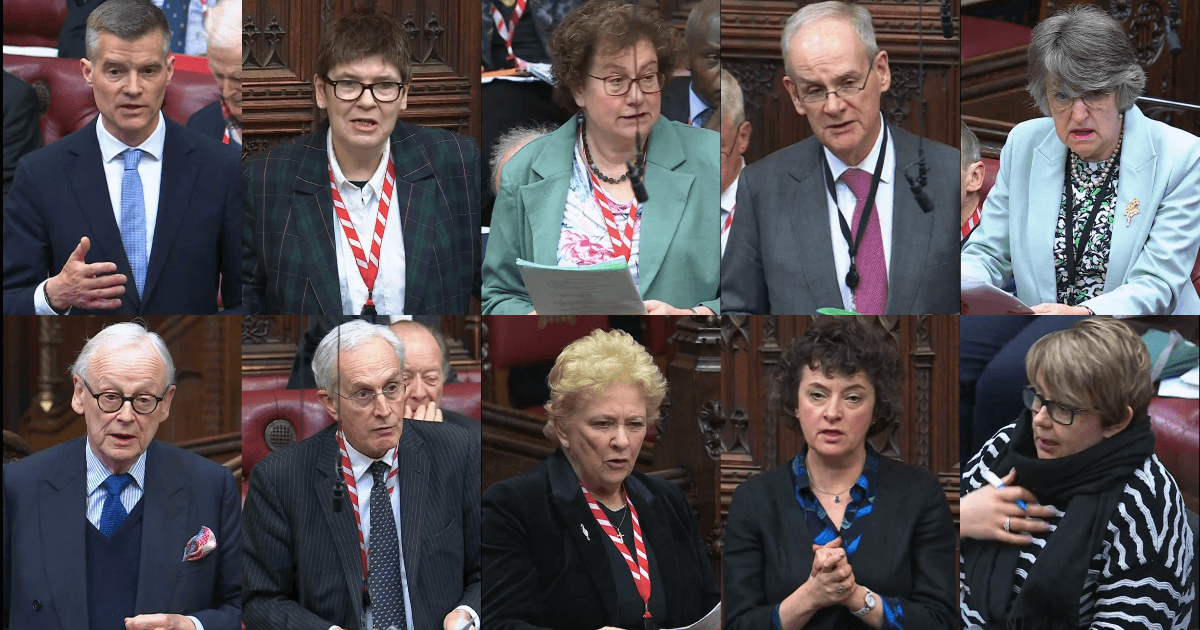
As Peers subjected the assisted suicide Bill to its tenth day of Committee Stage scrutiny on Friday 27 February, more than four in five speakers who took a position in a speech spoke against the Bill, amid proclamations that the Bill would almost certainly fail.
Across the day’s debate, of the 41 Peers who took a position in a speech, 35 (85%) spoke against the Bill, while only 6 (15%) spoke in favour of it.
The debate came shortly after it had been revealed that the assisted suicide Bill will “almost certainly” run out of time in the House of Lords and will not become law after the Government Chief Whip in the Lords confirmed that the Government will not be committing any further time to the Bill.
Peers criticise accusations by assisted suicide supporters of filibustering
A number of Peers pushed back against the accusation of filibustering during the debate. Rather, these Peers argued they were doing their job of scrutinising the Bill. Lord Rooker kicked off the debate by stating that he was “getting really irritated” by frequent media appearances of assisted suicide supporters claiming that opponents of the Bill are filibustering. He argued that they refrain from saying so in the House of Lords, but only say it in the media.
Lord Moore concurred with this, pointing out that those scrutinising the Bill “do not think we are filibustering and we think we are debating the Bill”. Lord Harper, attempting to speak to this point, was subsequently interrupted by an assisted suicide supporter, Baroness Murphy. He reminded her of the request from the Government Chief Whip that Peers should treat each other with “kindness, courtesy and respect”.
Baroness Fox also highlighted the misleading comments that supporters of the Bill have made about filibustering, arguing that the reputations of Peers are being “impugned” as a result.
Lord Sandhurst also criticised these accusations, specifically those accusing him of filibustering by tabling many amendments in a deliberate attempt to delay the Bill. He countered this by reaffirming that all but two amendments he had tabled were put forward by the Law Society of England and Wales and by the Complex Life And Death Decisions group at King’s College London.
Assisted suicide commissioner would not be an impartial role, Peers argue
One of the main points of contention during the debate was the role of the so-called ‘death tsar’, who would have oversight of the assisted suicide process. Peers raised concerns regarding the appointment of an assisted suicide commissioner, who would be appointed by the Prime Minister.
Lord Moylan pointed out that the powers that this commissioner would be granted would be “very extensive”, including “a general power to do anything which may be necessary or appropriate for the commissioner to do”.
Baroness Finlay argued that there is a possibility, due to a lack of explicit information regarding conflict of interests in the Bill, that an assisted suicide commissioner could also be a patron of an assisted suicide organisation. She highlighted that this is currently the case in Belgium.
Baroness Grey-Thompson also drew attention to the fact that there is no requirement in the assisted suicide Bill that this commissioner would have to declare any relevant interests publicly.
Lord Beith, referring to scandals that have beset the Government recently, argued that the assisted suicide commissioner appointment should be met with proper due diligence, as “if you do not have proper scrutiny of appointments and a system in which the right questions are asked, things can go very badly wrong”.
Baroness Cass said that the “dual role” of the assisted suicide commissioner under the Bill, in that they would have responsibility for the delivery of assisted suicide, as well as the monitoring and reporting on it. She argued that this is inadequate, as it would mean that the commissioner would be “both poacher and gamekeeper and to mark their own homework”.
Baroness Fox also highlighted that it would be likely that any assisted suicide commissioner would not be an individual who had reservations about assisted suicide itself. She argued that this could easily lead to “mission creep”.
Concerns raised regarding lack of safeguards in assisted suicide eligibility panels
Peers argued that the eligibility panels, which would decide whether an individual should be given permission to end their life by assisted suicide, do not have adequate safeguards.
Lord Harper highlighted that, under the Bill, members of the eligibility panels would not be physically required to meet with or speak to an individual who is seeking to end their life. He said that this is “frankly appalling”.
Baroness Coffey also pointed out that, according to the Government’s Equality Impact Assessment of the assisted suicide Bill, they had costed it under the assumption that the eligibility panels would only spend two hours on each individual decision.
Baroness Berridge stated that, in Canada, where assisted suicide is legal, people have presented to the assisted suicide and euthanasia eligibility panels there because they are poor or homeless. She argued that this should not be allowed to be the case under the assisted suicide Bill.
Peers reiterate that assisted suicide is not healthcare, so should not receive healthcare funding
Baroness Finlay made the point that the current NHS budget “appears to be in such a difficult and parlous state” that creating a new assisted suicide service on the NHS and diverting funding into this would be dangerous, reiterating that assisted suicide “is not a healthcare treatment”. She argued that this may incentivise people to end their lives rather than seek out treatment.
Lord Moylan reiterated this point, stating that the principle of medical treatment that is free at the point of use should not apply to a service that seeks to end lives, arguing that it should not be something that taxpayers should fund.
Baroness Fox drew attention to the fact that we have already been told that assisted suicide would be funded through the reprioritisation of existing NHS budgets, arguing that care boards may have to choose between funding either palliative care or assisted suicide.
Baroness O’Loan reminded the House that many people who live in care homes are forgotten and isolated, and that if assisted suicide is more prevalent than adequate care opportunities, these individuals may feel pressured into ending their lives.