




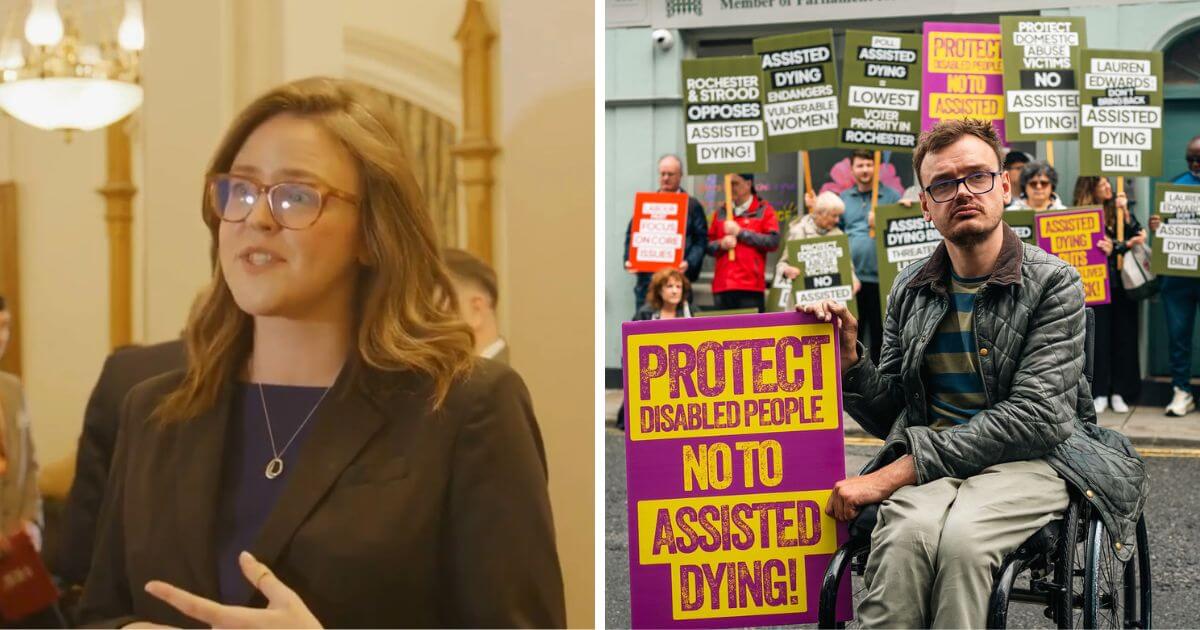
Residents of Rochester and Strood have delivered a petition, signed by over 550 constituents, to the constituency office of Lauren Edwards MP, who has stated that she intends to bring back the assisted suicide Bill, urging her not to do so.
These constituents, along with representatives from disability groups, women’s interest groups, and eating disorder charities, met outside Lauren Edwards’ constituency office to deliver a petition urging the MP not to bring forward assisted suicide legislation, but rather to introduce a bill that would benefit and unite all her constituents.
Edwards, who voted in favour of Kim Leadbeater’s assisted suicide Bill at its Third Reading in the House of Commons, came second in the House of Commons Private Members’ Bill ballot. She has since said she intends to reintroduce Kim Leadbeater’s assisted suicide Bill, which would likely ignite a civil war in the Labour Party. However, Edwards does not have to formally present her Private Members’ Bill in the House of Commons until lunchtime on Wednesday, 17 June.
The petition, signed by over 550 of Edwards’ constituents, was organised by women’s advocacy group The Other Half. The group has expressed concern that reintroducing the assisted suicide Bill would pose dangers to vulnerable women, including those who are experiencing coercion or domestic abuse.
Also present at Edwards’ constituency office were representatives from the grassroots-led organisation of people with disabilities who campaign against assisted suicide, Not Dead Yet UK. The organisation, which argues that assisted suicide would have a disproportionate impact on the way that people with disabilities are valued and supported within society, submitted their own letter of concern to Edwards.
The Rochester and Strood petition came shortly after a mega-poll of over 10,000 people, reported in the Daily Mail, revealed that, in every single constituency in Great Britain, a majority of voters do not want their MP to support a law pushed through Parliament without full scrutiny and consent of both Houses of Parliament. This suggests that there is no public mandate in any constituency for the assisted suicide Bill to be brought back and forced into law using the Parliament Acts, as is being proposed.
In Edwards’ constituency, only 61% of people agreed they would not want their MP to support a law pushed through Parliament without full scrutiny and approval by both the House of Lords and House of Commons – as would be the case if the assisted dying Bill were brought back by Lauren Edwards and then forced through Parliament using the Parliament Acts. The poll also revealed that legalising assisted suicide came at the very bottom of a list of priorities for constituents of Rochester and Strood, suggesting that there is no public mandate in the constituency for resurrecting the assisted suicide Bill and then using the Parliament Acts to bypass the House of Lords to force it into law.
Fiona MacKenzie, CEO of The Other Half, said that the large number of constituents who signed the petition showed that Edwards should “use this opportunity to bring forward a bill that unites and benefits their entire community, rather than bringing back the divisive assisted dying Bill”.
Return of Bill would cause division in the Labour Party at the worst possible time
A new assisted suicide Bill would distract Labour from focusing on core priorities, undermining any attempted political reset after the local elections, and cause a major headache for Andy Burnham if he becomes Prime Minister.
Following Edwards’ announcement of her intention to bring forward the assisted suicide Bill again, several Labour MPs took to X to point out that bringing back the assisted suicide Bill would fuel the flames of current tensions in the Labour Party, causing further division, at the worst possible time. These MPs included Adam Jogee, David Smith, Rupa Huq, Ian Byrne and Kirsteen Sullivan. Other MPs including Ashley Dalton, Emma Lewell, Antonia Bance, Allison Gardner, Daniel Francis, and Andrew Pakes, alongside Labour Peers Luciana Berger and Barbara Keeley have all also expressed serious concern about the return of the Bill.
Still more Labour MPs have reposted the concerns of their colleagues, including Chi Onwurah, Jess Asato, Mary Glindon, Melanie Ward and Patrick Hurley, as well as former Labour rebel Karl Turner, who predicted defeat for a new Bill, making the division this Bill will cause pointless. Former Labour MPs Diane Abbott and Rosie Duffield have also opposed the return of the Bill.
The speed at which Labour MPs are speaking out publicly, even before Edwards’ announcement, indicates that Edwards would face an uphill battle even getting the Bill through the Commons again, let alone using the Parliament Acts.
Andy Burnham likely to oppose reintroduction of assisted suicide Bill if he returns to Westminster
The New Statesman reported on Tuesday, 16 June, that Andy Burnham may oppose the assisted suicide Bill if it is brought back, and would not welcome its return.
“Should Burnham return to Westminster as MP for Makerfield on Friday (and later prime minister) it is hard to see a world in which he would welcome this Labour Party-dividing legislation”, the report suggested.
Andy Burnham, frontrunner to succeed Keir Starmer, has said he supports the principle of assisted suicide, but has set a precondition that hospices must be “properly funded and sorted out” before any law change
Burnham stated, “[In] terms of the implementation of it, I would say there should be a kind of requirement that the hospices of this country get properly funded and sorted out before that law change comes in”.
He added that palliative care is not “in the strong position it should be in”, stating that, “Consequently, you can’t have this law change with an underfunded hospice movement”.
Given the end-of-life care crisis in this country, it is improbable that Burnham’s precondition, that palliative care is properly funded before assisted suicide is introduced, would be met. It therefore seems unlikely he would support a revived assisted suicide Bill.
Burnham’s position is similar to Labour leadership rival Wes Streeting – Streeting is also not against the principle of assisted suicide, but has said that end-of-life care is not in a condition where people at the end of their life would have genuine freedom to choose an assisted death. On this basis, he opposed the Leadbeater Bill at both Second and Third Readings.
Additionally, Louise Haigh, Burnham’s highly influential by-election campaign chief, has told constituents she “would not support attempts” to invoke the Parliament Acts to force the Bill through. Haigh’s opposition is significant because she supported Leadbeater’s bill.
Member of the House of Lords with a disability calls for Lauren Edwards to think again
The Times reported on Monday, 15 June, that Lauren Edwards MP previously had to apologise for using an ableist slur.
Lord Shinkwin, who himself has a disability, said that although Edwards had claimed to be sorry for using the slur, “Those claims will ring hollow if she now ignores the voices of disabled people and our pleas not to revive a bill that will put a target on our backs”.
“If Lauren Edwards chooses to bring back the assisted dying bill”, he said; “it would make a mockery of her apology: it would be meaningless”.
“Not one organisation of or for disabled people backed the bill during its passage in Parliament”, Lord Shinkwin added.
“Hundreds of disability organisations have highlighted the serious risks that the assisted suicide bill would pose to disabled people. Disabled people have directly called on Lauren Edwards to bring forward a positive bill to improve palliative care. This would benefit the country and bring her local community together”.
Spokesperson for Right To Life UK, Catherine Robinson, said “We commend the residents of Rochester and Strood for making their voices heard and showing that they do not want their MP to bring back the assisted suicide Bill”.
“Lauren Edwards should listen to the views of her constituents in this regard, and elect to bring forward a different piece of legislation that has the lives of all constituents as its focus – not the assisted suicide Bill. There is still time for her to change her mind”.