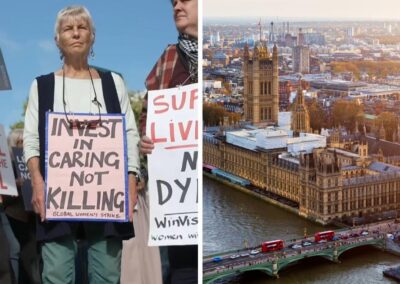





A Labour Party MP has said that Andy Burnham is right that the care sector needs to be fixed before any debate around legalising assisted suicide should take place.
Just weeks before Second Reading of the new assisted suicide Bill on 11 September, Douglas McAllister, the Member of Parliament for West Dunbartonshire, has argued in support of the Prime Minister Andy Burnham’s latest statement on assisted suicide, in which he expresses serious reservations about making assisted suicide legal when end of life care is in such a poor state.
McAllister, who voted against the last, almost identical, assisted suicide Bill, said his “concerns have not gone away”.
McAllister’s article came after the Prime Minister said that the debate around introducing assisted suicide should not take place in a context where palliative and social care remains poorly funded, confirming “that’s the position I will stick to”.
“I take the view that that debate – and I don’t say that there shouldn’t be a debate at some point about those issues – personally, I think there’s something that needs to happen first. That is the fixing of the funding of palliative care and social care”, Burnham said.
McAllister argued that it is correct that Parliament should “first aim to provide the care that [terminally ill people] need to live out their last days well” before any possible legalisation of assisted suicide were to take place.
The MP explained that the assisted suicide Bill brought forward in the last session of Parliament by Kim Leadbeater underwent many months of scrutiny in the House of Lords. The recent Bill brought forward by Lauren Edwards is an almost identical copy of the Leadbeater Bill, meaning that, if MPs vote it through at Second Reading on 11 September, “we once again face months debating the same issue that dominated headlines and divided colleagues and communities last year”, McAllister observed.
McAllister argues that the palliative and end-of-life care sector is worryingly underfunded
McAllister stated that he voted against the previous assisted suicide Bill because of the clear lack of safeguards within it, and that the lack of differences between it and the new Bill has meant that he has not changed his mind.
While the issue of a lack of safeguards is important, McAllister said that the Prime Minister’s comments about the inadequate funding of palliative and end-of-life care make a broader point that the sector’s issues must be fixed before it may be feasible to introduce assisted suicide.
The MP for West Dunbartonshire reminded readers that the Labour Party manifesto for the 2024 General Election promised to fix the country’s broken public services, including improving health and social care.
“It is difficult to talk about genuine ‘choice’ and ‘autonomy’ over death if people weighing up a potential suicide cannot access specialist palliative care; or if disabled people must still fight for the support that allows them to live independently”, he said.
He raised the case of one of his constituents, the late Michelle Moffatt, who had become wheelchair-bound after a spinal injury and who had sought to end her life at an assisted suicide clinic in Switzerland.
Fortunately, after being helped by a GP to combat her suicidal thoughts, along with the community of her family and friends, Moffatt changed her mind and went on to live a full life for six more years. McAllister related how Moffatt threw herself into caring for her four children and fundraising for causes she cared about, even canoeing the Zambezi River in Africa. Additionally, she became devoted to campaigning against assisted suicide to protect other people, who found themselves in her position, from ending their lives.
McAllister went on to share how easy it is in many jurisdictions for people to make themselves eligible for assisted suicide or euthanasia by meeting definitions laid out in legislation.
“If an anorexic refuses to eat; if a diabetic refuses insulin; if a paralysed person like Michelle refuses to change a catheter and invites infection that she refuses to treat, anyone could make themselves fit a very loose definition of ‘terminal’. Similar cases have already happened in places where assisted suicide is legal”, he said.
“[T]hanks to the law prohibiting assisted suicide at the time, Michelle emerged from that period of despair, grateful that she had been helped to live rather than helped to die”.
He pointed out that many professional organisations, such as the Royal College of Physicians and the Royal College of Psychiatrists, are concerned that many people’s lives would be ended needlessly if assisted suicide were to be made legal in England and Wales.
McAllister concluded his piece by imploring his colleagues to see the sense in Burnham’s comments, saying that the Labour Party should be “remembered as a party which secured better help and care to those in need, not the party that simply offered them death”.
Spokesperson for Right To Life UK, Catherine Robinson, said “Douglas McAllister’s comments regarding the upcoming vote on the assisted suicide Bill are most welcome, and his fellow Labour MPs should take heed of what he says.
“Assisted suicide should never become legal, not least in a societal context where many people go without the care and support they require. It would be disastrous to legalise such a practice at this time.
“MPs should ensure they listen to what the Prime Minister has said, and vote against the assisted suicide Bill at Second Reading next month”.