



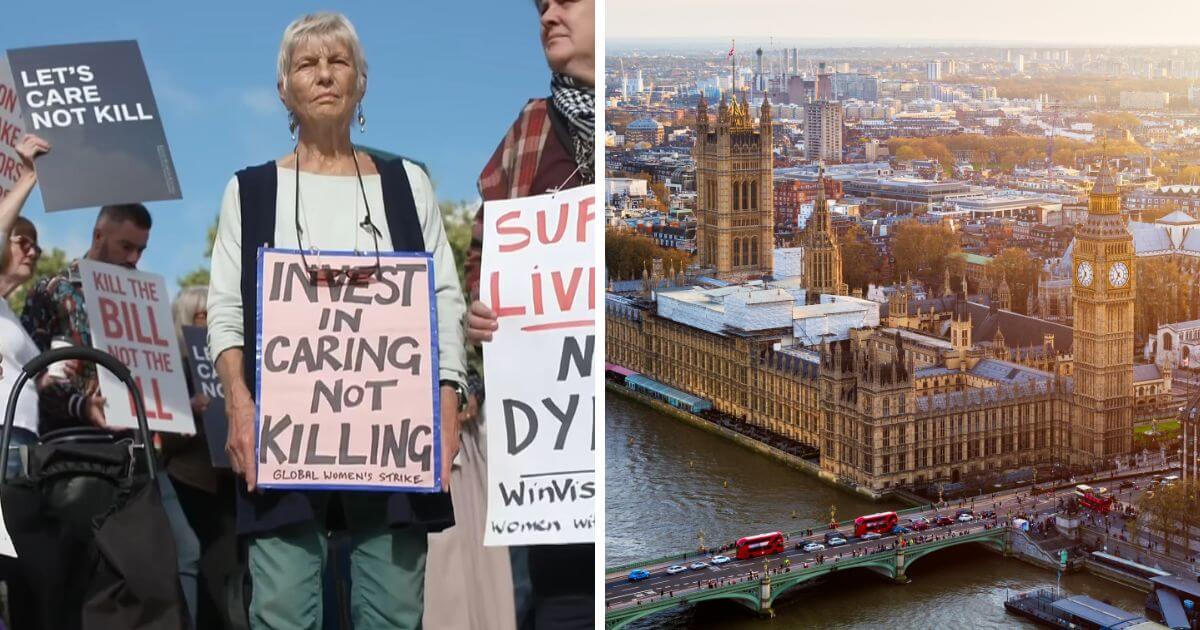
Following the defeat of the assisted suicide Bill in the House of Commons on Friday 11 September, many figures in politics and the media have celebrated the fall of the Bill as “a victory for the vulnerable”.
Lauren Edwards’ assisted suicide Bill was defeated by 286 votes to 270 in a major victory for opponents of the Bill, settling the issue in England and Wales for a generation after a two-year national debate.
The assisted suicide Bill was opposed by the leaders of Labour, the Conservatives, Reform UK and the Liberal Democrats, while not a single Northern Irish MP voted for it.
After a similar major victory in Scotland in March of this year, and the most intense scrutiny that the question of assisted suicide has ever received in England and Wales, MPs in Westminster have rejected introducing assisted suicide.
Reflecting on the campaign that has run across the UK over the last two years against these major attempts to introduce assisted suicide, a prominent pollster has recognised the campaign against assisted suicide as one of the two “most successful 21st Century UK social issue campaigns”.
Now, following the decisive rejection of the Bill, many figures in politics and the media have celebrated the outcome.
In The Telegraph, non-affiliated Peer and former editor of The Spectator Lord (Charles) Moore wrote that the defeat of the assisted suicide Bill was “a victory for a society which cares for the vulnerable”.
Moore, who participated in many of the debates on the assisted suicide Bill in the House of Lords, detailed how he was impressed by the many people who spoke up “for those who could not do so”.
Despite claims from supporters of the assisted suicide Bill that the House of Lords acted inappropriately and the House of Commons came to the wrong decision, Moore rejected that characterisation, describing the process as “a counter example of Parliament working well”.
“This was the fourth unsuccessful attempt this century to allow people to get state help to kill themselves”, he added. “There cannot be another in this Parliament. Surely there should not be another in this generation”.
“We did our bit, and they did theirs”
Baroness (Rosa) Monckton, a Conservative Peer and opponent of the assisted suicide Bill, agreed that both Houses of Parliament came together to defeat the legislation, saying, “We did our bit, and they did theirs”.
Writing in The Telegraph, Monckton shared that many people were battling against the assisted suicide Bill on behalf of people with Down’s syndrome, including her 31-year-old daughter, Domenica.
Monckton argued that people with Down’s syndrome or other learning disabilities, like Domenica, “could be easily coerced into making a life-or-death decision”.
She recalled that Damian Hinds MP, who is now the Shadow Health Secretary, tabled an amendment to the assisted suicide Bill designed to protect people with Down’s syndrome from the legislation; however, members of the Bill committee, including the Bill’s sponsor, Kim Leadbeater, voted down the amendment.
“Why? On what possible grounds? Such a lack of understanding and compassion is incomprehensible to me”, Monckton said.
She said that, when the Bill was rejected on Friday, she “felt overwhelming relief”, adding that she was “proud to play a small part in this”.
It was the viewpoint of The Telegraph itself, not just Monckton, that the House of Lords “did its job and prevented the Commons from rushing into enacting legislation that would have transformed the country”, arguing in its lead article that “the Lords have proved their worth”.
Nikki da Costa, former Director of Legislative Affairs at 10 Downing Street, agreed that the House of Lords “gave the Commons the chance to think again, with so much more information available, and clarity on what was intended, and the problems in the Bill”.
Lack of changes in reintroduced Bill convinced some previous supporters of the Bill to oppose
The Conservative MP George Freeman outlined that, despite voting in favour of Kim Leadbeater’s assisted suicide Bill at Second Reading last year, he voted against the Bill this time round, due to the lack of engagement from the Bill’s supporters with the actual concerns raised with the legislation.
Freeman stated that introducing an almost identical Bill, without any amendments to reflect concerns previously raised by MPs and Peers, was a “disappointing” decision.
Freeman criticised what he called the “dangerously emotive arguments” from the Bill’s supporters, which “should not form the basis of a Parliamentary vote on a matter of this magnitude”.
He added that Private Members’ Bills are not suitable vehicles for legislation of this magnitude, which demands a far greater level of detailed scrutiny than the Private Members’ Bill process allows.
Madeline Grant posited a similar viewpoint, asking whether “the nuclear threat of the Parliament Acts had spooked wavering MPs”, or whether “backbenchers no longer thought a matter of life and death equal to the question of their careers” since the replacement of assisted suicide-supporting Prime Minister Keir Starmer with sceptical Andy Burnham.
Ashley Dalton “tore the bill, and the people who brought it, to pieces”
The Times’ parliamentary sketchwriter, Tom Peck, wrote a moving account of Labour MP Ashley Dalton’s pivotal role in the final debate.
Since the assisted suicide Bill was first introduced two years ago, Dalton has been diagnosed with metastatic breast cancer and is now terminally ill. She spoke courageously about how it is “irresponsible” for supporters of the Bill to “scaremonger people like me into believing our deaths will be horrific”.
“A choice between a painful death and an assisted death is not a choice; it is a threat”, she said.
The journalist Dan Hitchens explained how Janet Daby MP came to reconsider her support for the Bill after voting in for it at Second Reading last year, ultimately voting against it on Friday.
Hitchens recounted how Daby’s doubts were reinforced by the experience of someone she knew who had HIV and AIDS, who previously wished to end his life by assisted suicide, but who has since found the correct treatment to continue living, sparking concerns about what could have been an unnecessary early end to his life.
Hitchens went on to state that, ultimately, the Bill fell as a result of “a steady accumulation of doubts” on many different issues from a varied cross section of the political spectrum.
Vote was “a victory for human dignity”
The academic and writer Yuan Yi Zhu explained how the rejection of the assisted suicide Bill was “a victory for human dignity and a reaffirmation of the duties we have for each other, in life as well as near death”.
The consistent refrain from the Bill’s supporters that scrutiny in the House of Lords was inappropriate, Zhu argued, did not hold much sway with MPs, given that those most opposed to the Bill in the Lords included disability activists, palliative care specialists, and social care experts.
The writer and political commentator, Adam James Pollock, agreed with this assessment, writing that the Bill’s most reliable supporters “relied on trickery and deceit” to mislead people into supporting their cause.
He referred to this unified opposition to the Bill as “the most significant social issue campaign since gay marriage was legalised”, declaring that despite the grimness of the debate itself, it has given “a meaningful voice and an important time in the spotlight to many of our country’s most marginalised people”.
Spokesperson for Right To Life UK, Catherine Robinson, said “After a two-year-long national debate, the country has decided to reject assisted suicide, settling the issue for a generation”.
“The breadth of coverage in the media celebrating the defeat of this flawed and dangerous piece of legislation reveals how widely condemned it was by a veritable cross-section of society”.
“It is vital that MPs now unite to give full attention to fixing the fundamental issues with health and end-of-life care provision, focusing on the goal of delivering universal access to high-quality palliative care, ensuring true dignity and care for all at the end of life”.