



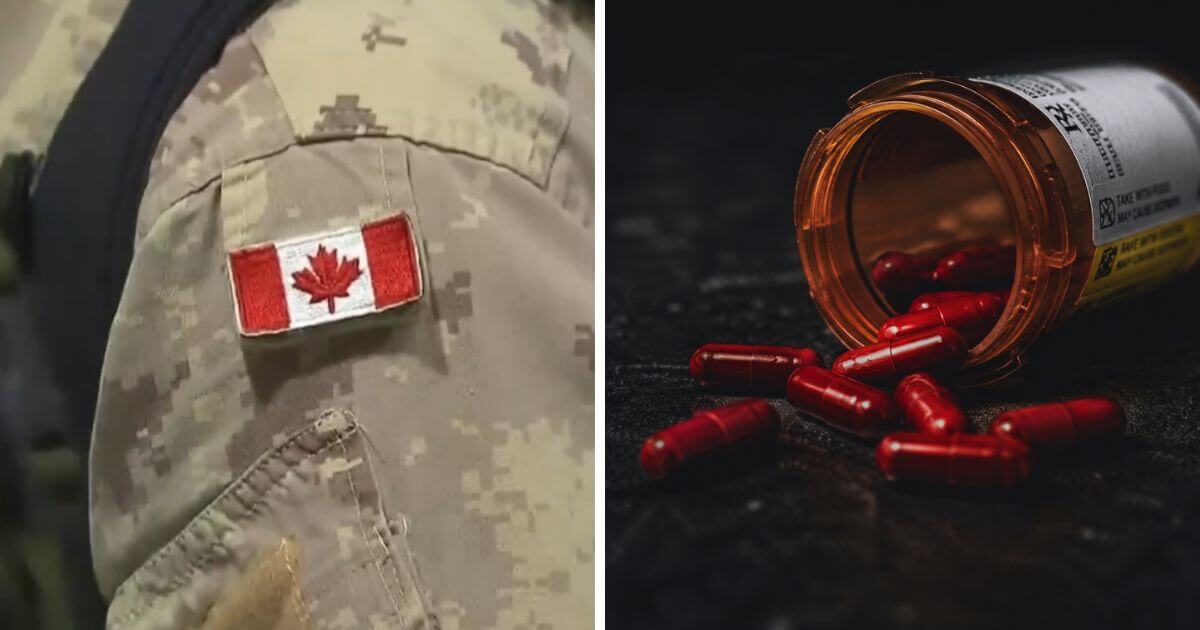
Canadian military veterans living with serious injuries or post-traumatic stress disorder (PTSD) are being offered assisted deaths by officials without first raising it themselves.
An investigation by the Daily Mail has discovered a number of cases of veterans in Canada being offered assisted deaths unprompted in response to requests for assistance in living. David Baltzer, a former soldier who served two tours in Afghanistan, reached out to Veterans Affairs Canada (VAC) after struggling to reintegrate into civilian life. Instead of being provided with the help he needed, he was asked if he had considered ending his life.
David had been receiving psychological treatment for PTSD and suicidal thoughts when his veterans’ benefits, which he relied on to live after finding it difficult to reintegrate into civilian life following his discharge from the military, were unexpectedly cut.
When he contacted VAC, he was passed on to a caseworker who provided an alternative option to attempting to reinstate his benefits.
“He looked at my file and said, ‘I can see the therapy you’ve done. It doesn’t seem like much has helped. I’d like you to keep an open mind and think about this’”, David recalled the caseworker saying.
“‘Have you ever given any thought to medical assistance in dying?’”
David, who is physically healthy, said that this suggestion that he could end his life by assisted suicide was “confirmation” for him that “my life is worthless”.
He said this conversation became a turning point, after which he revealed that he began “questioning my value”.
“I had a really bad attitude and was engaging in anti-social behaviour. Not even thinking about consequences, but thinking about things in the moment and just doing them”, David explained. He quickly descended into alcohol and substance abuse as his actions became more self-destructive.
Despite being proud of his achievements in the military, David said that his treatment following his discharge, telling him he should consider ending his life by an assisted death, makes him regret serving Canada.
“After everything that’s been done, if I could go back in time, I wouldn’t have served Canada”, he confessed.
Booking an assisted death appointment was “as easy as ordering a pizza”
David is not the only veteran of Canada’s armed forces who has been asked if they would consider ending their lives by an assisted death.
Tony Jenkins, a weapons technician from Nova Scotia who served in the military for two-and-a-half decades, says he was offered an assisted death twice.
After suffering a brain injury after being struck on the head by part of an armoured vehicle in 2015, he experienced migraines, slurred speech, and nerve damage in the years that followed.
According to Tony, his complaints about his condition were repeatedly dismissed. When he lost feeling in his arms around two years after his brain injury, a military doctor asked him whether he was suicidal instead of addressing his physical symptoms.
“I was shocked. I’m like, no, I’ve never been suicidal. She kept saying, you know, ‘Are you sure? Are you sure you’re not suicidal?’ She’s like, ‘Well, if you are, I can help you’”, Tony revealed.
Despite insisting that he had no desire to end his life and that he was already seeing a psychologist, Tony recalled that the military doctor kept asking the same questions about his suicidality and reiterating that they could help, which he understood as an offer to assist him in ending his own life.
After leaving the military in 2022, Tony found that a repeat prescription he had, which was needed to control his migraines, had been sent to a pharmacy in a different town. This left him suffering from a debilitating migraine for nine days without medication.
Desperate for relief from the pain, Tony called a Nova Scotia health advice line and asked about euthanasia. He recalled that he was immediately transferred to another line where a nurse began attempting to arrange a MAID (Medical Assistance In Dying) appointment, before even attempting to address his physical symptoms.
“She said, ‘When you’re ready, you call this number again, and we just book the slot, and that’s it’”, Tony recalled, adding, “It was as easy as ordering a pizza”.
“When I realised it was so easy, literally two phone calls, and you could be killed the next day, I thought to myself, this isn’t right”, he added.
Tony explained that, the following day, he was able to get his prescription issues sorted out and his medication refilled by bringing his empty box of medication to a pharmacy.
“It was as simple as that. If they just would have told me, ‘Take your empty box of medication and go to the pharmacy and get a refill.’ That’s all they had to say. But nobody offered that to me. Nobody”, he said.
Tony and David are now considering leaving Canada permanently.
“I was looking for help – not to die”
Another veteran, Corben McGown, says he was offered euthanasia when he was only 22 years old.
Corben was suffering from PTSD, depression, and anxiety, and he had previously attempted to end his own life on several occasions. He had received therapy from VAC, but did not find the process helpful.
After undergoing therapy for around a year and a half, Corben said he was unexpectedly offered a euthanasia during a phone call with a caseworker.
“It was brought up almost as though I qualified for it. They knew about my situation at the time because I had been quite open about my suicidal thoughts”, he revealed.
“When [the caseworker] brought it up, it was essentially presented as: ‘You qualify for it’”, Corben stated.
“I was stunned. It was a lot to take in. I was looking for help – not to die”, he explained.
Canadian veteran and Paralympian asks for stairlift, gets offered euthanasia instead
In another instance, Christine Gauthier, a retired corporal who competed in the 2016 Rio de Janeiro Paralympics, testified before a Canadian House of Commons Veterans Affairs Committee at the beginning of December 2022 that an unnamed veterans affairs case worker had said that Ms Gauthier could access euthanasia when all she had wanted was a stairlift to be installed in her home.
It took Christine five years of petitioning before a stairlift was installed in her home, during which time she had to crawl up and down the stairs outside her home, dragging her wheelchair with her, just to be able to enter or leave her house.
“Then, one day, during [a phone call with a Veterans Affairs agent], I told him: ‘I really can’t keep going on like this. This is ridiculous. I keep injuring myself. I just can’t take it anymore’”, Christine said.
“And [the caseworker] blurted out: ‘Well, if you really feel you can’t keep going on like this and you can’t take it anymore, you know you have the right to die’”, she recalled.
“I was shocked. I said, ‘I can’t believe you’re telling me I have the right to die, but you’re not going to give me the equipment I need to live’”, Christine stated.
Catherine Christensen, a lawyer who has represented numerous veterans over the years, said that despite the VAC issuing guidance to their staff making it clear that they should not inform veterans about assisted suicide or euthanasia, the problem persists.
“The issue with MAID being offered to veterans is that veterans are an extremely vulnerable group”, she explained.
“They’re trained for the mission, and then themselves. When they’re struggling, they think about their family and their mission to take care of their family”, Catherine stated, adding, “You plant that idea in a veteran’s head, and all of a sudden they’re thinking that sacrificing themselves is for the betterment of their family”.
Spokesperson for Right To Life UK, Catherine Robinson, said “It is utterly shocking that so many veterans of Canada’s military have been offered euthanasia or assisted suicide apparently as a solution to their problems”.
“Euthanasia and assisted suicide are not treatments, and individuals who experience mental or physical conditions as a result of serving their country deserve better than being told they can simply end their lives”.
“These examples illustrate one of the many enduring difficulties with euthanasia and assisted suicide legislation, which is the subtle, and sometimes not-so-subtle, pressure that it places on vulnerable people to end their own lives”.