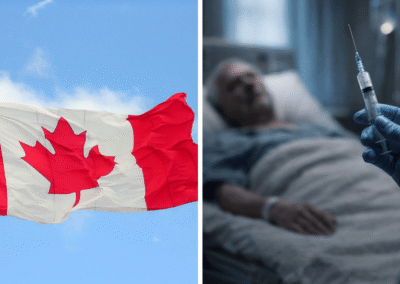





Canada will prevent the expansion of its assisted suicide and euthanasia law that would have permitted individuals to end their lives solely on the basis of having a mental illness, according to Canada’s Justice Minister, Sean Fraser.
While Canada legislated in March 2021 to enable assisted suicide and euthanasia for those whose sole underlying medical condition is a mental illness, operational difficulties and a chorus of concerns meant this aspect of the legislation was delayed until March 2027.
Speaking in 2024 about the delayed introduction of euthanasia on the grounds of mental illness alone, then Canadian Health Minister Mark Holland said “We need more time”.
“Although the curriculum is present, although the guidelines are set, there has not been enough time for people to be trained on them, and provinces and territories are saying their systems are not ready and need more time”.
No real difference between “reasoned wish to die” and suicidality
A special joint committee was created in April 2021, which was subsequently directed to assess the “degree of preparedness attained for a safe and adequate application of [euthanasia and assisted suicide] where mental disorder is the sole underlying medical condition”. The report from the committee raised several concerns about the proposed law change on the basis of testimonies from healthcare professionals, including psychiatrists.
These concerns included the difficulty of accurately predicting the long-term prognosis of a person with a mental disorder, the challenge of distinguishing between a “reasoned wish to die” and suicidality, and the availability of enough trained practitioners, especially psychiatrists, to provide assessments for applicants.
However, earlier this week, the Minister of Justice and Attorney General of Canada, Sean Fraser, announced that the Government would table legislation to indefinitely halt the expansion of the law that would have legalised assisted suicide and euthanasia for those whose sole underlying medical condition is a mental illness.
“Canada has made a decision not to move forward with the expansion”, he said.
“While there is not a perfect consensus on this issue, we believe this is the correct approach”, the Justice Minister added.
Horrors from the Netherlands reveal the tragedy that could have been if euthanasia was made legal for mental illness alone
In the Netherlands, where it is legal to end your life by assisted suicide or euthanasia if you are deemed to be suffering from a psychiatric disorder, there have been cases of people ending their lives who were not terminally ill and who otherwise could have received care and support.
In one case, reported in the Netherlands’ Regional Euthanasia Review Committees’ 2024 annual report, a boy aged between 16 and 18 had his life ended by euthanasia following a suicide attempt.
The report describes that he had been diagnosed with autism, had “feelings of depression and no longer wanted to live” from a very young age, and had repeated suicidal thoughts. It argued that his depression and wish to die were a consequence of his autism. The review committee behind the report found no evidence the physician had failed to act in accordance with the law.
However, the report also noted that an independent psychiatrist revealed that not all treatment options had been tried.
Spokesperson for Right To Life UK, Catherine Robinson, said “It is welcome news that Canada has indefinitely halted the expansion of its assisted suicide and euthanasia law. This will doubtless avert numerous tragedies and preventable deaths from occurring in those with mental illnesses whose lives could improve”.
“There is no real difference between what they describe as a ‘reasoned wish to die’ and suicidality. People who are suffering from illness, whether mental or physical, need help and support to live, not to die”.