



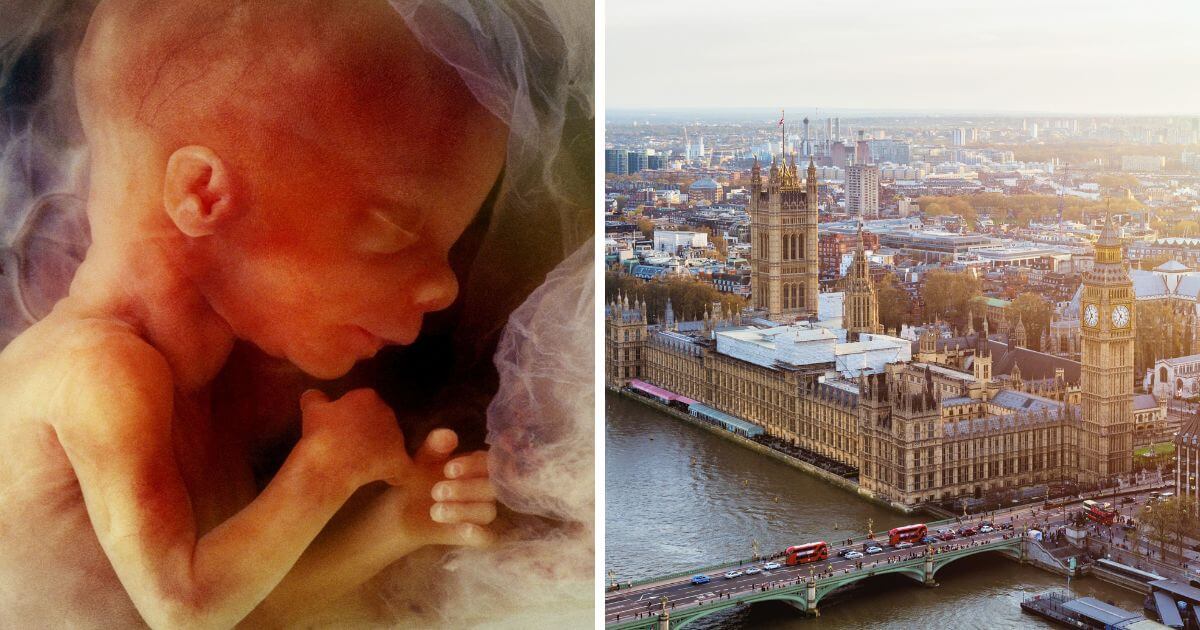
The Government has admitted that it is no longer a criminal offence for a woman to intentionally deceive a doctor about the gestation of her baby in order to receive abortion pills by post beyond the legal time limit in England and Wales, at any stage of pregnancy, right up to birth.
The Government has published an Equalities Impact Assessment on the ‘abortion up to birth clause‘ in the Crime and Policing Act 2026, which makes it no longer illegal for women to perform their own abortions for any reason, including sex-selective purposes, and at any point up to and during birth.
The Assessment also reveals that it would no longer be a criminal offence for a woman at full term to lie to an abortion provider about her unborn baby’s age to obtain abortion pills to end the life of her fully formed unborn baby.
It states that a woman could “deceive a registered medical practitioner about the gestation of her pregnancy in order to procure an abortion by pills via pills by post beyond the 10-week time limit” without the possibility of a criminal conviction for doing so.
Through the passing of this law, women who have previously been convicted or cautioned for criminal offences related to abortion in regard to their own pregnancies will be pardoned, and relevant records are to be deleted. The Government has stated that it does not know how many arrests or investigations this will impact, as data is not available relating to this. This means that Parliament has legislated for a potentially widespread deletion of records, the extent and scope of which the Government cannot quantify.
Majority of abortion-related offences proceeded against involved male defendants
The law change was forced through by campaigners who focused on using the idea that women were being prosecuted for ending their own pregnancies. In these Assessments, however, the Government admits that the majority of prosecutions relating to this were actually for men. These offences have been used against men who forced abortions on women, including Stuart Worby, who secretly administered abortion drugs without the woman’s consent. Only seven cases have involved female defendants.
The changes brought in under the Crime and Policing Act 2026 nullify any abortion-related criminal effects for women in relation to their own pregnancies arising from the Offences Against the Person Act 1861 and the Infant Life (Preservation) Act 1929 regarding abortion.
However, the Equality Impact Assessment admits that not only are prosecutions in relation to these Acts “low in volume”, but that the “majority of abortion-related offences proceeded against have involved male defendants, amounting to 71% of cases (17 out of 24 cases where the defendant’s sex was recorded)”. Only 7 out of 24 cases proceeded against involved female defendants.
Furthermore, the assessment concedes it does not know how many of these seven women were “pregnant and acting in relation to their own pregnancy”.
Impact assessment assumes no increase in late-term abortion based on “limited evidence”
In addition to the Equality Impact Assessment, the Ministry of Justice has also released an Impact Assessment for the abortion up to birth clause of the Crime and Policing Act. The assessment assumes that “there will be no change in the incidence of abortions post a gestation of 24 weeks”. However, it immediately concedes that there is “limited evidence” to justify this assumption.
The assessment makes reference to the decriminalisation of abortion in New Zealand, saying that following the change in the law, the average gestation at the time of abortion decreased.
What the New Zealand data shows, though, is that there was a 43% increase in late-term abortions, which coincided with the change to the law to allow abortion up to birth in the country.
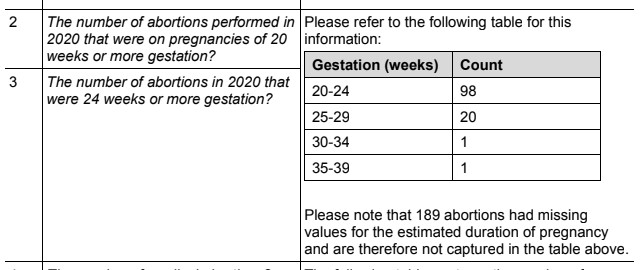
Data, obtained by an Official Information Request by Right To Life New Zealand to the New Zealand Ministry of Health, revealed that there were 120 abortions where a baby was at 20 weeks gestation or later in New Zealand in 2020, compared to the previous year when there were 84.
The Impact assessment also admits that “If there were an increase in late-stage abortions following the legislation, this could result in increased health costs”.
At the end of the document, and despite the admitted limited data on which the assessment makes some of its assumptions, the Government states it has “no plans to formally evaluate these provisions”.
The Government has also admitted, under a section entitled “Indirect discrimination”, that by passing this law, there will be “arguably an indirect differential treatment” of certain people, meaning that different categories of people may be treated differently under the exact same law. According to the Equality Act 2010, indirect discrimination “occurs when a policy which applies in the same way for everybody has an effect which particularly disadvantages people with a protected characteristic”.
MPs and Peers called for delay in commencement of abortion up to birth clause until impact assessment release
These Assessments have only been published after the Act has already received Royal Assent and become law, meaning that any concerns raised by them were not available for MPs and Peers to base their analysis and subsequent votes on.
After the abortion up to birth clause was approved by the House of Lords, a cross-party group of 79 MPs and Peers wrote to the Home Secretary, Shabana Mahmood, and the then-Secretary of State for Health and Social Care, Wes Streeting, calling for delaying the commencement of the ‘abortion up to birth’ clause (241) until an impact assessment and guidance for police, prosecutors and healthcare professionals have been published and approved by both Houses.
This coincided with Baroness O’Loan, former Police Ombudsman for Northern Ireland, supported by a large cross-party group of Peers, tabling a Regret Motion at Third Reading in the House of Lords, which noted their regret “that no impact assessment was conducted in relation to clause [241 and 242], and that therefore the House has not been able to assess its potential effects on vulnerable persons, women’s health, criminal law, and policing”.
Polling has revealed that the public opposes abortion up to birth and legalising sex-selective abortion. 89% of the general population and 91% of women agree that gender-selective abortion should be explicitly banned by the law – and only 1% of women support introducing abortion up to birth.
Spokesperson for Right To Life UK, Catherine Robinson, said “It is deeply troubling that these Equalities Impact Assessments were not conducted in relation to the abortion up to birth clause of the Crime and Policing Act before it became law. If they were, perhaps MPs and Peers may have been more aware of just how terrible and badly thought out the law they have passed is”.
“The abortion up to birth clause is one of the most extreme pieces of legislation ever introduced in Parliament. Pro-abortion MPs hijacked a government Bill to rush through this radical and seismic change to our abortion laws after just 46 minutes of backbench debate”.
“This was the first time this extreme amendment had been debated in Parliament. There had been no prior public consultation, no impact assessment, and no evidence sessions on this far-reaching change to our laws”.
“This is the most significant change to abortion legislation since the Abortion Act was introduced in 1967. There is no public appetite for this change, and it was not part of the Government’s manifesto”.
“There are now almost 300,000 abortions every year in this country. Britain’s abortion time limit is already double that of the most common abortion limit among EU countries. These Assessments have highlighted that there are now even fewer safeguards for women and fewer protections for the unborn, even late in pregnancy”.
“The law change will likely lead to the lives of many more women being endangered because of the risks involved with self-administered late-term abortions and also tragically lead to an increased number of viable babies’ lives being ended well beyond the 24-week abortion time limit and beyond the point at which they would be able to survive outside the womb”.