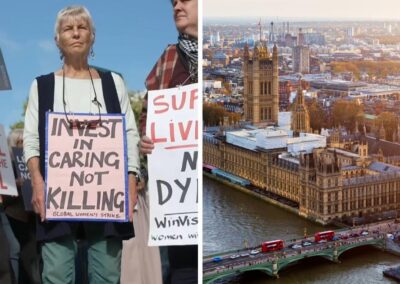





Pro-life veteran, crossbench Peer, and senior member of the All-Party Parliamentary Pro-Life Group, Lord Alton of Liverpool, is calling on opponents of the assisted suicide Bill to act now to ensure its defeat this Friday 11 September.
With only days to go and only 12 MPs needing to change their minds, the assisted suicide Bill can be defeated.
Lord Alton warns that if the assisted suicide Bill passes, it will “alter the moral landscape of a nation.” As with the Abortion Act in 1967, “MPs are now being asked to cross another threshold: from a law that prohibits assisting another person’s suicide to one that would make helping patients end their lives through assisted suicide a lawful part of healthcare.”
“At the heart of this debate is a simple question. When someone is at their most vulnerable, should our law say, ‘We will care for you, protect you and stand beside you’? Or should it offer assistance to end their life?”
“If this Bill ultimately becomes law, our country will never be the same again.”
Lord Alton’s message is reproduced in full below
Now is the time to approach your MP, and you can make a difference
If constituents have not yet contacted their MP, they can use Right To Life UK’s simple 30-second tool to do so. Lord Alton also urges constituents who know an MP personally that “now is the time for a direct approach. A brief, respectful appeal in person or by telephone, asking them to be in the Chamber and vote against the Bill on Friday, could carry particular weight. If the connection is through someone else, ask them today to make that appeal. Please do not assume that someone else will.”
Being an MP for 18 years, Lord Alton emphasises the effect that “sincere personal messages from constituents” can have and give MPs “the courage to reconsider.”
“If you know an MP personally, whether or not they are your own MP, or know someone who does, now is the time to act. Make one final appeal yourself, or ask your contact to do so, in person or over the telephone if possible. Ask the MP directly to attend the vote on Friday and vote against the Bill, explaining briefly, in your own words, why this decision matters. Even if the subject has come up before, ask once more. In a vote this close, one sincere conversation could be decisive.”
Only 12 MPs need to change their mind to defeat the Bill
When the previous assisted suicide Bill was voted on at Third Reading, it passed with a majority of only 23, before being subjected to many months of scrutiny in the House of Lords, after which it failed to pass.
A new Government assessment of the revived assisted suicide Bill, which MPs will vote on at Second Reading this Friday 11 September, has warned that poverty, poorer access to healthcare, lower-quality care and domestic abuse could lead to “disproportionate numbers of ethnic minority people” opting to end their lives through assisted suicide, as new Government modelling has increased its central estimate of assisted deaths by 60%.
It has also newly identified neglect, poverty and difficult living conditions as potential structural pressures on disabled people considering assisted suicide.
The new warning comes after the Prime Minister, Andy Burnham, said “the fixing of the funding of palliative care and social care” needs to happen before Parliament debates whether to introduce assisted suicide. Burnham said it would be deeply challenging to hold that debate while people were not receiving the care they needed or the peace of mind that such care would be available.
The assessment gives further weight to Burnham’s warning, identifying poorer access to healthcare and lower-quality care as structural pressures that could result in disproportionate numbers of people from ethnic-minority backgrounds opting for an assisted suicide.
In the new impact assessment, the Government has increased its central Year 10 estimate for annual assisted suicide deaths upwards by 60%, from 2,183 to 3,502. This would amount to almost ten assisted suicide deaths every day. The high scenario has risen from 4,559 to 6,257 deaths a year, more than 17 every day.
A similar Bill was rejected earlier this year in Scotland, where, strikingly, 85% of Labour MSPs (17/20) opposed the Bill. Many new intake Labour MPs likely voted for the Westminster Bill previously because of the support of Keir Starmer early on in their parliamentary careers.
Given only 12 MPs would need to change their minds for the Bill to be defeated, and the fact that this vote would likely become a referendum on the use of the Parliament Acts as well as on the flawed Bill itself, this strongly suggests that the Bill is on track to be defeated.
***
Message from crossbench Peer, senior member of the All-Party Parliamentary Pro-Life Group, and patron of Right To Life UK, Lord Alton of Liverpool’s full call to action for opponents of the assisted suicide Bill.
Before anything else, thank you.
Whether you have visited your MP, met them at a constituency surgery, written a personal letter, sent emails, telephoned their office, spoken to friends and neighbours, shared the campaign in your church or community, you have helped bring us to this point.
You have ensured that the case for protecting vulnerable people cannot be ignored.
After almost two years of campaigning since Kim Leadbeater introduced her assisted suicide Bill, we have reached the home straight.
In only a matter of days, this Friday, 11 September, MPs will vote at Second Reading on the revived assisted suicide Bill tabled by Lauren Edwards MP. On the arithmetic of the last Commons vote, a swing of just 12 MPs would defeat it.
Some parliamentary votes are forgotten by the following week. Others outlive the Parliament that cast them and alter the moral landscape of a nation.
This is not an ordinary parliamentary vote. It is one of those rare decisions that can permanently change the character of a country, like the Abortion Act did when it was passed in 1967.
When Parliament passed the Abortion Act, that one decision reshaped not only our law, but our entire culture and our understanding of the value of human life.
Despite the promoters of the Bill saying it was not their intention to leave a wide-open door for abortion on demand, in the decades since the Act was passed, more than 10 million unborn lives have been lost to abortion, while many women and families have been left carrying grief and pain that are too rarely acknowledged.
Indeed, Lord Steel, the architect of the Abortion Act, later said that he never anticipated “anything like” the current volume of abortions when promoting his Bill.
MPs are now being asked to cross another threshold: from a law that prohibits assisting another person’s suicide to one that would make helping patients end their lives through assisted suicide a lawful part of healthcare.
Before entering the House of Commons, I spent five years teaching children with special needs.
The last child I taught, Ian, was dying from cystic fibrosis. He and his family taught me far more than I taught him. He died only a few weeks after I entered Parliament.
Ian’s life left me with a simple conviction: illness, disability and dependence do not reduce human worth. They deepen our responsibility to accompany, support and care for one another.
The Government’s impact assessment on the new Bill, reveals how much the projected scale has grown since MPs considered the previous Bill. Its central estimate for the scheme’s tenth year has risen by 60%, from 2,183 to 3,502 assisted deaths.
Its high scenario now projects 6,257 assisted deaths in that year. That is more than 17 deaths every day. A number of experts say these projections are likely substantially underestimated, and could be much higher.
This is not an abstract danger. In a single year, thousands of people could die by assisted suicide if this Bill becomes law.
These are not merely figures on a page. They are people who may be elderly, disabled, seriously ill, frightened, isolated or worried that they have become a burden, who will have their lives ended.
At the heart of this debate is a simple question. When someone is at their most vulnerable, should our law say, “We will care for you, protect you and stand beside you”? Or should it offer assistance to end their life?
If this Bill ultimately becomes law, our country will never be the same again.
But I do not write to you in despair.
This Bill can be defeated.
At Second Reading, the previous Bill passed by a majority of 55. By Third Reading, after months of scrutiny, that majority had fallen to 23. The Bill then fell after it failed to complete its passage through the House of Lords before the end of the parliamentary session.
In Scotland this year, a similar Bill went from a 14-vote majority to a 12-vote defeat.
Minds can change. Votes can move.
The last Commons majority was 23. On that arithmetic, just 12 MPs changing sides on Friday would defeat this Bill.
12 votes are not the measure of an impossible task. They are the measure of a winnable one.
Most of you reading this have already contacted your MP. Thank you. If you have not yet done so, or if a friend has forwarded this message to you, I have included Right To Life UK’s simple 30-second tool here:
Email your MP before Friday and ask them to vote against the Bill.
Some of you may know an MP personally, or know someone who does. If so, now is the time for a direct approach. A brief, respectful appeal in person or by telephone, asking them to be in the Chamber and vote against the Bill on Friday, could carry particular weight. If the connection is through someone else, ask them today to make that appeal. Please do not assume that someone else will.
For most of you, however, the task now is not repetition. It is multiplication.
Every new person you persuade to act may bring another constituency and another MP within reach. A friend, relative or colleague may be able to influence an MP you cannot. One of their messages may be the one that moves the 12th vote.
Think of ten people who may share your concerns: family members, friends, neighbours, colleagues or people from your church or community and encourage them to email their MP using the tool linked above.
A personal request from someone they trust may be more successful than a general campaign message.
If asking them over WhatsApp is easier, you can click the link below and it will open WhatsApp with a ready-written message Right To Life UK have written. You can check the wording and then choose ten friends, family members or appropriate church or community groups to send it to:
Share with friends on WhatsApp
You can also send it to a church, family or community group where it would be welcome.
One supporter reaching ten other people could generate ten more constituent emails. One of those emails could reach one of the 12 MPs whose decision determines the result.
When I was 21, I was elected to Liverpool City Council from a ward regarded as hopeless, with only six fellow students helping me on the ground. I have never forgotten what a small group of determined people can accomplish.
During my 18 years in the House of Commons, I learned never to underestimate sincere personal messages from constituents. They can give an MP both a reason and the courage to reconsider. The same is true of a personal appeal from someone an MP knows and trusts.
If you know an MP personally, whether or not they are your own MP, or know someone who does, now is the time to act. Make one final appeal yourself, or ask your contact to do so, in person or over the telephone if possible. Ask the MP directly to attend the vote on Friday and vote against the Bill, explaining briefly, in your own words, why this decision matters. Even if the subject has come up before, ask once more. In a vote this close, one sincere conversation could be decisive.
History will record how MPs vote on Friday. But what happens in the Chamber may be decided by what each of us does before then.
Please do not wait until the last minute. Choose your ten people and contact them now.
We have fought this Bill for almost two years. The vote is on Friday and there are only 12 votes to defeat it. Let us use every day, make every message count and finish what we began.
With my deepest thanks,
Lord Alton of Liverpool