



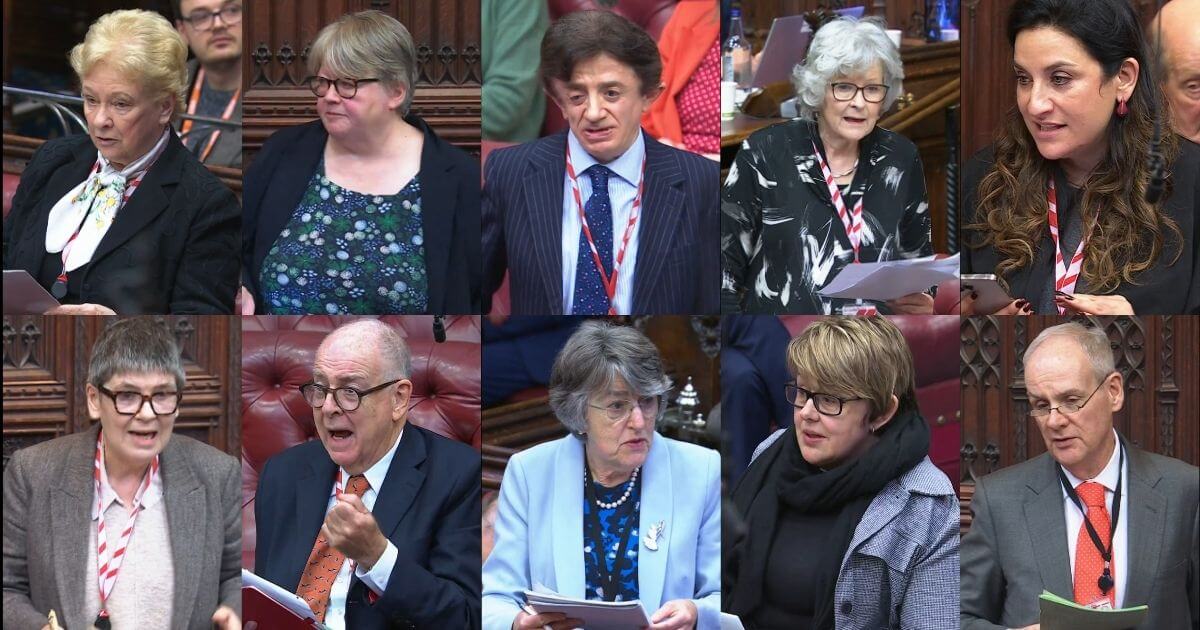
As Peers subjected the assisted suicide Bill to its ninth day of Committee Stage scrutiny on Friday 6 January, almost four in five speakers who took a position in a speech spoke against the Bill, while the Government cut the debate short to prevent debate around a Prime Minister-appointed assisted suicide commissioner from taking place.
Across the day’s debate, of the 39 Peers who took a position in a speech, 31 (79%) spoke against the Bill, while only 8 (21%) spoke in favour of it.
Sponsor of the assisted suicide Bill loses temper, rejects amendments designed to improve safeguards
The assisted suicide Bill’s sponsor, Lord Falconer, rejected a series of amendments designed to improve the safeguards within the Bill because they would “require the dying person to make difficult decisions”.
Lord Falconer also angrily snapped at a fellow Peer during a heated speech regarding the length of time the House of Lords is spending scrutinising the assisted suicide Bill, shouting “Let me finish”.
He also argued that Peers who do not have disabilities “have to listen as hard as [they] can” to those who do have disabilities, “because it is not part of [their] experience”. Despite saying this, Lord Falconer dismissed every single amendment that Peers have considered, prompting disabled Peer Lord Shinkwin to say that Lord Falconer has “reminded the House of the extent to which he is listening”.
Extensive evidence that terminal prognoses are often inaccurate
Baroness Finlay drew attention to the “extensive body of evidence” that proved there is no “clinical truth” behind using a six-month terminal prognosis as the basis for eligibility for assisted suicide, pointing out examples of fellow Peers who were given terminal prognoses yet are still alive.
Baroness Fox concurred, highlighting that terminal prognoses are often “unreliable” through the example of her mother, who “kept being told that she was about to die” but “got better over many a year”.
Lord Evans reiterated this point by stating that his cousin was diagnosed with Duchenne muscular dystrophy in the 1960s when it was regarded as a terminal illness. Despite this, he lived for five years longer than average, highlighting the unreliability of prognoses.
Lord Shinkwin highlighted that, despite him being given a six-month terminal diagnosis 30 years ago, he is still living and able to contribute to this debate from the House of Lords.
Peers at a disadvantage due to disabilities and late sittings
Baroness O’Loan argued that allowing the Lords to sit so late disadvantages Peers who do not live nearby, such as herself, who had to leave during the debate to catch a flight home.
Baroness Grey-Thompson also highlighted that Peers who have to take part in the debate remotely, like Baroness Campbell of Surbiton, due to her disability, are at a disadvantage because they cannot raise questions or intervene on speeches.
Lack of high-quality palliative care removes choice at the end of life
Lord Harper said, “[I]f we do not have high-quality, universally available palliative care, then we are not giving people a genuine choice”, arguing that if the Government cannot even produce the plan to improve care on time, then their priority is not likely to be on improving palliative care.
Lord Shinkwin, who has a disability, said, “I fear that the Bill implicitly puts a price on my head and those of people with lifelong congenital conditions, because it effectively facilitates a pathway whereby withholding expensive treatments risks making people like me eligible for assisted dying”.
Baroness O’Loan argued that legalising assisted suicide, while not working to improve care, would make people with disabilities feel that their lives have a “lesser value”.
Peers criticise wide range of reasons people can end their lives by assisted suicide
Baroness O’Loan drew attention to evidence from places where assisted suicide is already legal, pointing out that people with terminal illnesses end their lives by assisted suicide for a variety of reasons, including an inability to access palliative care, pregnancy, serious mental illness, poverty, and isolation. “In so many cases, it is the circumstances of their lives which lead so many people in other jurisdictions to seek assisted suicide and euthanasia, not illness”, she said.
Baroness Coffey said that in places where assisted suicide is legal, people have ended their lives due to conditions such as arthritis, hernias, and HIV/AIDS, which can become terminal if treatment is refused.
Lord Moylan pointed out that Lord Falconer and the Government can’t even agree on a question as central as who would be eligible to die under the assisted suicide Bill, stating that the Government’s interpretations appear to differ from what the Bill says in plain language.
Man with Down’s syndrome has argument against assisted suicide Bill quoted
Baroness Grey-Thompson quoted Tommy Jessop, a British actor who has Down’s syndrome, highlighting his worries about the assisted suicide Bill. He said there needs to be “rules to keep us safe, but that has not happened … our lives are worth living … Please protect us”, and “we are not collateral damage”.
Assisted suicide would have many unintended consequences
Baroness Lawlor argued that a state-run assisted suicide service may end up killing many more people than intended or predicted, as “bureaucracies have their own momentum”.
Lord Carlile raised the issue that a Christian nursing-home charity, Mission Care, could likely be forced to close down if assisted suicide is legalised due to the conscientious objection of Christian staff members who would not want to take part in assisted suicide procedures. This would negatively impact its 300 staff and 230 residents, he argued.
Questions were raised regarding capacity and consent
Baroness Berger quoted assisted suicide campaigner Esther Rantzen, who said the assisted suicide Bill “only applies to terminally ill people like me”. That claim “centres those who have no doubts about their capacity to make this decision and no doubt that they would freely choose, but it removes from the room people who are not like us. It is our job to balance the needs of those with true agency, for whom this will be a free choice, with those who may be pressured or led towards this path, in particular because of the inadequacies of the Mental Capacity Act”, Baroness Berger said.
Baroness Hollins raised the issue that cognitive impairment is relatively common at the end of life, and can seriously impact an individual’s capacity to give consent. She argued that this is particularly worrying in the case of assisted suicide.
Many issues in the Bill could have been fixed long ago
Baroness Berridge stated that Peers should not still be talking about issues regarding the Mental Capacity Act with the assisted suicide Bill, as these issues had been raised by the Royal College of Psychiatrists as far back as November 2024, and yet still no amendments have been put forward.