



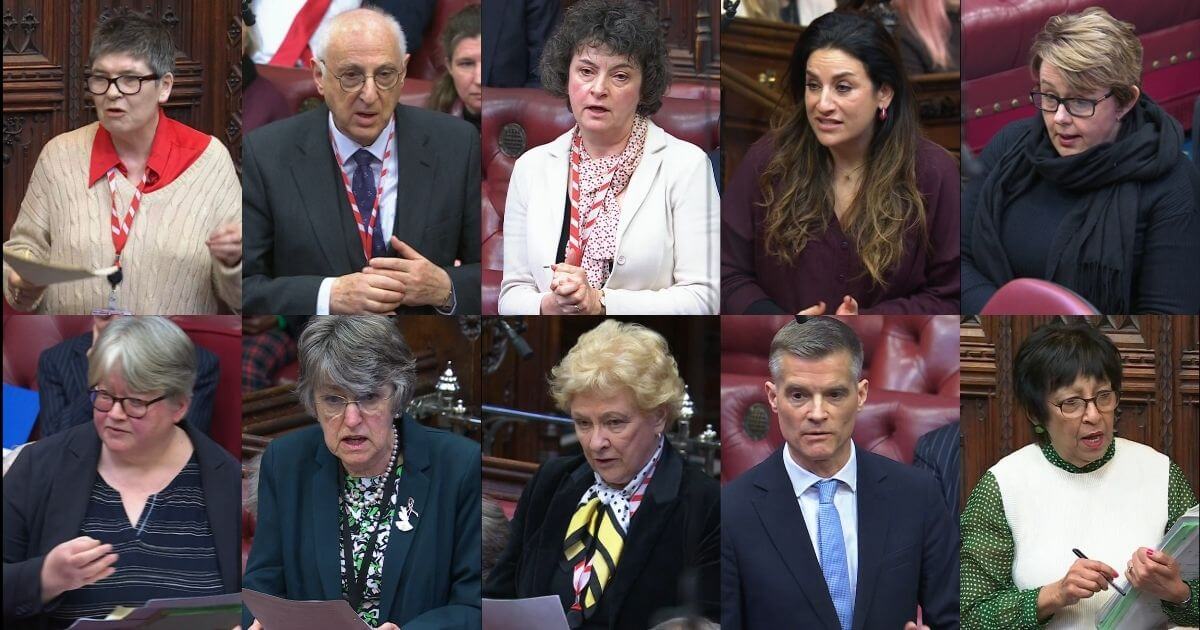
As Peers subjected the assisted suicide Bill to its eighth day of Committee Stage scrutiny on Friday 30 January, more than four in five speakers who took a position in a speech spoke against the Bill, while the Bill’s sponsor in the House of Lords came under intense criticism for intimidating Peers with threats of using the Parliament Acts to force the Bill through.
Across the day’s debate, of the 51 speakers who took a position in a speech, 42 (82%) spoke against the Bill, while only 9 (18%) spoke in favour of it.
Government will not be adopting the assisted suicide Bill despite Parliament Acts threat
Importantly, the Government Chief Whip in the House of Lords, Lord Kennedy, made it clear that the assisted suicide Bill would absolutely not become a Government Bill if the Parliament Acts were used to attempt to force the Bill through, as some supporters of the Bill have argued it should.
“The Government have no intention of bringing back this Private Member’s Bill”, Lord Kennedy said. “It will remain a [Private Members’ Bill], and the Government have no intention of bringing it back in the next Session”.
This follows on from a media campaign instigated by the sponsor of the Bill in the House of Lords, Lord Falconer, in which he seemed to threaten the use of the Parliament Acts to attempt to push through the assisted suicide Bill without the consent of the Lords, as Lord Moore highlighted.
Lord Moore also pointed out that the Bill’s sponsor “said that what was going on in all these proceedings was just a filibuster”, arguing that this would likely undermine any answers that he would give in the following days of debate.
Lord Ahmad clarified that it would be “unprecedented” for the Parliament Acts to be used for this purpose, as they have never before been used on a Private Members’ Bill.
“If the Bill did not pass and the Parliament Act was invoked, it would not be for the Bill’s supporters to make that call. My understanding is that that would be a matter for Mr Speaker, after careful consideration. Equally, my reading of the two Acts is that it is very clear that the House of Lords would still have a role”, he added.
Accusations of filibustering shot down
Baroness Falkner also shot down accusations of filibustering by drawing attention to the fact that many more Peers would like to speak to amendments than actually do, due to a desire not to hold up proceedings.
“[W]hile many people across this House would wish to intervene on every amendment, we hold back to allow those who are more expert than we are to articulate our concerns in order not to delay the passage of the Bill”, she said.
“It is our self-restraint that has made us arrive at where we are today”.
Lord Empey reminded the House that the assisted suicide Bill is not normal, as far as Private Members’ Bills go. It is much longer and much more complex than other Private Members’ Bills, he argued, and so Peers spending much longer debating the Bill makes sense.
Lord Deben asserted that one of the main reasons the debate around the assisted suicide Bill has been going on for so long is due to the Bill’s poor drafting and a subsequent lack of answers from Bill sponsors. He criticised “the general campaign that suggests that this House, in doing its job [of scrutinising legislation], is somehow or other behaving badly”.
Remote eligibility assessments for assisted suicide widely criticised
Lord Carlile reminded the House of guidance from the General Medical Council that states that “Face to face consultations may be preferable when … The patient has complex clinical needs or is requesting higher risk treatments”. He argued that a life-ending process certainly meets the criteria for “higher risk”, and that remote eligibility assessments should be removed from the Bill.
Baroness O’Loan told the House that, during covid, her brother tried to see a doctor for six months due to having worrying symptoms; however, he was only given telephone calls and told to take painkillers. It later transpired that he had stage 4 lung and bone cancer. Baroness O’Loan argued that cases like her brother’s serve as a warning about the dangers of remote consultations.
Baroness Smith of Newnham told a similar story, sharing how her father was told that he had pancreatic cancer during a remote consultation in the midst of covid. After spending weeks saying goodbye to his loved ones, tests finally showed that he did not, in fact, have pancreatic cancer.
“That demonstrates one of the flaws of doing something remotely”, she said.
Lord Harper reminded Peers that Kim Leadbeater MP, the sponsor of the assisted suicide Bill in the House of Commons, had previously been considering amendments to the Bill to ensure remote consultations were not possible. These amendments have not transpired.
Lord Harper asked, “In the absence of amendments such as these, how can the Minister ensure that Parliament is discharging its most important responsibilities to the people of this country?”
Baroness Grey-Thompson also drew attention to how “uncomfortable” the Bill’s sponsor in the Commons was with remote consultations, arguing that they could become little more than a “tick-box exercise”.
Baroness Coffey raised concerns that remote consultations make it difficult to detect whether coercion or undue influence may be occurring in an individual’s decision to opt for an assisted suicide.
“What happens when people are making a declaration? Are we sure that somebody is not in the room, giving them the eyes so that they will give the right answers? How are we to understand whether coercion can happen or not?” she asked.
Baroness Coffey also stated that she found it “disappointing that the Justice Minister is not in her place on the Front Bench today”, as the Ministry of Justice has responsibility for capacity assessments.
Baroness Finlay added to these concerns about coercion, saying, “[I]n remote assessments, the clinician cannot tell whether there is another person in the room standing out of sight behind the camera”.
Baroness Lawlor also commented on this issue. “[H]ow on earth can any doctor judge the mind—the physical and mental condition—of the person whom he or she may be ticking off to death without being in the room with them, particularly as this doctor may never have treated them in person?” she asked.
Baroness Keeley pointed out that even the witnessing of a will has to be conducted in person rather than over a remote call – surely this is not more important than a life-or-death decision, she argued.
Assisted suicide supporters attack Peers’ religious beliefs
Baroness Fox highlighted that “a media briefing suggesting that there is some cynical plot of outside forces and that, somehow, we are all influenced by hidden religious views” is discrediting the House.
Baroness Berridge also criticised the view that “those opposing the Bill are just a random group of religiously motivated people”, adding, “It is not how I have ever been treated as a Christian in this House”.
No barriers to AI being used to end lives
Baroness O’Loan pointed out that there are no restrictions in the legislation on the use of AI in any part of the assisted suicide process, arguing that AI has already been proposed for use to end lives in the Netherlands.