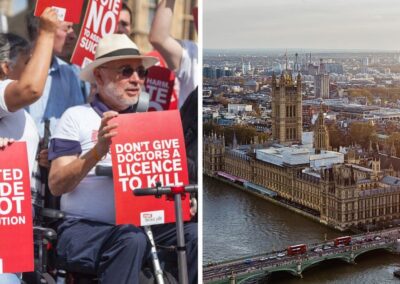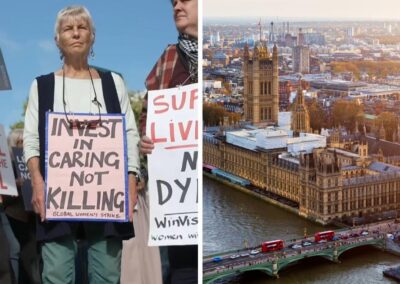





The Peer leading attempts in the House of Lords to introduce assisted suicide has conceded that the assisted suicide Bill will not become law this year, unless it can be forced through without the Lords’ consent using the Parliament Acts.
Lord Falconer, the sponsor of the assisted suicide Bill in the House of Lords, told the BBC that, as things stand, there is “absolutely no hope” that the Bill will become law before the end of the current parliamentary session in May.
Lord Falconer has proposed a “fundamental change” in tactics in an attempt to ensure his assisted suicide Bill becomes law, by using the ‘Parliament Acts’ to force the Bill through without the consent of the House of Lords.
The Parliament Acts 1911 and 1949 provide a rarely-used method of forcing legislation that has been agreed by the House of Commons through without the consent of the House of Lords. Only seven Bills have ever become law under the Parliament Acts, and they have never been used for a Private Members’ Bill – that is, a non-Government Bill – like the assisted suicide Bill. In practice, for the Parliament Acts to be used, it would likely require the Government to adopt the assisted suicide Bill as a Government Bill or to provide time for its passage.
This comes as supporters of the assisted suicide Bill have been pushing to rush the legislation through Parliament, limiting the opportunity for detailed scrutiny of its provisions.
Previously, assisted suicide campaigners had encouraged the House of Commons to vote in favour of the Bill on the basis that more detailed scrutiny would come in the Lords. During the Bill’s progression through the Lower House, assisted suicide campaign organisation Dignity in Dying said “[t]he House of Lords is expected to bring high-quality scrutiny to the bill” through “meaningful second-chamber oversight”, while the Bill’s sponsor in the Commons, Kim Leadbeater, said the Lords would bring “robust debate and scrutiny” to the Bill. Now, supporters of the Bill are seemingly seeking to avoid this scrutiny by using the Parliament Acts to force the legislation through.
The British public are at risk “without the proper scrutiny”
Rebecca Harris, a former Government Chief Whip who was in charge of Private Members’ Bills for seven years, said, “I can categorically state this system is not designed to deal with legislation of this importance and magnitude. This Bill alters the foundations of our NHS, the relationships between doctors, their patients and their families and would leave much of the actual practical implementation to Ministers, codes of practice and regulations years in the future with little Parliamentary oversight”.
Nikki da Costa, former Director of Legislative Affairs at 10 Downing Street, commented, “As predicted, Lord Falconer wants to bully the Lords and force this reckless PMB, which no Royal College will say is safe, on to the [statute] books. He wants to walk Labour MPs into a firestorm”.
Palliative care expert Professor Katherine Sleeman said, “No biggie. Just a plan to ‘force through’ a Bill of momentous consequence (whichever side you’re on), and of which the RCPsych and RCPhysicians said (in a rare joint statement) does not ‘achieve adequate protection of patients’”.
Conservative Peer Lord Moylan remarked, “It’s excellent news that there is now complete unanimity that the Terminally Ill Adults Bill will not complete its passage through Parliament this session and so will fall. So why are we still going through the motions with it? What is it costing? Is it fair to staff?”
Conservative MP Tom Tugendhat also said, “If difficult questions cause problems for a bill perhaps the bill isn’t ready. Scrutiny isn’t blocking, it’s literally the job of Parliament”.
Labour MP Chi Onwurah likewise asked, “Can someone explain to me why a House of Commons private members’ bill should be entitled to automatic passage in the House of Lords without proper scrutiny and debate?”
Conservative MP Saqib Bhatti was another to express concerns, saying, “Bad law is still bad law, no matter the objective. Trying to force it through, to avoid scrutiny, is just proof that its proponents know how flawed it is. Ultimately it is the British public who are at risk if this goes through without the proper scrutiny”.
Conservative MP Ben Spencer suggested that the new tactic was an “admission that the Bill is flawed. Rather than fight against proper scrutiny, better to withdraw the Bill and do the research and legal review properly”. He added, “I’m disgusted by the repeated attempts to frame desire for proper scrutiny as being some sort of subversion of process”.
Palliative care consultant Professor Mark Taubert said, “Using Parliament Act to force through the Assisted Dying Bill would mean that none of the well known issues with the Bill would be fixed. The high number of amendments tabled by the Lords are a symptom, rather than the ailment, of how afflicted this flawed Bill is”.
Reacting to Professor Taubert’s comments, Liberal Democrat MP Tim Farron concurred, adding that, “On balance, I think most of us would trust a palliative care specialist ahead of politicians trying to play parliamentary games with the lives of the most vulnerable people”.
Spokesperson for Right To Life UK, Catherine Robinson, said “While it is pleasing to hear that supporters of the assisted suicide Bill are increasingly certain that the flawed legislation will not be passed by the House of Lords in this parliamentary session, it is disconcerting that they would attempt to undermine due parliamentary processes by using the Parliament Acts to force the Bill through”.
“It would be constitutionally novel for the Parliament Acts to be used for a Private Members’ Bill, let alone one that has been consistently shown to be lacking in adequate safeguards to protect society’s most vulnerable people from harm”.
“The Government should reject any assertion that the Parliament Acts might be used for this Bill, and remain steadfast in its commitment to not make the assisted suicide Bill a Government Bill, either formally or by the back door”.