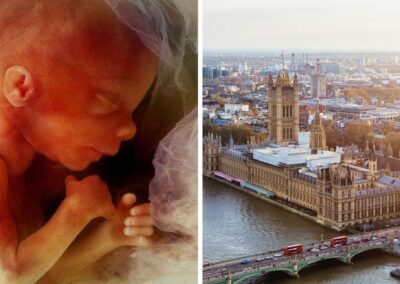




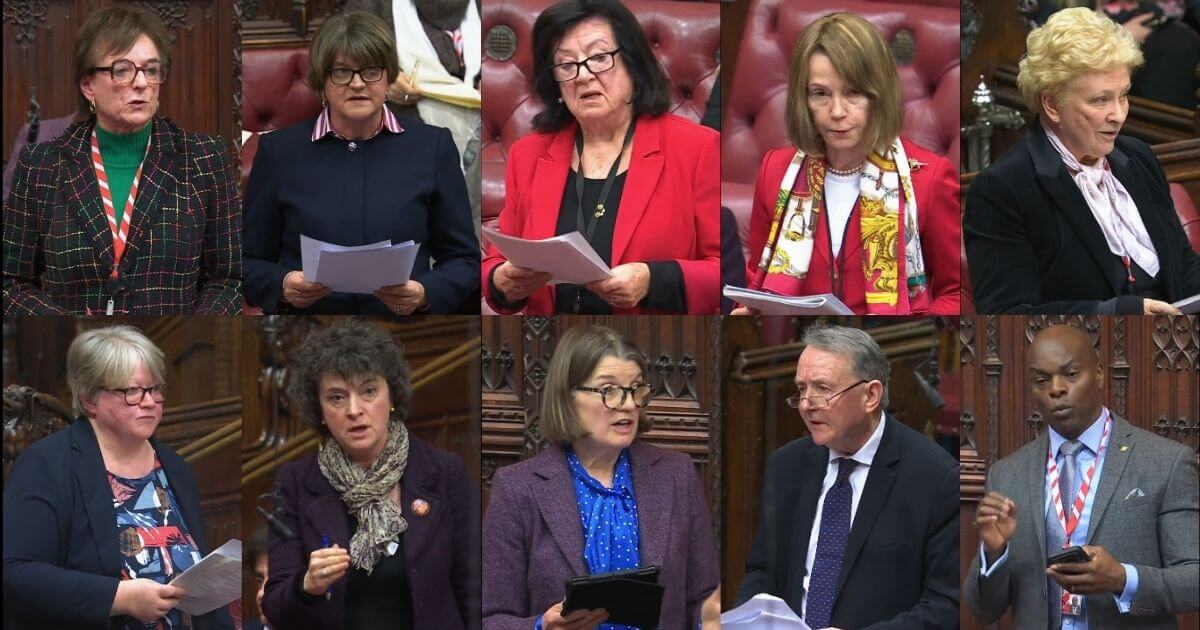
Peers lined up on Monday 2 February to back a major bid to overturn the abortion up to birth clause in the Crime and Policing Bill, and to reinstate the requirement for in-person consultations with a medical professional prior to an abortion taking place at home.
Across the day’s debate during the Lords Committee Stage, of the 29 speakers who made speeches and took a stance, 21 (72%) spoke against changing the law so it would no longer be illegal for women to perform their own abortions right through to birth, while 8 (28%) spoke in favour of it.
Clause 191 was introduced by Tonia Antoniazzi MP in the Commons after just 46 minutes of speeches – there was no prior consultation with the public, no Committee Stage scrutiny, no evidence sessions and no impact assessment.
The clause would change the law so it would no longer be illegal for women to perform their own abortions for any reason, including sex-selective purposes, and at any point up to and during birth, likely leading to a significant increase in the number of women performing dangerous late-term abortions at home.
Baroness Monckton, along with other female Peers, tabled an amendment to the Bill at Committee Stage that would remove clause 191 from the Crime and Policing Bill.
Abortion clause received little scrutiny and is not relevant to the wider Bill
Baroness Monckton criticised the abortion decriminalisation clause for the lack of scrutiny it has received, saying, “Good laws require careful thought and prior consideration regarding any unintended consequences”.
“Clause 191 fails to meet these criteria and should not become law. It was hastily added to an unrelated Bill and concerns a proposal that was neither a government manifesto commitment, nor called for by the public, nor subject to even rudimentary scrutiny”, she added.
Baroness O’Loan reiterated this point, saying, “Clause 191 was passed in the other place following a very brief and truncated debate, entirely incommensurate with the gravity of its impact”.
Lord Bailey also criticised the lack of scrutiny that “the most radical change to abortion laws in a generation” received in the House of Commons, and argued that it was the duty of the Lords to subject it to rigorous, detailed scrutiny.
Lord Jackson highlighted that the debate on this clause in the House of Commons was so brief that it only allowed for 46 minutes of speeches from backbench MPs, criticising “a scandalous lack of consideration of this change in our law and its impact”.
Lord McCrea added to this point, saying, “This is not responsible lawmaking on a matter that carries profound consequences for the status of the unborn and the safety of women”.
Speaking for the Opposition Front Bench, Lord Cameron of Lochiel added to these criticisms, saying, “Many Members in the other place were limited to less than five minutes of speaking time. On such an issue of profound social change, in no way can that be described as a full and proper debate—compare that to the vigorous debate we have had today”.
Peers draw attention to the “uncomfortable truth” of what this clause would allow
Lord Alton highlighted the “uncomfortable truth” of what would transpire if clause 191 becomes law, namely that “if a woman intentionally induces an abortion at a very late stage and the baby dies in utero or during the process and is not born alive, there would be no criminal offence available in respect of her actions, regardless of gestation”.
Baroness Meyer spoke about the vast difference between the current law and the worrying reality that clause 191 would bring, saying, “Under the current law, a woman at 32 weeks’ pregnancy—when a baby is fully formed—who contacts an abortion service may receive support, counselling or discuss adoption, but an abortion cannot be performed. Under Clause 191, however, she could obtain pills and end her own pregnancy without breaking the law. The consequence is clear: no prosecution at any stage, for any reason, even when a baby is capable of being born alive”.
Baroness Monckton argued that such a proposal is radical, saying, “Clause 191 is not moderate; it is radical. Its effect is to decriminalise abortions of babies up to birth if a woman seeks to induce a termination late in pregnancy by obtaining easily acquired pills”.
Clause 191 would decriminalise ending the lives of viable unborn babies
Peers reiterated that changing the law so it would no longer be illegal for women to perform their own abortions at any gestational age would mean that viable unborn children, who could likely survive outside the womb, would have their lives ended.
Baroness Meyer highlighted that advances in modern medicine mean that babies are surviving at an increasingly young gestational age. “When the 1929 Act was passed, viability was understood to be around 28 weeks. Today, it is generally around 24 weeks, but medical advances mean that some babies can survive from around 22 weeks. Our abortion law recognises viability, and this is precisely why there is a time limit”, she said.
Lord Jackson highlighted the discrepancy between refusing to focus on viable unborn children, saying, “A full-term child is not a theoretical entity. It is not an abstract concept. It is not a clump of cells. It is a living, viable human being who, if delivered mere hours later, would be held in a mother’s arms, placed in a cot, given a name, registered as a citizen and received into the world with joy”.
“At such a stage of gestation, surely the law’s interest cannot lie solely in the choices of the woman. It must acknowledge the parallel interest in the life of a viable child”, he added.
Baroness Monckton reiterated this discrepancy in the proposed legislation, saying, “It is not accidental that the legal limit for abortion is 24 weeks. That marks roughly the stage at which the baby is fully viable when born. This clause not only fails even to consider that person but would endanger the mother”.
‘Pills by post’ makes dangerous, late-term abortions more likely under clause 191
Baroness Meyer argued that abortion pills that are easily accessible through the ‘pills by post’ scheme make dangerous, late-term abortions much more likely. She explained that removing the criminal liability could make it harder to discover and prosecute abuse and coercion.
Baroness Maclean said that a large reason some people are calling for the decriminalisation of abortion is due to cases of prosecution following misuse of abortion pills obtained through the ‘pills by post’ scheme.
“Taking these pills outside the 10-week gestational limit is a dangerous course of action. The Department for Health and Social Care consultation found that the risks of this would include an ongoing viable pregnancy, reduced efficacy of abortions and death”, she added.
Baroness Monckton said that, despite all the issues with the ‘pills by post’ scheme, those who lobbied for it would rather “seek an even more radical law that would cover up the consequences of their scheme and make further such cases more likely” than repeal it.
Many moral and ethical concerns with changing the law so it would no longer be illegal for women to perform their own abortions were discussed
Baroness Spielman made the comparison that, by the same logic as the decriminalisation argument, “the killing by a woman of her living child or her partner, which of course nearly always happens in distressing circumstances, should be pre-emptively legitimised irrespective of the particular facts”.
Changing the law so it would no longer be illegal for women to perform their own abortions simply puts the rights of the mother above the rights of anyone else, she argued, saying, “I fear the uncomfortable truth is that it is simply easier to sway people to give mothers’ interests absolute priority when the child harmed has as yet no face and no voice, so that the very real conflict between the child’s rights and needs and those of the mother—the mother absolutely does have rights and needs too—can be denied”.
Viscount Hailsham drew attention to the arbitrary nature of changing the law so it would no longer be illegal for women to perform their own abortions, ending the life of a baby in the womb, while it remains a crime after giving birth.
“I find it very difficult to make an ethical or moral distinction between killing a child immediately after birth and killing a child immediately before birth. One has been born, the other has not, but I cannot discern any difference in principle”, he said.
Baroness Monckton raised the case of Sarah Catt, who was convicted in 2012 for having an abortion at 39 weeks gestation and was described by the chief inspector as “cold and calculating”. Baroness Monckton argued, “Under Clause 191, it would not even be permissible for the police to have investigated such a case”.
She continued, arguing that changing the law so it would no longer be illegal for women to perform their own abortions would, in effect, “reintroduce back-street abortion, as women would not be able to have terminations in a clinic beyond the 24-week limit but could do so at home, on their own, without the prospect of any subsequent investigation, using pills not designed for use outside of a clinical context beyond 10 weeks”.
Peers give additional comments following debate
Following the debate, Baroness Monckton said, “I was pleased to be able to speak for many peers and, I believe, most of the country today in opposing the extreme proposal to remove the legal deterrent against women aborting their babies up to birth”.
“Such a change in the law would seriously endanger women’s lives because of the risks of self-induced late-term abortions away from a clinical context, and likely lead to increased numbers of viable babies’ lives being ended. It would also decriminalise self-induced sex-selective abortions. I very much hope peers will support my amendment at Report stage and stop these proposals from becoming law”.
Baroness Foster added, “Decriminalising self-induced abortion to full-term must be one of the most extreme proposals the House of Lords has ever had to debate. The debate today made it clear that the real problem here is not our already extreme abortion laws, which permit abortions up to nearly six months into pregnancy, but the lack of an in-person consultation with a medical professional before abortion pills are prescribed, allowing women to administer their own abortions beyond the legal limit”.
“Reinstating in-person appointments enjoys wide public support and would allow reliable gestational age checks, protecting women from the significant health risks associated with late abortions and from the risk of coercion”.
Baroness Eaton, who tabled an amendment to ensure sex-selective abortions could not become legal under the abortion up to birth clause, said, “Today’s debate highlighted how little thought has gone into proposals to decriminalise self-administered abortions up to birth. The clause was passed hurriedly after minimal debate in the Commons, via the hijacking of an unrelated Bill”.
“Today, the House of Lords did its job in giving the proposals the scrutiny MPs were unable to offer. The debate exposed many unanswered questions and the likely tragic unintended consequences should the clause become law. The Government must find a way to pause these proposals and remove them from the Bill. Neither abortion up to birth nor sex-selective abortion has any place in a civilised country”.
Spokesperson for Right To Life UK, Catherine Robinson, said “The House of Lords has the opportunity to put right a great wrong. This proposed law change would endanger women as well as viable unborn babies. It is also deeply unpopular – only 1% of the public supports abortion up to birth”.
“Numerous Peers highlighted the many dangers with the abortion up to birth clause, and the unacceptable way it was rushed into the Bill, taking the public and commentators by surprise. It has no mandate. Peers need to be clear that far from being moderate, these proposals are radical and, combined with the pills by post scheme, would make our already extreme 24-week time limit effectively redundant for women who wish to abort late in pregnancy via easily obtained pills”.
“The same activist groups behind these proposals have recently recommended removing the prohibitions on sex-selective abortion and healthcare professionals performing abortions up to birth for ‘social reasons’ in Scotland. They want to bring the same changes to the law here, and the Westminster proposals are the thin end of the wedge”.