




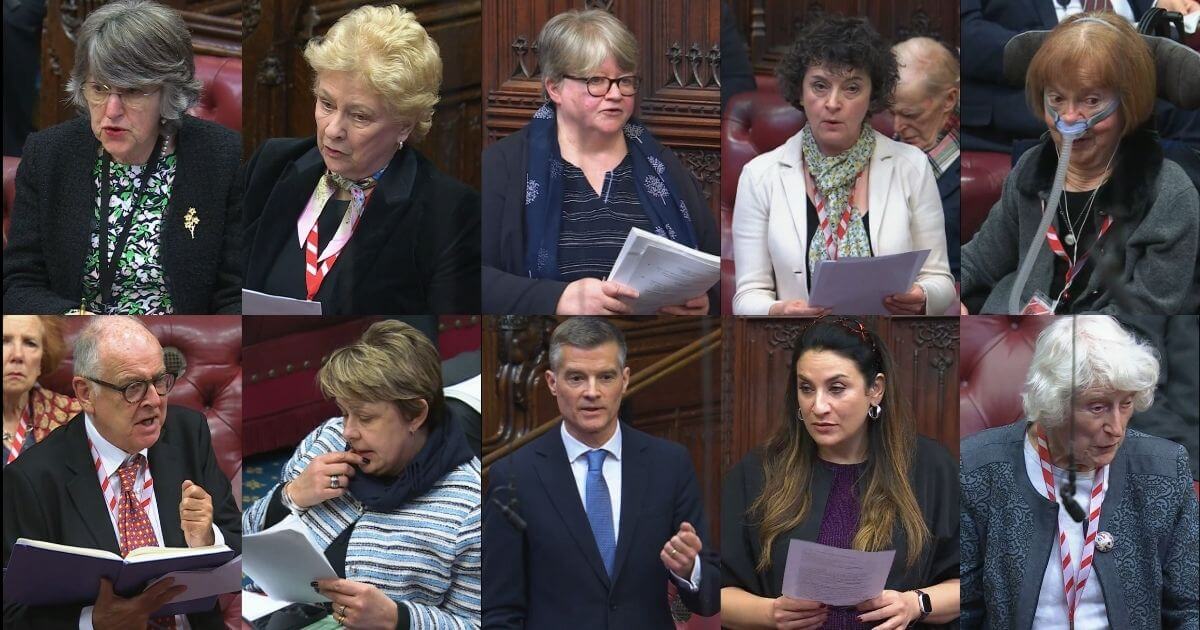
As Peers subjected the assisted suicide Bill to its sixth day of Committee Stage scrutiny on Friday 16 January, over 80% of speakers who made speeches spoke against the Bill, and the Bill’s sponsor in the House of Lords came under intense criticism for his openness to people ending their lives due to financial constraints.
Across the day’s debate, of the 34 speakers who made speeches, 27 (81.82%) spoke against the Bill, while only 6 (18.18%) spoke in favour of it.
Lord Falconer appeared to admit that someone may, under the terms of the Bill, choose to end their lives by assisted suicide due to their financial situation, saying, “I put forward the Bill on the basis that choice is the key thing. Your financial position might be an element in what makes you reach a decision”.
Seeking clarity on this point, Lord Harper argued that if you’re choosing assisted suicide “because you have no money”, that is “not a freely reached decision”.
“Is [Lord Falconer] really saying that he is okay with poor people ending their lives, with the assistance of others, because they are poor?”
Lord Falconer replied, saying that he was “strongly against saying poor people should not have that choice [to end their lives by assisted suicide]”.
Lord Harper continued to press the sponsor of the Bill on this point. “If someone is making the decision because they feel pressured because of their financial circumstances, that is not a free choice”, he said. That is a choice that is being forced upon someone by their circumstances”.
“They are not in an equal position to someone with resources. That would be very wrong, and I think people would be horrified that he is suggesting that someone, because of their financial circumstances, should be more likely to end their life than someone else”.
Falconer insisted that people experiencing financial hardship should still have the choice of assisted suicide.
Lord Falconer also acknowledged that individuals could end their lives as a result of feeling like they were placing too large a financial burden on their loved ones or the health service, stating, “They may find the whole sense that they are incurring expenditure for somebody else so awful for them that it makes them feel bad and they do not want to go through it”.
Assisted suicide supporter Lord Markham also admitted that under the terms of the Bill there are many reasons why an individual might feel motivated to end their life by assisted suicide. He stated that assisted suicide “is about being less able to engage in enjoyable activities. Yes, sometimes it is about feeling a burden, inadequate pain controls or financial concerns as well”.
“Assisted dying” is a euphemism
Baroness Fox, Lord Frost, Lord Moore, Lord Goodman and Lord Gove all focused on the euphemistic language used throughout the assisted suicide Bill. Baroness Fox argued that referring to the act of ending one’s life as anything other than suicide could make people more likely to do so.
She said, “If a person is dying and goes to the trouble of organising, obtaining and ingesting a lethal substance – poison – that is suicide. That is an accurate use of language. By removing the word ‘suicide’ from the discussion, there is another danger. Advocates of this Bill, without saying the S-word, nonetheless argue that assistance in ending one’s life can, in certain circumstances, be dignified, a positive choice and a happy release. I am afraid that normalises taking one’s own life”.
“Even if you do not use the S-word, that is the sort of thing I associate with the propaganda on pro-suicide, pro-self-harm sites, rather than with a Bill such as this. I suggest that normalising and even glamourising taking one’s life as a happy end result is not something we should do. Therefore, I would at least like to call it suicide so that people might gulp and think again”.
Lord Frost agreed with this, saying, “The provision of medical help to commit suicide by the provision of lethal drugs is what the Bill does. That is what it does and that is what it should say that it does”.
He added that “exactly the same concern arises from the Bill’s use of the phrase, ‘approved substance’ when what is meant is a lethal drug”.
Lord Frost continued, arguing, “The inclusion of euphemism in this Bill is, to me, a troubling and worrying sign about the degree to which the Bill’s proponents are genuinely ready to defend in public the specifics of what they advocate in this Bill. I suggest that we should avoid those risks and concerns by being clear and unambiguous about what is involved”.
Lord Harper added, “If people find us being clear and speaking plainly about what we are doing either uncomfortable or distressing, that should make us pause and ask ourselves whether what we are doing is the right thing. We should not change the language to make the thing that we are doing more palatable. We should speak plainly about it, then judge accordingly”.
“Burden is real” argues Peer after returning to Lords following injury
Returning after months away from the House of Lords due to an injury, Baroness Campbell, who has spinal muscular atrophy, argued that the answer to feeling like a burden is good social care, not assisted suicide.
“We all know that burden is one of the primary reasons for people to seek an assisted death. That is not only in the conversations I have had here, but we know it is the primary reason throughout the world. Burden is real”, she said.
Peer calls out Lord Falconer for misrepresenting their views on the Bill
During the debate, Baroness Butler-Sloss stood to correct Lord Falconer, who had emailed Peers telling them she wanted to get his assisted suicide Bill through.
“I am extremely anxious to get this Bill through to Third Reading, but I profoundly dislike it, and I never said that I wanted to get it right the way through to the House of Commons. I just wanted to put that right”, she said.
Assisted suicide Bill doesn’t preclude people from making applications on behalf of someone else
Baroness Berger implored Lord Falconer to ensure that no one can request an assisted suicide on behalf of someone else, and argued that the Bill was unclear on this point.
“It is essential that Clause 1, which sets out the key principles of eligibility for an assisted death, is as clear and as accurate as possible, leaving no room at all for ambiguity or wider interpretation later on”, she said.
Peer with disability has concerns raised in letter ignored by Lord Falconer
Lord Shinkwin, who was born with osteogenesis imperfecta, told the House that the Prime Minister ignored a letter that he sent raising concerns about the extension of the debating hours for the assisted suicide Bill.
“I am deeply disappointed”, Lord Shinkwin said, “that without consultation and despite my having written to the Prime Minister, it has effectively been decided that, as a severely disabled Member who has to leave the House by 3pm on a Friday in order to catch my flight home, I should not be enabled to contribute on an equal and non-discriminatory basis to scrutiny of a Bill that would have a devastating impact on disabled people if it became law”.
“Instead, I have had to fly home at very short notice so that I can contribute, but unequally, without the ability to intervene in this debate remotely. The Prime Minister never replied to my letter, so I assume this decision is his response. It does not reflect well on him or his great party which I respect. His great party deserves better than being saddled with what everyone knows is ultimately the Prime Minister’s Bill”.
Individuals with mental health conditions could be eligible for assisted suicide, says Lord Falconer
Lord Falconer also suggested that having a mental health condition should not, in itself, be a barrier to an individual ending their life by assisted suicide.
He said, “[I]f the position is that you may have a mental health condition but are perfectly capable of making a decision, you should be allowed to make it”.
Baroness Fox criticised this, saying, “I point out that, for anyone who wants to commit suicide, it is their choice and they want it, but some of us spend a lot of time asking them please not to do it, not saying, ‘Yippee!’”
Peers raise concerns about expansion of assisted suicide legislation through the courts
Lord Harper, talking about the eligibility criteria for assisted suicide, said that courts would likely be used to widen the eligibility, as has been the case in other regions where assisted suicide and euthanasia are already legal.
“We know this will get challenged in the courts and be expanded, because that has happened everywhere else. As I said earlier, the Minister keeps telling us about the human rights provisions. They will absolutely be used, if not to change what is in the Bill, to widen and challenge the regulations made under it. That is why so many of us want more safeguards on the face of it and not left to statutory instruments, which we know judges are very happy to change and strike down”, he said.
Lord Falconer rejected this assessment, saying “it is unlikely that the courts will interfere in a deliberate choice made by the Government”