




A new poll published today from More In Common shows that the majority of the public does not support bypassing the House of Lords to force through the assisted suicide Bill, as would occur if the Parliament Acts were invoked in relation to the Bill in the next parliamentary session, as Lord Falconer has threatened.
Despite the polling including leading questions in favour of the Bill, 54% of the public polled thought the Bill should either not return or would have to pass both Houses again, whereas only 46% of those polled thought the Bill should bypass the House of Lords.
The polling showed that majorities do not support the bypassing of the House of Lords among both men and women, and among voters of every major political party.
The polling also showed that those who strongly support legalising assisted suicide remains low at just 28% of the public, a drop compared to the 32% of those polled who strongly supported legalising assisted suicide in November 2024.
Using the Parliament Acts for a Private Members’ Bill would be unprecedented
The release of the polling follows ongoing campaigning from assisted suicide lobby group, Dignity in Dying, to build support for using the Parliament Acts to bring back the Leadbeater assisted suicide Bill in the next parliamentary session and then use the Parliament Acts to bypass the House of Lords.
Taking the route of using the Parliament Acts to bypass House of Lords scrutiny of a Private Members’ Bill would be unprecedented. It would be the first time ever that the Parliament Acts would be used for a Private Members’ Bill – and this polling confirms that taking this approach is not supported by the public.
The results of this poll follow earlier polling, which showed that 70% of the public who expressed a view believe peers should be able to vote against a Private Members’ Bill, like the assisted suicide Bill, if they believe it would harm vulnerable people.
The House of Lords Constitution Committee and Hansard Society have both confirmed that peers are constitutionally free to reject the Bill. As the Bill is not a Government Bill and was not in any party election manifesto, there is no convention requiring the Lords to pass it.
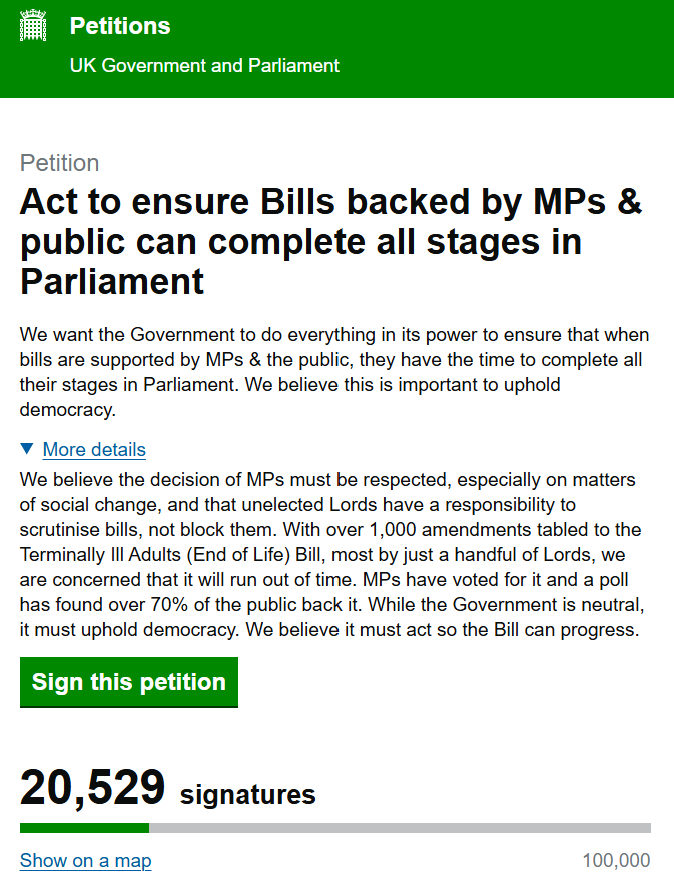
Support for bypassing the House of Lords even appears to be weak from among supporters of the assisted suicide pressure group, Dignity in Dying. The group claims to have over 600,000 supporters on its database and wrote to supporters on Friday 6 February, asking them to support a petition calling for the bypassing of House of Lords scrutiny.
Despite being promoted to their supporters and extensively on social media, only just over 20,000 people have signed the petition, a number which is far lower than for petitions on comparable issues. By way of comparison, after the same four-day timeframe, a recent petition opposing the puberty blocker trial secured over 100,000 signatures, five times the number, even without the benefit of well-funded campaign groups behind it.
More In Common lists UK institutional funders of their work as including the John Ellerman Foundation. The John Ellerman Foundation is also a major funder of Compassion in Dying, which is the sister organisation of the assisted suicide pressure group, Dignity in Dying.
Spokesperson for Right To Life UK, Catherine Robinson, said “Today’s polling shows the public does not support bypassing the House of Lords to force through the assisted suicide Bill”.
“Even with leading questions framed in the bill’s favour, 54% say it should either not return next session or should have to pass through both Houses again, while only 46% support using the Parliament Acts to bypass the Lords”.
“Taking this unprecedented route to bypass House of Lords scrutiny of a private members’ bill would be politically explosive. The Parliament Acts have never been used to force through a Private Members’ Bill before, and this polling confirms the public does not support taking this deeply controversial route”.
“Any talk of using the Parliament Acts to force this Bill into law must now be put to rest”.