



The UK Government is to introduce a new controversial screening test to identify whether an unborn baby has a high probability of having Down’s syndrome, despite the fact that existing data suggests that this will likely see an increase in abortions of babies with Down’s syndrome.
Public Health England announced that the screening tests are set to be available across the NHS from 1st June this year. Non-invasive prenatal testing (NIPT), also called ‘cell-free DNA’ (cfDNA) will be an additional test offered during pregnancy.
Campaigners for the rights of people with Down’s syndrome have pointed out that the existing evidence suggests that the rollout of NIPT as a free test on the NHS will likely lead to an increase in abortions of babies found to have the condition.
An increase in abortions of babies with Down’s syndrome
A 2019 investigation by The Sunday Times found that the number of babies born with Down’s syndrome has fallen by 30% in the small number of NHS hospitals that have already introduced the new form of screening.
In December last year, The Telegraph reported that “the number of British babies born with Down’s syndrome has halved as more parents opt for a controversial blood test to identify the condition during pregnancy”. This coverage was based on research recently published in the European Journal of Human Genetics.
The National Institute for Health and Research’s RAPID evaluation study projected that the proposed implementation will result in more babies with Down’s syndrome being identified each year. Currently, around 90% of all babies diagnosed with Down’s syndrome in the womb are aborted. As Down’s syndrome is detected more frequently, it is likely that there will be a corresponding increase in abortions.
‘Informally eugenic anti-disabled discrimination’
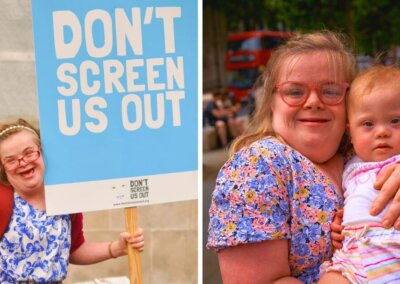
The campaign group ‘Don’t Screen Us Out’ has called on the Government “to assess the impact that the introduction of the test will have on people in England living with Down’s syndrome and to introduce reforms, such as guidelines on antenatal care for women found to be carrying a baby with Down’s syndrome”.
“Without corrective action, NIPT may only worsen the culture of informally eugenic anti-disabled discrimination that exists in the Fetal Anomaly Screening Programme”, they said.
Lynn Murray, spokesperson for the Don’t Screen Us Out campaign said: “As a mother of a daughter who has Down’s syndrome, I see every day the unique value she brings to our family and the positive impact she has on others around her”.
“While the screening itself is being heralded as a move to reduce the number of miscarriages associated with invasive amniocentesis, the figures published in the Sunday Times revealed that the number of babies born with Down’s syndrome fell by 30% in NHS hospitals that have already introduced the new test. When this test is rolled out across the country, we can expect to see this situation replicated elsewhere. Such outcomes are likely to have a profoundly negative impact on the Down’s syndrome community”.
“There also needs to be greater support for parents who are expecting a child with Down’s syndrome”.
“Despite Nuffield Council of Bioethics’ 2017 call for RCOG to take immediate action and introduce professional guidance to cover the continuation of pregnancy after a diagnosis of fetal anomaly there are still no guidelines to support women who choose to continue their pregnancies after finding that their baby has Down’s syndrome”.
Right To Life UK spokesperson, Catherine Robinson, said: “There have already been numerous reports from women who, after a diagnosis of fetal disability, felt pressured by healthcare professionals to have an abortion, even when they made it clear that they did not want one. These reports have been confirmed by recent Royal College of Obstetricians and Gynaecologists (RCOG) guidelines which indicate that this pressure is fairly widespread”.
“There appears to be a medical culture in some hospitals in the UK with an evident bias against disabled babies in the womb. Without reforming this culture, the widespread availability of NIPT is likely to see a further increase in eugenic abortions on those babies with Down’s syndrome”.