



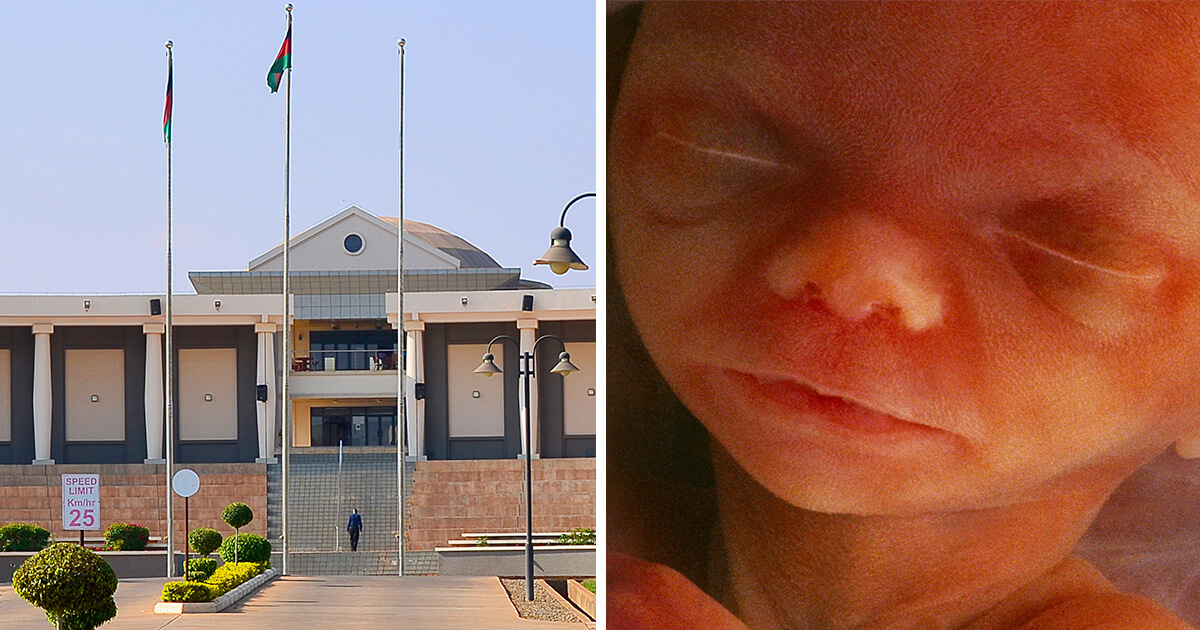
An extreme abortion Bill, which has the backing of international abortion organisation Ipas and would allow de facto abortion on demand, right up to the point of birth, is due to be brought forward to Malawi’s National Assembly.
Chairperson of the Parliamentary Committee on Health, Matthews Ngwale, is expected to introduce the extreme Bill during the Assembly’s current sitting which ends on 23 October.
Abortion for any reason, on-demand, up to birth
The Termination of Pregnancy Bill outlines that abortion would be available without a time limit on grounds that “the termination of pregnancy is necessary to prevent injury to the physical or mental health of a pregnant woman”.
While this language appears to provide abortion on only narrow grounds, in practice it will likely allow for de facto abortion on demand to be allowed in Malawi through a broad interpretation of the term “health”.
Malawi’s Christian Medical and Dental Fellowship expressed ‘grave concern’ after a similarly worded bill was introduced in 2016, stating it “has led other countries to effectively practice abortion on demand”.
The group noted that 98% of the UK’s abortions take place under equally permissive language.
However, unlike the UK’s 24-week limit, Malawi’s Termination of Pregnancy Bill has no time limit attached to the clause allowing abortion on mental health grounds and would effectively allow de facto abortion on-demand, up-to-birth.
The proposals will also allow children to procure an abortion without parental consent and could result in doctors who don’t want to be involved in an abortion procedure, or provide a referral, receiving five-year prison sentences.
Abortion can be performed on children and teens
The proposed legislation does not include an age limit for abortions meaning that abortions can be performed on children and teenagers.
No parental consent required
The proposals also include a clause which allows a health service provider to provide an abortion without their parent’s consent if they feel that “that termination of pregnancy is in the best interests of the child.”
The legislation does not mention the introduction of any specific legal safeguards to prevent third-parties from taking children for abortions. This could open up the possibility of an adult who has sexually abused a child to take them for an abortion, to help cover-up their actions.
Five-year-jail sentence for doctors who conscientiously object
The change in law would also introduce a five-year jail sentence for any health professional that conscientiously objects to being involved with providing an abortion and does not want to be complicit in the abortion process by providing a referral onto another health professional who will provide an abortion.
No requirement that a doctor must be involved with abortions prior to 12-weeks
Under the proposed law, abortions can be performed by medical assistants, midwifery technicians, registered nurses, midwives and clinical officers, without a trained doctor present, in case of a complication.
In England and Wales, abortions can only be performed by a registered medical practitioner (doctor), and the Abortion Act requires the approval of two doctors before an abortion can be performed.
Even with this legal restriction in place, there are still many cases of complications during abortions in the UK, resulting in babies being born alive, women’s uteruses being perforated or severe haemorrhaging that has resulted in death.
Under the proposed law in Malawi, prior to 12-weeks gestation, there is no requirement that a doctor perform and no requirement for the approval of two doctors before an abortion can be performed.
Babies born alive after abortion to be left to die
In the new legislation, there is no mention of a legal requirement that babies born alive after an abortion are resuscitated or provided with medical assistance.
This is more common than many people think. In 2008, a UK report found that 66 infants were born alive after NHS terminations in one year. The majority of those 66 babies took over an hour to die.
In Victoria, Australia, where there is a similarly extreme abortion law to that proposed in Malawi, scores of babies were left to die after being removed alive during a number of ‘botched’ terminations, according to one official review.
The review reported that in 2011 there were 40 ‘terminations of pregnancy’ after 20 weeks ‘resulting in live birth’. While these figures are comparable in scale, Victoria’s population of 5.5 million is just a tenth of Britain’s.
This shows the scale of this problem in an environment where there are very few legal safeguards around abortion.
Legalised partial-birth abortions
In the proposed framework there is no mention of a legal restriction on the types of abortion methods used to abort babies.
This could allow for the use of particularly gruesome abortion methods such intact dilation and extraction abortions (also knows as partial-birth abortions) and other controversial methods of abortion.
A ‘partial-birth’ abortion involves the feticidal injection of digoxin or potassium chloride at the beginning of the procedure to allow for softening of the fetal bones before the fetus is removed in a breech position. If the baby’s skull is too large to fit through the birth canal, it is crushed to allow the skull to be removed. Decompression of the skull can be accomplished by incision and suction of the contents, or by using forceps.
Sex-selective abortion
Sex-selective is the practice of aborting a baby because of their sex. The practice usually targets baby girls due to a preference among certain parents and some cultures for having sons.
There is no specific provision in the proposed legislation banning sex-selective abortion.
In the UK, where there is a similar mental health clause allowing for abortion on demand through to 24-weeks, without a provision banning sex-selective abortion, there is evidence that sex-selective abortions have occurred under that clause.
This practice is already happening in other countries which have very permissive abortion laws. For example, abortion is available in Canada for any reason and as such, it has been described as a “haven” for parents wishing to have an abortion because their child is a girl.
How international organisations are pushing for abortion law change
The international abortion group and other organisations are attempting to use a legislation change model which, in practice, introduces de facto abortion-on-demand, right up to birth.
This model firstly involves international organisations lobbying Governments to introduce new legislation, as they are currently doing in Ghana, Kenya, Malawi, Namibia, and likely other countries across Africa. They then place themselves as key advisers on the roll-out of the new abortion service, including advising on associated standards and protocols across the country.
In this position as a key adviser, the organisation produces comprehensive guidance for the respective Government and healthcare providers. This guidance outlines how they can interpret language in the new legislation to allow for abortion on demand.
For example, this model can be seen in operation in Ghana, where the legislation relating to abortion includes what appears to be restrictive grounds for abortion “where the continuance of the pregnancy would involve risk to the life of the pregnant woman or injury to her physical or mental health”.
While the language sounds restrictive, Ipas assisted guidance instructs healthcare professionals to take a very broad interpretation of the wording. This has, in practice, allowed abortion to take place de factor on-demand.
The involvement of Ipas in writing Ghana’s abortion guidance has not been hidden or obscured. A foreword to the current guidance states: “This document has been put together by a team of national experts with technical assistance from Ipas and WHO, Geneva.”
In Malawi, without a time limit in the proposed legislation, a similarly broad interpretation would allow de facto abortion-on-demand, up to birth.
Radical abortion legislation not wanted in Malawi
While there has not been any research on the public opinion around abortion in Malawi, local campaigners revealed to Right To Life UK that the vast majority of Malawian citizens are pro-life.
This mirrors a 2020 Ipsos Synovate poll from Kenya, where there is also currently international pressure to change abortion legislation, which showed just 6% of people think abortion should be permitted.
Therefore, the extreme changes being pushed on abortion legislation in Ghana, Kenya, Malawi, Namibia, and other African countries, by international organisations are likely not to be in line with the views of individuals living in the country.
However, it is highly probable Ipas and other abortion proponents will continue pushing for a change in law undeterred.
President likely to oppose Bill
Pro-life campaigners in the country expect the current President, Lazarus Chakwera, to come out in opposition to the Bill.
His son, Nic, has recently written an opinion piece against the Bill stating all humans have a right to life.
Campaigners are also calling on the Malawi Special Law Commission to condemn the Bill given how extreme the proposed legislation is.
‘Ideological colonialism’
Pro-life campaigner, Ella Duru told Right To Life UK: “This is a brazen attempt by Western abortion organisations to impose de factor abortion on demand, up to birth on Malawi.
“Women in Malawi don’t need abortion to be empowered. Instead, lawmakers should look at proposals which support women such as improved healthcare, good schools and additional skills training.
“To have these well-funded overseas organisations spending lots of money to try and force more extreme abortion laws on Malawi and other African countries, particularly when it is unwanted, is a form of ideological colonialism.
“Cash rich donors from the West continue to exploit their privilege and position to offer abortion which is contrary to the pro-life values held by a large majority of African people.
“Given that these proposals would likely deny unborn babies the right to life right up to the point of birth, these proposals must be defeated by lawmakers if they reach the National Assembly.”
‘Sad sign of the times’
Rev. Dr Zacc Kawalala Chairperson of Ethics, Peace and Justice Commission (EPJC) of Evangelical Association of Malawi told Right To Life UK: “The Bill being put forward, with the help of international abortion organisations would deny unborn babies the right to life. This is the most important right of all so the Bill must be defeated.
“It is a sad sign of the times that ‘development’ now consists of pushing abortion laws on countries that want to protect life at its most vulnerable stage.
“Women don’t need abortion to be empowered. Instead, lawmakers should look at proposals which do support and empower the people of Malawi such as improved healthcare, good schools and additional skills training.”