



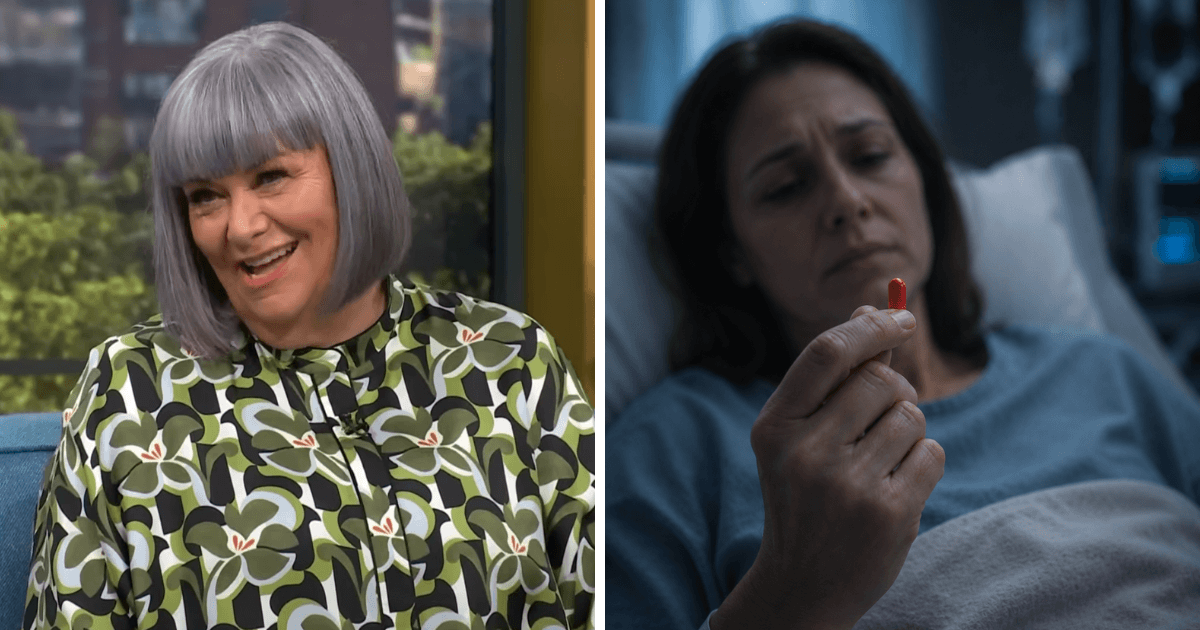
Only weeks after voicing her support for a change in the law on assisted suicide, Dawn French has now expressed grave doubts about the negative effects that legalising assisted suicide will likely have on those in poverty.
Appearing on a podcast to talk about her latest book, in which she makes her sympathy for a change in the law on assisted suicide known, the Vicar of Dibley actress indicated that she has had a change of heart on her support of the assisted suicide Bill, due to the adverse impact that the Bill would have on vulnerable people.
“Like so many social constructs like this, big laws like this, poor people will be the people that suffer”, French said. “They’ll be left out, they will feel like they’re a burden. They will feel like they have to go. There won’t be anybody to speak on their behalf”.
“I had never considered the social injustice it might bring. I had to have a second thought about that. And I need to investigate it a bit further”, she added.
When it comes to the intricacies of the proposed legislation, French made it clear that it is much more complex and nuanced than the soundbites from the Bill’s supporters make it out to be. “I also don’t know enough about it. I know it’s nuanced. I know it’s complicated”, she said.
“There would have to be lawyers and family and doctors – and the agency of that actual person. Everybody would have to agree, and it would have to be very watertight”, the actress reiterated, shedding light on some of the difficulties with legislating on such a difficult issue.
“So many people don’t have that [agency]”, she explained.
Polling reveals that people do not understand what the assisted suicide Bill entails
Recent polling has confirmed that Dawn French is not alone in finding the assisted suicide Bill nuanced and complicated, highlighting that the vast majority of people do not actually understand what the legislation proposes.
The polling, undertaken by JL Partners in April 2026, revealed that despite 80% of respondents believing that they understood the details of the assisted suicide Bill, only 38% of 1,635 respondents actually understood that it was about providing lethal drugs to allow terminally ill people to end their lives.
11% of these respondents believed that the assisted suicide Bill involved providing end-of-life hospice and palliative care to people who are terminally ill; 17% believed it meant offering drugs and sedatives to reduce suffering in the final stages of life, including unconsciousness before the individual passes away; a further 17% believed it meant giving patients the right to refuse or stop life continuing treatment; 10% believed that it was about an instruction that no attempts should be made to resuscitate an individual or restart the heart or breathing if they stop.
Burnham and Streeting express doubts about assisted suicide
Dawn French is not the only public figure to voice doubts about the assisted suicide Bill.
The support of the Prime Minister that the assisted suicide Bill and its sponsors have enjoyed under Keir Starmer’s tenure as Prime Minister is unlikely to continue if he is succeeded in his role by Andy Burnham.
The New Statesman reported on Tuesday 16 June that Andy Burnham may oppose a new assisted suicide Bill, and would not welcome its return.
The article stated that, should Burnham become Prime Minister, “it is hard to see a world in which he would welcome this Labour Party-dividing legislation”.
Burnham has said he supports the principle of assisted suicide, but has set a precondition that hospices must be “properly funded and sorted out” before any law change.
Burnham previously stated, “[In] terms of the implementation of it, I would say there should be a kind of requirement that the hospices of this country get properly funded and sorted out before that law change comes in”.
He added that palliative care is not “in the strong position it should be in”, stating that, “Consequently, you can’t have this law change with an underfunded hospice movement”.
Given the end-of-life care crisis in this country, Burnham’s precondition, that palliative care is properly funded before assisted suicide is introduced, has plainly not been met. It therefore seems unlikely he will support the revived assisted suicide Bill.
Burnham’s position is similar to that of Wes Streeting, the former Health Secretary who came out in support of Burnham’s bid for leadership. Streeting is also not opposed to the principle of assisted suicide, but has said that end-of-life care is not in a condition where people at the end of their life would have genuine freedom to choose an assisted death. On this basis, the former Health Secretary opposed the Leadbeater Bill at both Second and Third Readings.
Return of Bill will cause division in the Labour Party at the worst possible time
After Lauren Edwards announced she would bring the Bill back, several Labour MPs took to social media to point out that bringing back the assisted suicide Bill would fuel the flames of current tensions in the Labour Party, causing further division, at the worst possible time. These MPs include Adam Jogee, David Smith, Rupa Huq and Kirsteen Sullivan. Other MPs, including Ashley Dalton, Emma Lewell, Antonia Bance, Allison Gardner, Daniel Francis, Uma Kumaran, Ian Byrne, Scott Arthur and Andrew Pakes, alongside Labour Peers and former MPs Luciana Berger and Barbara Keeley, all also expressed serious concern about the return of the Bill.
Still more Labour MPs reposted the concerns of their colleagues, including Chi Onwurah, Jess Asato, Mary Glindon, Melanie Ward and Patrick Hurley, as well as former Labour rebel Karl Turner, who predicted defeat for a new Bill, making the division this Bill will cause pointless. Former Labour MPs Diane Abbott and Rosie Duffield also publicly opposed the return of the Bill.
Karl Turner MP, currently suspended from the Labour Party, has also argued that “bringing back the assisted dying bill is a huge mistake”, concluding, “Parliament should address existing failures within our healthcare system – not seek to give the most vulnerable in society a false choice”.
Given the ongoing turmoil in the Labour Party and the fact that 42% of Labour MPs (160, including several Cabinet Ministers) voted against the Bill at Third Reading in 2025, many MPs will be dismayed at the return of a controversial Bill that will cause division and distract from other priorities, while also leading to a backlash from constituents, especially when it will likely fail.
A similar Bill has recently been rejected in Scotland, where, strikingly, 85% of Labour MSPs (17/20) opposed the Bill. Many new intake Labour MPs likely voted for the Westminster Bill previously because of the support of Keir Starmer early on in their parliamentary careers.
Given only 12 MPs would need to change their minds for the Bill to be defeated, and any new vote would likely become a referendum on the use of the Parliament Acts as well as on the flawed Bill itself, this strongly suggests that the Bill is on track to be defeated.
Spokesperson for Right To Life UK, Catherine Robinson, said “Dawn French, just weeks after the release of her pro-assisted suicide novel, is now experiencing serious doubts about assisted suicide. It seems that the more people learn about the assisted suicide Bill, the more they oppose it”.
“Hopefully, as MPs become more familiar with the Edwards’ Bill and recognise it has the same flaws as its predecessor, MPs will reject this dangerous Bill at Second Reading”.