




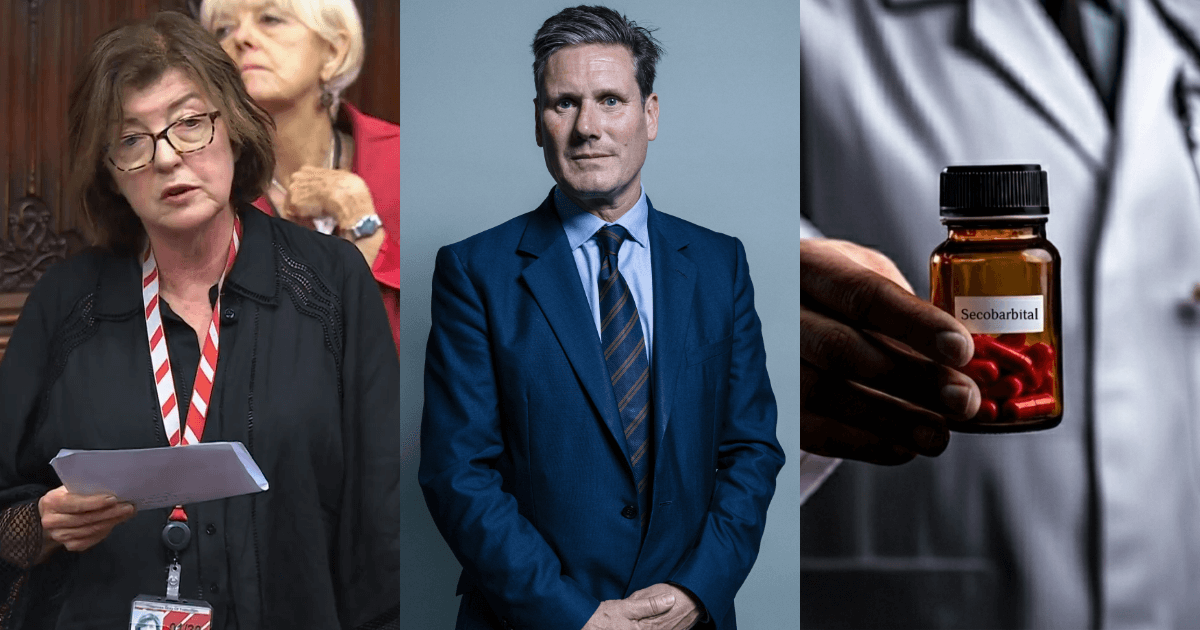
Prime Minister Keir Starmer’s former Chief of Staff has come out in opposition to the assisted suicide Bill, saying she fears that vulnerable people may face pressure to end their lives.
Baroness Sue Gray criticised the assisted suicide Bill during a Committee Stage debate on Friday, 12 December, warning that vulnerable people may seek to end their lives by assisted suicide “simply because they have been too worn down for too long”.
The Terminally Ill Adults (End of Life) Bill would legalise assisted suicide in England and Wales for those with a prognosis of six months or less. Despite the requirement for an individual to have been given a prognosis of six months or less to be eligible for assisted suicide, Baroness Gray said there was “nothing in the Bill that would stop a person accessing an assisted death for reasons that were nothing to do with their illness but simply because they had been too worn down for too long by problems that could have been solved with the right care, attention and funding”.
Among those who would likely be most vulnerable to assisted suicide are homeless people, according to Baroness Gray.
“Not only are people who are homeless, by definition, cut off from and invisible to key public services, including healthcare, but they often have complex further needs, such as abusive relationships, poor mental health and addiction”, Baroness Gray said.
“I am especially concerned that we are looking to introduce it at a time when the cost of living means that homelessness has reached critical levels throughout the UK”, she added.
“How can we imagine that they will not be at risk of being offered an assisted death simply because those needs are judged too hard to meet, or because someone else has decided that their lives are not worth while?” she said.
Baroness Gray continued, “Only yesterday, the Government published a national plan to end homelessness, and I commend the Government for that, but there are some shocking statistics in that plan about the numbers who are homeless”.
“It paints a picture of utter despair and isolation for some of the most vulnerable in our society. It is wholly impossible to justify leaving out safeguards that would prevent homeless people being coerced into an assisted death, whether through abuse, absence of choice or simply their despair”, she said.
Baroness Gray highlighted how cases like this have happened in Canada, where assisted suicide and euthanasia are legal.
The PM’s former Chief of Staff’s intervention comes shortly after the Government created seven additional sitting Fridays for the assisted suicide Bill in the new year in the House of Lords, in addition to the three sitting Fridays that had already been scheduled.
The announcement was made by the Chief Whip in the House of Lords after the Budget in November. There will now be a total of ten further House of Lords sitting Fridays dedicated to the Bill, seven more than originally scheduled. This decision will require Peers to sit every Friday in January after the Christmas recess ends, and on most other Fridays before Easter, including 27 March, when the House was supposed to be in recess.
Former Director of Legislative Affairs at 10 Downing Street, Nikki da Costa, responded to the Government intervention, saying that it “has come out swinging for [the] Assisted Dying Bill, despite saying they’re ‘neutral’”.
“Lords usually sit only one Friday a month”.
“[O]nce again the Government are pushing back recess (this time Easter recess) to create more time for the Bill on 27 March. More ‘neutrality’!”, she added.
Spokesperson for Right To Life UK, Catherine Robinson, said “Baroness Gray is right to raise the issue of the assisted suicide Bill being likely to have a disproportionately harmful impact on homeless people”.
“The appalling lack of safeguards in this legislation means that all manner of vulnerable groups of people are worried about what would happen if assisted suicide is legalised”.
“Vulnerable people in our society need our support and care. Those pushing for assisted suicide are opening the door to allowing these people to be pressured or coerced into an unnecessary death. This terrible Bill should never become law”.