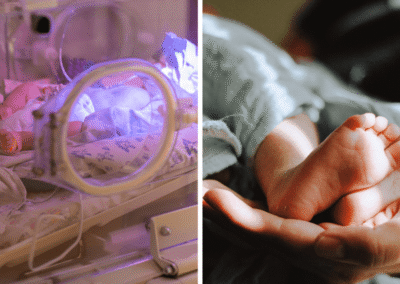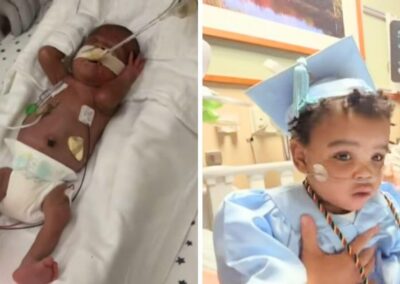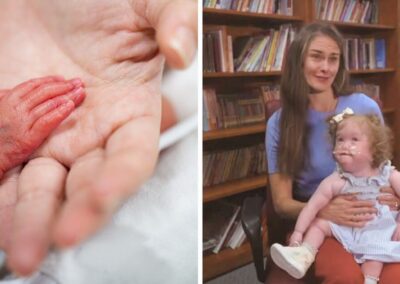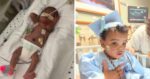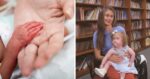




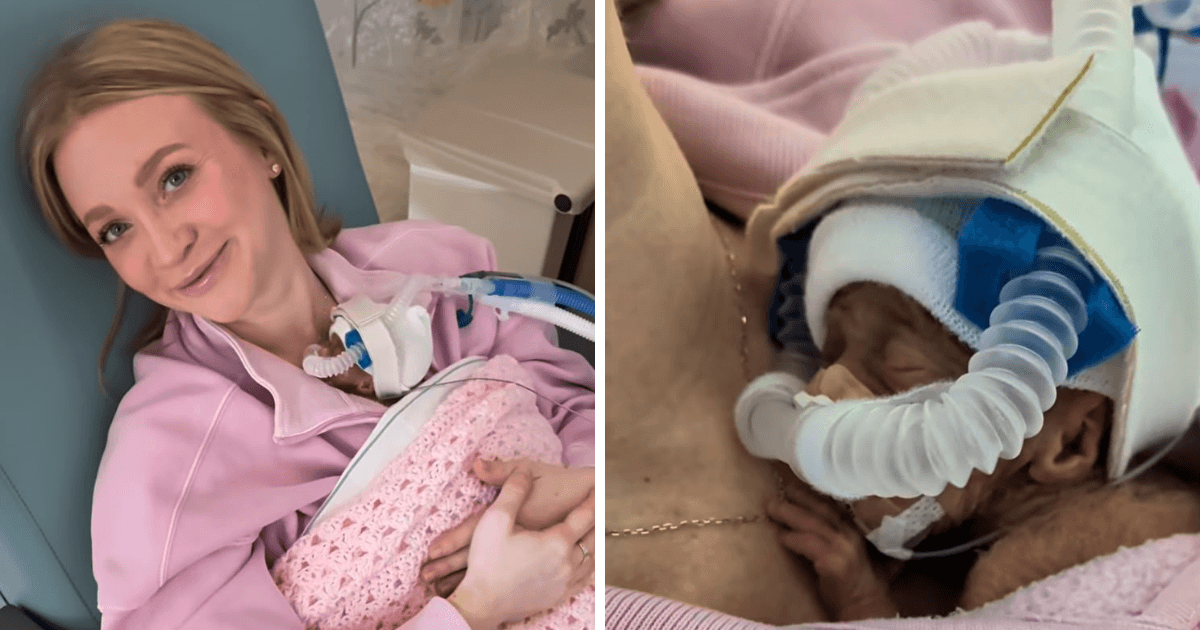
Five days after delivering her premature baby girl at just 29 weeks, mother Taylor Plemmons was finally able to hold her daughter, Margot.
Taylor described the moment she was able to hold her daughter for the first time as “the sweetest and scariest feeling in the world”.
“When the nurse placed her in my arms, I exhaled for the first time since seeing two pink lines”, explains mum Taylor. “She was impossibly small, far tinier than my mind could comprehend, yet perfectly formed. Ten tiny fingers and ten tiny toes”, she says.
“When I began to speak, she lifted her eyes and settled against me. In that moment, the fear quieted”, Taylor reminisces. “I knew she was fragile, but I didn’t yet understand the depth of her strength. After so much uncertainty and loss, I was finally holding my daughter, and that was all that mattered”.
At around 10 weeks of pregnancy, Taylor was diagnosed with a subchorionic haematoma, a condition in which blood forms between a baby’s amniotic sac and the uterine wall. This caused her to experience several haemorrhages.
Doctors offered Taylor the possibility of having an abortion. Instead, Taylor says, the news “ignited a determination in me to fight for her”, and she “focused on the present moment and what was directly in front of me, rather than all the ways things could go wrong”.
As the pregnancy continued, Taylor developed further complications. At 16 weeks, her alpha-fetoprotein (AFP) level was elevated, indicating that baby Margot was at increased risk of certain health problems. Three weeks later, Margot was diagnosed with severe growth restriction. At 23 weeks, Taylor developed pre-eclampsia, a condition that can cause serious complications during pregnancy. She was hospitalised so that she and her unborn baby could be closely monitored for the remainder of the pregnancy.
Although the medical team worked “tirelessly to prolong the pregnancy as safely as possible”, Taylor’s condition continued to worsen. At 29 weeks, her pre-eclampsia progressed into HELLP syndrome, a rare but life-threatening pregnancy condition.
“We were given one hour’s notice to proceed with an emergency C-section to save both of our lives”, Taylor explains. “It was a surreal moment. I had spent my entire pregnancy preparing for an early delivery, so in a strange way I was grateful to have made it to 29 weeks. At the same time, I was in shock”.
Despite being repeatedly warned that baby Margot might not survive, Taylor celebrated the moment she finally held her daughter in her arms. And eventually, after 82 days in hospital, Margot was able to return home on Good Friday to her mum, dad, and her older sister, Scottie.
Reflecting on her experience, Taylor says it transformed the way she views motherhood and the gift of life.
“When I became pregnant with Margot, I carried a heightened awareness of just how miraculous life truly is, how many things must go right, how many cells must divide perfectly, and how deeply a mother’s body is asked to carry and sustain a child”, she explained. “This experience stripped away my desire to be perfectly put together or to live a curated life. It shifted my priorities entirely”.
“I want to cherish my daughters for the miracles they are”, Taylor explained. “If my story can help someone feel less alone, then something meaningful has come from the hardest seasons of my life”.
Spokesperson for Right To Life UK, Catherine Robinson, said: “Taylor was offered an abortion after serious complications were identified with baby Margot, but she chose instead to continue her pregnancy and fight for her daughter. Margot’s survival is a powerful reminder that a poor prognosis is not a certainty, and that every baby deserves the chance to live. It is wonderful that Margot is now home with her family and continuing to thrive”.