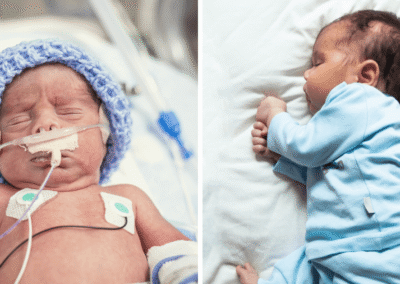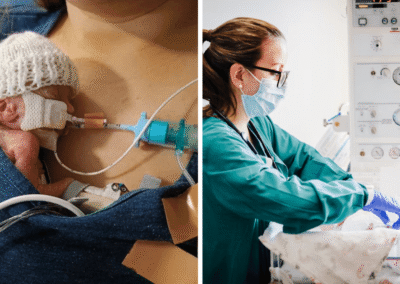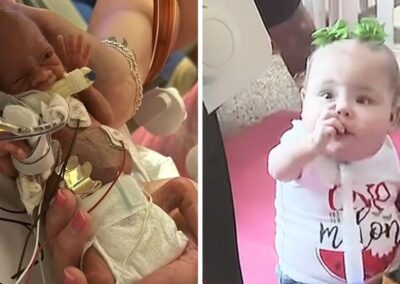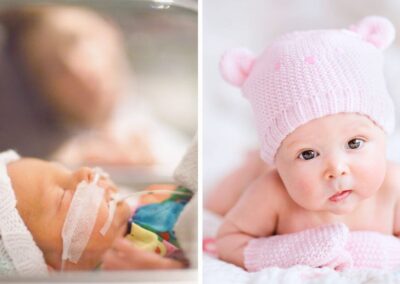




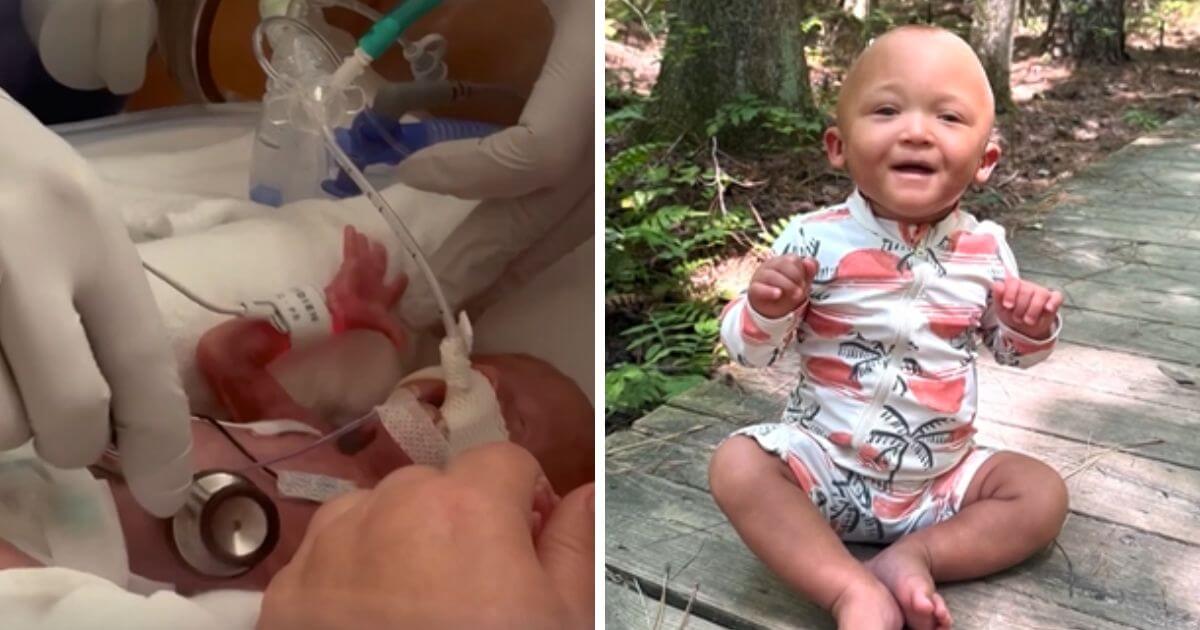
A boy who was given only a 20% chance of survival after being born at 23 weeks has officially graduated from the neonatal intensive care unit (NICU)..
Baby Levi Rice weighed just 1lb when he was delivered by emergency caesarean section after his mum, Mary Arthur, went into premature labour.
When baby Levi was born, he was not in a good way.
“There was no heart rate”, recalled Dr Pankaj Kumar, the neonatologist who treated Levi at delivery. “He was blue, he was limp, he was gasping. He required active resuscitation”.
“We put a breathing tube in, stabilised him and brought him to the NICU”, he explained.
Levi was classified as a micropremmie because of his extremely premature birth. His organs were not yet fully developed, and he faced a series of life-threatening complications during more than six months in the neonatal intensive care unit.
He required breathing support, underwent operations for a hernia and problems with his eyes, and suffered brain bleeds. At one stage, his heart stopped.
“When you walk in that room and you see your child flatline, and you hear that noise, and you don’t see a dry eye in there, but they steadily worked and they worked on him”, his dad, Lamont Rice, recalled.
Mum Mary remembered the moment the medical team successfully restored his heartbeat.
“I remember them saying that we have a heartbeat, and he hasn’t lost it since”, she recounted.
Levi’s mother described the distress of seeing him for the first time after his birth.
“They brought him by and I just lost it, because I knew it wasn’t good from what I could see”, she recalled. “You see your baby in a bag and a little one-pound baby with a tube in his mouth”.
“You couldn’t see anything, but his little head”, she continued. “And the doctor had told me that the first 24 hours were going to be critical, but they were gonna do everything they could to save him”.
Celebrating every milestone
During his lengthy hospital stay, the team that cared for baby Levi celebrated each stage of his progress, from his earliest movements and expressions to the first time his parents were able to hold him.
“We celebrated every little milestone”, Dr Kumar reflected. “You know, the first touch, the first holding of the baby, first cry, first smile, first opening of the eyes. You know, skin-to-skin care. It was truly amazing”.
Nurse Howard Barasi, who cared for baby Levi in hospital, developed such a close relationship with Levi and his parents that they began referring to him as “Uncle Howie”.
“They started calling me Uncle Howie, because of everything I did with baby Levi’s care, and that means so much to me”, he remarked.
After spending more than six months in intensive care, Levi was well enough to leave hospital and return home.
Now aged two, he has continued to thrive and has exceeded expectations for his development. He no longer needs to return for appointments.
“He’s just a strong little guy”, mum Mary observed.
The family’s therapist said Levi could probably start nursery early.“And I was like, ‘Well, hold on, wait a minute’”, his mum said.
Levi has gained 27lb since his earliest days in hospital.
His caregivers said that watching him grow into a healthy and energetic toddler had been particularly meaningful because neonatal staff do not always have the opportunity to see the children they treated after they leave hospital.
“I was not just a nurse with baby Levi, but you know, I’m also part of his family and his support system,” nurse Howard Barasi explained.
“We don’t usually get to see when they’re grown and healthy and thriving and meeting all these milestones,” nurse MacKenzie Babson reflected. “So it’s really, really special to see that he’s a crazy little boy, and he’s perfectly well.”
Spokesperson for Right To Life UK, Catherine Robinson, said “Baby Levi’s extraordinary progress, from being born at just 23 weeks and given a 20% chance of survival to thriving at the age of two, demonstrates the remarkable resilience of premature babies”.
“His story also shows the difference that skilled neonatal care and a dedicated medical team can make. Every child, however small and vulnerable, deserves to be cared for and given every opportunity to thrive”.