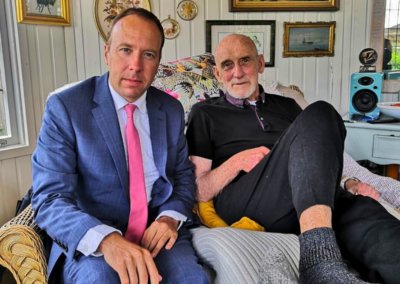





Disgraced former Health Secretary, Matt Hancock, has continued in his support for assisted suicide by giving a speech in its favour earlier this week in Parliament to MPs, to much public criticism.
After a large number of MPs spoke in opposition to assisted suicide during a debate prompted by an e-petition on the matter, the former Health Secretary said that the suicide rate among those who were terminally ill was “double the suicide rate in the rest of the population”.
He then went on to argue that the state should facilitate the suicide of a proportion of the population by making assisted suicide legal.
Hancock’s speech was greeted with mockery and scorn on X (formerly Twitter) with one user saying “The State, and especially people like you, should play no part in deciding when people die”.
In an apparent reference to Hancock’s role as Health Secretary during the COVID-era, one user said “Assisting people’s deaths is an area you have much experience in”.
Another added “You’ve proven clearly that the state cannot be trusted with this. I used to think it should be legal but then you lot were given an inch and took a million miles”.
One user also referenced the experiences of other jurisdictions in which assisted suicide and/or euthanasia has been made legal saying “Such a slippery slope from this … to Canada. Or the Netherlands, where doctors admit to euthanizing infants without even informing the parents, let alone obtaining consent”.
Large number of MPs speak in opposition to assisted suicide
MPs opposed to a future change in the law on assisted suicide emphasised the manner in which the eligibility criteria for assisted suicide in other jurisdictions has rapidly expanded, the risks this legislation imposes on the most vulnerable, and the distortion of the doctor-patient relationship created by assisted suicide, among other concerns.
A number of MPs discussed the likely expansion of a possible assisted suicide law as has happened in other jurisdictions such as Canada, the Netherlands and Belgium, where child euthanasia is now legal.
Pointing to the experience of Canada in particular, DUP MP Ian Paisley said “It was said in 2016 that its legislation would have a very narrow scope, but that narrow scope has turned into discussions about disability, sick children and chronic mental illness. Those are all now within the purview of the Canadian law, but of course they were never supposed to be”.
Fellow DUP MP, Carla Lockhart added that “the consequences of introducing assisted suicide are not a matter for speculation. The practice has been implemented in other countries not unlike ours, and when assisted suicide is permitted, it is a slippery slope”.
“Whenever assisted suicide has been legalised, however tight the initial safeguards and however sincere the assurances that it will be a narrowly defined law for rare cases, the practice has rapidly expanded”.
Conservative MP Nick Fletcher described the idea that assisted suicide could be tightly controlled once made legal as “naive”.
An increase in suicides
Sir Peter Bottomley MP and Danny Kruger MP both emphasised that assisted suicide is suicide and that making it legal will lead to a general increase in suicides.
Sir Peter said “There are about 5,000 to 6,000 suicides a year in this country. Do people think we are talking about 100 people a year extra or 1,000? I put it to the people here that if we had a Dutch level of medical assistance in death, we would add 15,000 deaths a year—we would treble the number of existing suicides and, including the existing figure, take it up to four times”.
Danny Kruger said that in countries in which assisted suicide is made legal, suicide goes up among the general population. “The fact is that suicide is contagious”, he said.
“Suicides among people who would not be eligible for assisted suicide increase in countries that have legalised it. I am afraid that is understandable when we consider that the Government have told society that some people would be better off dead. We have policies in this country to prevent suicide—we want to stop people committing suicide. It is important that we recognise the potential implication of a change in the law for others”.
While there is an assisted suicide bill under discussion in the Scottish Parliament at this time, there is no similar legislation for England and Wales.
Spokesperson for Right To Life UK, Catherine Robinson, said “Matt Hancock is championing a policy that has proven disastrous in Canada, the Netherlands and every other country that has implemented assisted suicide. The sick and vulnerable must receive the care that they need to live, not die”.
“It is encouraging to see such a large number of MPs speaking out in opposition to assisted suicide”.
“The debate on assisted suicide appears to be a policy area in which there is a genuine debate and sincere change of mind. Labour’s Shadow Minister for Disabilities, Vicky Foxcroft, who voted in favour of assisted suicide in 2015, has since changed her mind and now opposes the practice due to concerns raised by people with disabilities who fear they will be adversely affected by a change in legislation”.
“This particular debate is largely symbolic but is an opportunity for MPs and the public to learn from the mistakes of other jurisdictions such as Canada, where safeguards are rapidly being eroded including the removal of the requirement that a person be terminally ill to be eligible for an ‘assisted death’ and the planned expansion of ‘assisted dying’ on the grounds of mental illness alone from 2027”.
“Furthermore, the recent case of a Dutch woman who was granted and planned her own death due to her mental health struggles is a real wake-up call to our legislators who should recognise how assisted suicide legislation can become a form of state-approved death in response to despair”.
“Every debate on assisted suicide is a chance to show where this legislation almost inevitably leads. Instead of assistance in death, people experiencing suicidal ideation need comfort, support and love to alleviate the suffering as far as possible, not the offer of death”.