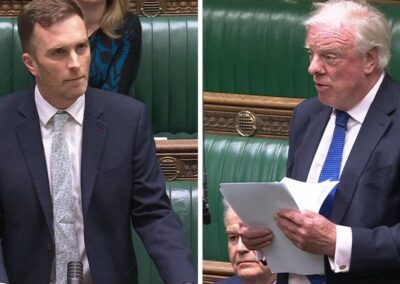





91% of the 28,000 respondents to a recent poll run by The Telegraph said were opposed to the extreme abortion up to birth law change that was recently voted through by MPs in the House of Commons.
The extreme abortion amendment, tabled by Tonia Antoniazzi MP, was passed by MPs by a vote of 379 to 137.
This amendment, if it remains in the Crime and Policing Bill and if the Bill receives Royal Assent, will change the law so it will no longer be illegal for women to perform their own abortions for any reason, including sex-selective purposes, and at any point up to and during birth, likely leading to a significant increase in the number of women performing dangerous late-term abortions at home.
“This law has legalised murder”
A Telegraph reader, Rosemary Wells, commented that the law had “legalised murder”, writing “A baby at full term or even six weeks before birth is capable of living outside the womb and is completely sentient. They’re conscious and able to feel pain. This law has legalised murder. This is legalising the destruction of anyone who is inconvenient and unwanted”.
Another reader, Giles Darling, wrote “Imagine how many people alive today could have been legally terminated if this abortion-up-until-birth policy had been the law in the past? A child with a congenital condition or an unwanted genetic trait could miss their chance to be an impactful future scientist or entrepreneur”.
Bernie Carolan, who contacted his MP about the vote, wrote “I asked her to vote no, as medical professionals have publicly raised grave concerns about the procedures involved in late-term abortions. These are not abstract debates – it’s a matter of life and human dignity”.
Pro-choice readers blast “disgraceful” amendment
Even pro-choice readers shared their displeasure at the extreme amendment. Sheridan Cooper wrote “There is no need for this. I’m pro-choice, but the cut-off point is there for a reason,” whilst Nicola Bradley, who also said “I am pro-choice”, described the law change as “disgraceful”.
There has been a large backlash after Tonia Antoniazzi MP said in an interview that she was comfortable with women being able to abort a viable baby at 37 weeks.
These changes are not backed by the general public nor by women in particular. Polling shows that 89% of the general population and 91% of women agree that gender-selective abortion should be explicitly banned by the law – and only 1% of women support introducing abortion up to birth.
Dismay at “rushed” debate
A significant number of MPs from both sides of the abortion debate shared The Telegraph readers’ disappointment, reacting with dismay after the Government’s Crime and Policing Bill was hijacked to rush through a seismic and unpopular change to abortion law after just two hours’ debate.
Referring to the brief time allocated to the debate, Conservative Leader Kemi Badenoch said “It was rushed, with just two hours of debate that ignored many fundamental issues. It will lead to dire outcomes for many women and babies, especially vulnerable women who are at risk of coercion”.
Conservative MP Ben Obese-Jecty also mentioned the length of the debate, saying “I voted no. I am pro-choice, but can scarcely believe that after just 46 rushed minutes of backbench debate in which only 13 MPs gave speeches, Parliament voted to decriminalise abortions of healthy babies up to full-term”.
Conservative MP Julia Lopez expressed her concerns about the vote, saying “I am deeply disturbed by last night’s debate and vote to decriminalise abortion. The biggest change to abortion law in fifty years passes the Commons after a two-hour debate. It is a profound change that leaves the unborn child and women themselves extraordinarily vulnerable. I worry intensely about the unintended consequences of this”.
“Many vulnerable women and third-trimester babies will be harmed”
Supporters of NC1 claim that time limits would remain. However, the explanatory note to NC1 itself explicitly states that it would apply “at any gestation”. By amending the abortion law in this way, self-administered abortions would, de facto, become possible up to birth as women could mislead abortion providers about their gestational age. For example, as in the case of Carla Foster, who pretended to be 7 weeks pregnant but took pills at 32-34 weeks gestation, rendering time limits redundant for women performing their own abortions. In such circumstances, neither the woman nor the abortion provider, who does not need to verify gestational age via an in-person appointment because of the pills by post scheme, could be held accountable for a late-term abortion that occurred between our current 24-week time limit and birth.
NC1 does not outline any circumstances in which it would continue to be an offence for a woman to perform her own abortion, and would not exclude sex-selective abortions.
Rebecca Paul MP warned of the consequences of the decision, saying “I’m devastated by the decision taken by Parliament this evening. I truly hope I’m wrong on this, because if I’m not, many vulnerable women and third-trimester babies will be harmed”.
Pro-abortion MPs out of step with public
Criticising the amendment, philosopher Kathleen Stock argued that “[t]here is no good case for full decriminalisation as voted for today”, and warned the decision would “undermine public trust in lawmakers”. Stock also queried “How could this have been decided so quickly without any proper consultation or discussion of a wide range of views? Why wasn’t it in the manifesto, if it is so important?”
Lord Alton of Liverpool said “This hasty change will have profound implications for the way that longstanding law in this country will operate. We know that there are potential real risks for the safety of women in particular who will be encouraged towards DIY abortions. I expect that colleagues in the House of Lords will wish to scrutinise its provisions very closely and to amend it as necessary to make it safe”.
Spokesperson for Right To Life UK, Catherine Robinson, said “Telegraph readers are showing that pro-abortion MPs who supported this extreme abortion amendment are desperately out of step with the public. Similarly, polling published last year found that there is very little public support for decriminalisation beyond 24 weeks, with only 16% of the general population supporting such a change, and a majority opposed”.
“This sickening amendment is inhumane and reckless, leaving many vulnerable women and babies at great risk, even those who are pro-choice call it ‘disgraceful’”.
“We will be fighting this amendment at every stage in the Lords”.