



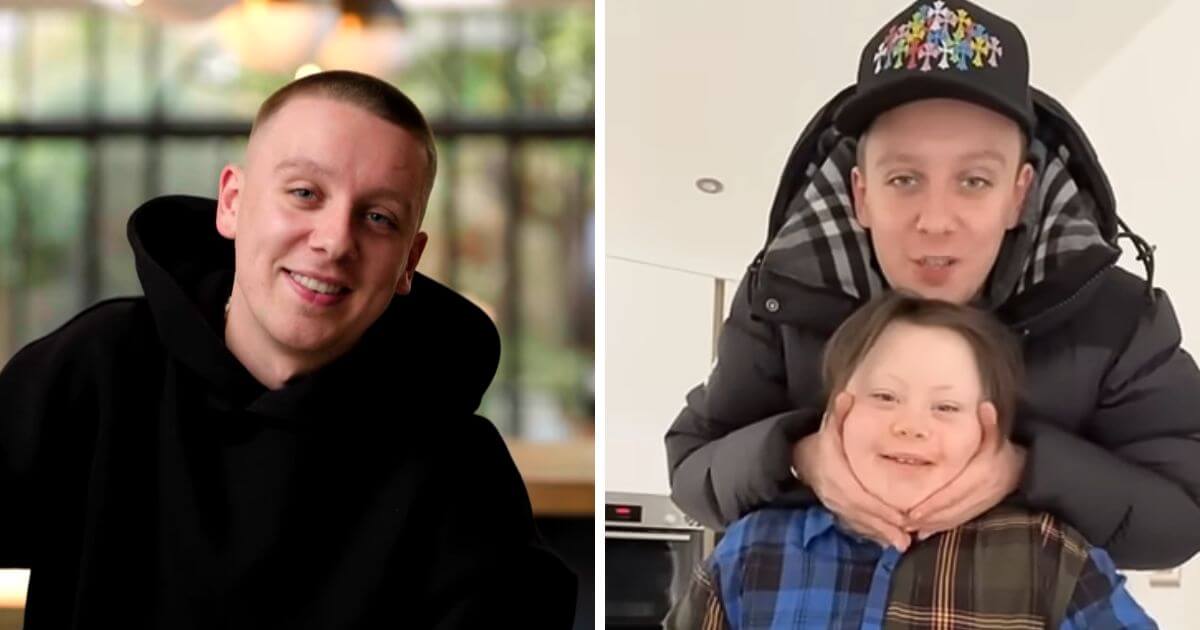
I’m A Celebrity contestant and Manchester rapper Aitch revealed he went on the show to raise awareness about people with Down’s syndrome and has publicly lamented the fact that under UK law, it is possible to have an abortion up to birth in cases where the unborn baby is diagnosed with the condition.
Aitch, 25, whose real name is Harrison James Armstrong and who has a 13-year-old sister, Gracie, who has Down’s syndrome, lamented the abortion law in the UK ahead of his appearance on the ITV show, saying, “I’ve just learned certain things over the years that make me a bit sad. In terms of you can be a day before giving birth, and if you find out your child’s got Down Syndrome, you can still have the option to terminate it”.
“Whereas in another situation, if your kid doesn’t have that, you’ve only got a certain amount of time before you can abort”.
Aitch, who is an ambassador for the Down’s Syndrome Association, also highlighted his close relationship with Gracie, describing her as “the most perfect girl I’ve ever met” and saying “’I wouldn’t even be half the person I am if she wasn’t here”.
Ahead of appearing on the show, he told the Daily Mail “I don’t want anyone to be like disheartened or feel s*** if they do find out someone in the family’s got Down Syndrome. It’s a blessing”.
“You’re going to have the best time of your life as long as you’re spending it with that person”.
“My main thing, really and truly, is because I don’t want Down Syndrome to be seen as a negative thing”.
“I don’t want anyone to go like, oh yeah, my kid’s got Down Syndrome, or my sister’s got Down Syndrome”.
“And anyone to have the reply of, ‘Oh, I’m sorry to hear that’ because it’s just definitely not the case. They’re the best people in the world”.
Since appearing on the show, another contestant said the most “touching part of the day” was when Aitch showed him his family photo of his twin sisters, Gracie and Hattie, and footage has been aired of him becoming emotional over a picture of his sister.
Under the Abortion Act 1967, the current abortion limit is 24 weeks, but for cases in which a baby is diagnosed with a disability, including Down’s syndrome, abortion is currently available up to birth.
“Discriminatory” abortion law criticised
The Down’s syndrome advocacy group ‘Don’t Screen Us Out’ called the abortion law “discriminatory”, whilst Sandra Parda of the Life Institute said “Aitch is right that the current UK abortion law allowing for abortions up to birth in the case of a disability is very sad, it is also very inspiring that he is actively raising awareness about Down Syndrome so we can see just how flawed this law really is”.
The annual abortion statistics for 2022, the most recent year for which abortion statistics for England and Wales are available, released by the Department of Health and Social Care, reveal there were 799 abortions where a baby had Down’s syndrome in England and Wales in 2022, a 17% increase from 2019 when there were 685.
The statistics also show there were 19 late-term abortions at 24 weeks gestation or over where the baby had Down’s syndrome for residents of England and Wales, a 58% increase on 2019 whenthere were 12.
Responding to the statistics, spokesperson for the Don’t Screen Us Out campaign, Lynn Murray, said “It is deeply concerning that despite the leaps that advocacy groups have made in raising awareness in support of people with Down’s syndrome, abortion in the case of Down’s syndrome is still so commonplace and widespread in the UK”.
Building momentum to stop abortion up to birth for Down’s syndrome
In recent years, there have been a number of high-profile interventions to stop abortion up to birth for babies with Down’s syndrome. Ahead of the 2024 General Election, Sir Liam Fox MP tabled an amendment to the Criminal Justice Bill that was signed by over 76 MPs to stop abortion up to birth for babies with Down’s syndrome.
Speaking of the amendment, Fox said “There is considerable cross-party support to remove an anomaly in UK law which allows those with Down’s syndrome to be aborted up until 40 weeks. Many of us believe this is utterly against the purpose of our equality legislation and treats those with Down’s syndrome as second-class citizens when it comes to their rights”.
Although the amendment was not voted on, it has helped build further momentum for change to stop abortion up to birth for Down’s syndrome.
Fox’s amendment reflected a growing momentum for a change in the law in this area after Heidi Crowter, a 30-year-old woman from Coventry who has Down’s syndrome, took a landmark case against the UK Government over the disability clause in the current law. Her case has been heard in the High Court and Court of Appeal.
Spokesperson for Right To Life UK, Catherine Robinson, said “Aitch is right to highlight the discriminatory mistreatment of people with Down’s syndrome under our abortion law, and it is encouraging that he is using his high-profile to remind others of the humanity of people with this condition”.