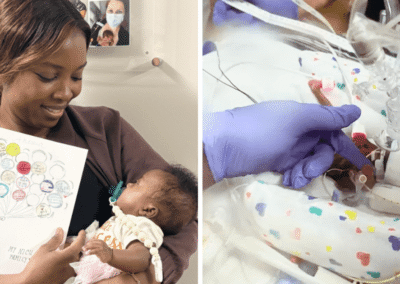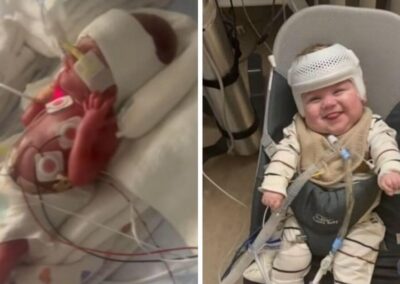





A tiny baby boy, who was born at only 25 weeks, weighing only one pound, four ounces, has gone home from hospital after almost 120 days.
Baby Sway, who was born to parents Candis and Carlton Smith, arrived via an emergency Caesarean section in June, despite not being due until October.
“Nobody wants to have a baby and not take your baby home”, Sway’s mother, Candis, said, “so it was hard to kinda leave from here and leave my baby behind”. Now, however, baby Sway has finally gone home.
“I’m probably gonna cry,” Candis continued, “‘cause I’m just happy we made it. We did this. And in the beginning I said it was going to be a wave that we had to ride, and we were gonna ride it until we couldn’t ride it no more”.
Speaking on what the immediate future holds for the family, Candis said, “The plan is just to hold him and make sure he is happy”.
When the family was finally leaving the neonatal intensive care unit (NICU), friends and family lined up outside, along with the nurses who cared for baby Sway, to blow bubbles in celebration of the milestone.
Brandy Garris, the nurse manager at the NICU where baby Sway was staying, said, “The whole goal all along is to get them home, and so to be able to go through this hard journey with them and see that they’re able to go home with their family – it makes us proud”.
Improved survival rates for extremely premature babies
The survival rates for extremely premature babies like Sway have significantly improved in recent decades. A 2008 study looking at survival rates for a neonatal intensive care unit in London found that neonatal survival rates at 22 and 23 weeks gestation had improved over time. In 1981-85, no babies who were born at these gestational ages survived to discharge. However, by 1986-90, 19% did and this increased to 54% in the period 1996-2000.
In the decade to 2019 alone, the survival rate for extremely premature babies born at 23 weeks doubled, prompting new guidance from the British Association of Perinatal Medicine (BAPM) that enables doctors to intervene to save premature babies from 22 weeks gestation. The previous clinical guidance, drafted in 2008, set the standard that babies who were born before 23 weeks gestation should not be resuscitated.
Spokesperson for Right To Life UK, Catherine Robinson, said “It is wonderful to hear this heartwarming story of how baby Sway is such a fighter and made it home after nearly 120 days in the NICU”.
“Babies who are born extremely prematurely have better odds of survival now than ever before, thanks to improvements in care and medical advances”.