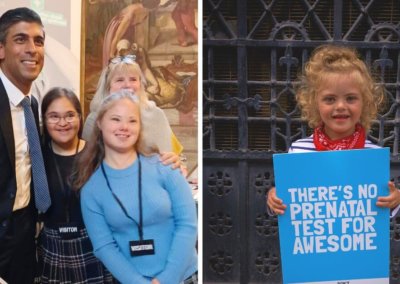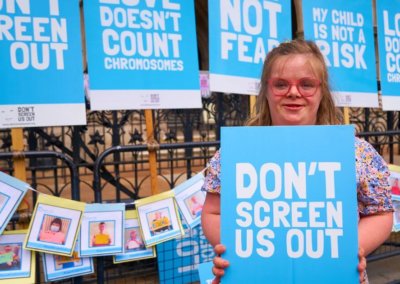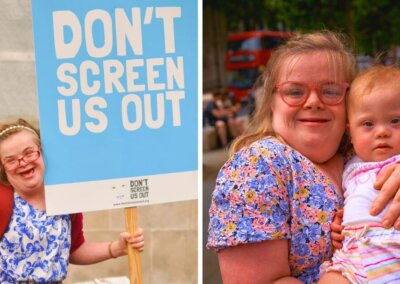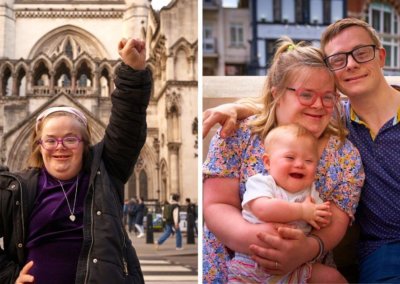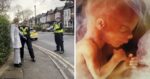




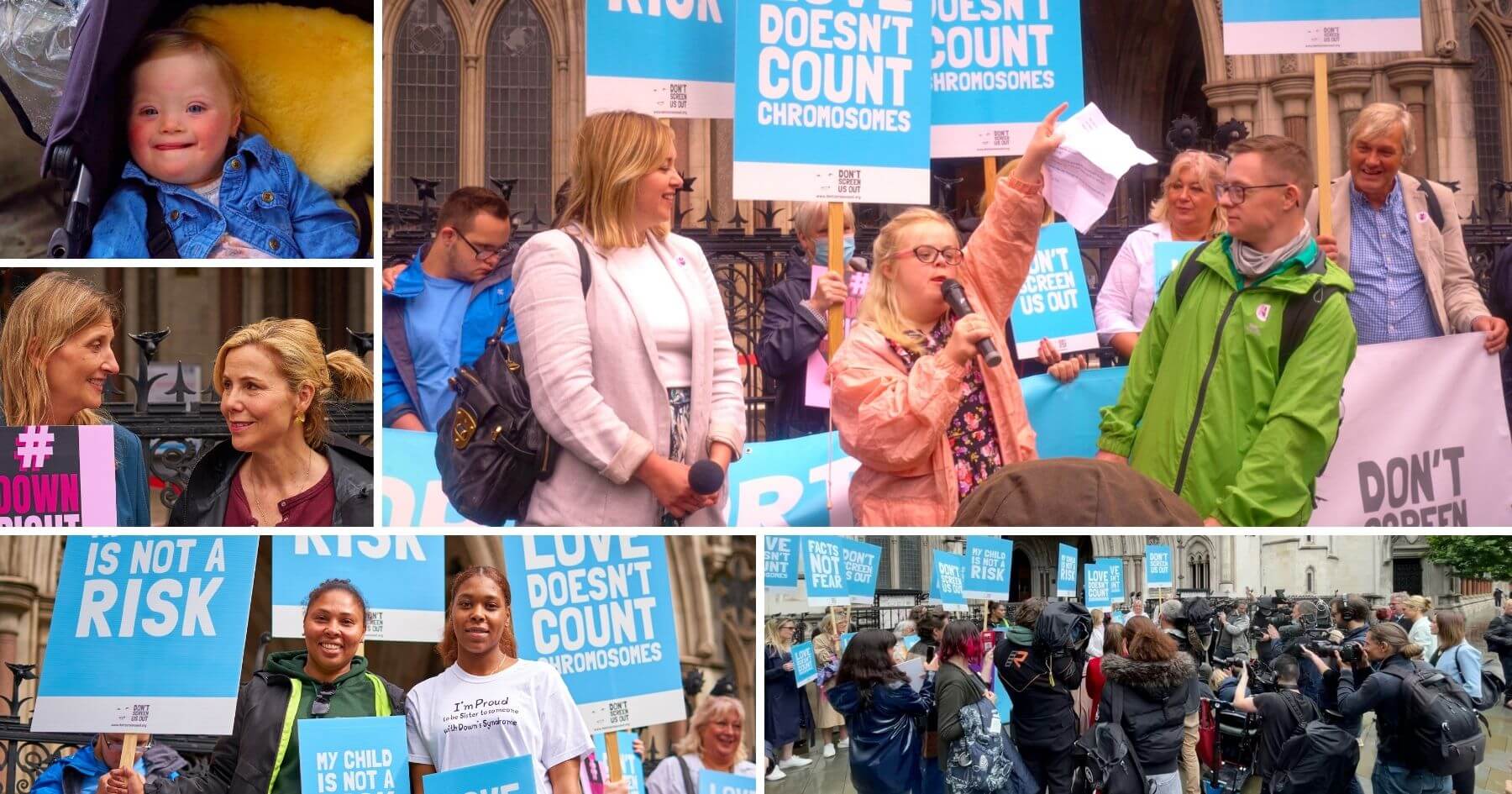
A large group of people with Down’s syndrome and their families rallied outside the High Court yesterday in support of Heidi Crowter and Máire Lea-Wilson as the first day of their court case against against the UK Government over the current discriminatory abortion law that allows abortion up to birth for Down’s syndrome was heard.
Heidi Crowter, a 26-year-old woman from Coventry who has Down’s syndrome, together with Máire Lea-Wilson from Brentford, West London, whose two-year-old son Aidan has Down’s syndrome, are challenging the UK Government over a disability clause in the current law. Máire Lea-Wilson was placed under pressure to have an abortion when a 34-week scan revealed her son had Down’s syndrome.
Heidi and Máire addressed a large rally of supporters who had travelled from around the country, including actress and comedian Sally Phillips.
“This law makes me feel I am better off dead”
Speaking outside the High Court, Heidi Crowter, from Coventry, who has Down’s syndrome said: “Here we are at the High Court to challenge the Downright discrimination that allows abortion up to birth for Down’s syndrome”.
“This law makes me feel I am better off dead, I know I’m not, but that’s how it makes me feel”.
“There is no difference between me and someone who doesn’t have Down’s syndrome, like my nephew. Life is good for people like me and abortion law needs to show that. Everybody is equal, and doctors shouldn’t tell women that they will be sorry if their child is born. They should be supporting them”.
“It makes me sad that this doesn’t happen. My family aren’t sorry I was born, my husband isn’t sorry I was born, and all my friends appreciate me too. We are happy with our lives. And my mum, who is also my agent, here today, realises she was wrong about me when I was born”.
“She thought I wouldn’t get married and I did. A year ago. It’s my anniversary this week. James, my husband, has Down’s syndrome too. He supports me in this case”.
“The judges need to know that we are not suffering and our parents and family don’t suffer. The doctors need to hear this, they need to hear from people like me and learn more about life with Down’s syndrome. My fight for justice and equality has brought us here today to change a law that makes me think I shouldn’t have been born. When the law changes for us then we will have won the fight. Let’s do this”.
“Everyone deserves to be treated equally”
Speaking outside the High Court, Ms Lea-Wilson, 33, an accountant from Brentford, West London and mother to Aidan who has Down’s syndrome said:
“I’ve been very much enjoying spending time with my new best friends Heidi and James today”.
“So my son came into my life two years ago and he is just the most incredible human being and everything that I’m doing now I am doing for him. It is a complete honour and a privilege to be stood being an ally beside Heidi and James and the rest of the Down’s syndrome community today”.
Our case is about equality and that everyone in the whole world deserves to be treated equally regardless of disability, gender, race, religion- and so I really hope that we win today and that we start to pave a path for true equality and acceptance of people with disabilities”.
“We are all equally valued – no exceptions”
Speaking outside the High Court, Lynn Murray, spokesperson for Don’t Screen Us Out and mother of Rachel who has Down’s syndrome, said: “For too long people with Down’s syndrome have been marginalised and excluded from society – but the advent of equality law means that this should no longer the case and these equality ideas should be embedded in every law, including abortion law”.
“Since January 2016, the Don’t Screen Us Out campaign has been working for the right reforms to ensure that the Down’s syndrome Community is brought in from the margins, fully included in society. We’ve been raising awareness with the NHS and the Government of inequalities in pregnancy screening programs and asking for the voice of people with Down’s syndrome to be part of health policy development”.
“And in April 2016, Heidi Crowter joined us in London to protest outside the Houses of Parliament at the Don’t Screen Us Out demo. Heidi addressed the crowd that day making the point to the crowd and to the Health Minister that we are all equally valued – no exceptions. And she hasn’t stopped saying it since to anyone that will listen! And lots of people have been listening”.
“Now Heidi’s an advocate of international stature and millions of people are hearing her voice and her message. And if the Health Minister wasn’t going to listen when she spoke nicely then she was going to take the fight for equality all the way. And she has!”
“Many people thought that the law needed to be changed but Heidi is the one who’s taken up the fight. Heidi has led and inspired many people and she has done it in her own inimitable way, charming those she meets along the way, especially when she tells people that she has a most amazing memory for remembering birthdays. Try it, test her, we haven’t seen her being beat yet!”
Sally Phillips, actress and comedian who attended the rally, and mother to Ollie who has Down’s syndrome previously told the Times: “Given advances in medical care and quality of life for people with Down’s syndrome, the different right to life is beginning to look not just dated but barbaric”.
“Intense pressure to abort”
Currently in England, Wales, and Scotland, there is a general 24-week time limit for abortion, but if the baby has a disability, including Down’s syndrome, cleft lip, and club foot, abortion is legal right up to birth.
Latest figures show that around 90% of babies who are prenatally diagnosed with Down’s syndrome are aborted.
“Offensive and discriminatory”
The UN Committee on the Rights of Persons with Disabilities has consistently criticised countries that provide for abortion on the basis of disability. The Committee on the Rights of Persons with Disabilities’ concluding observations on the initial report of the United Kingdom of Great Britain and Northern Ireland also made a key recommendation that the UK change its abortion law so that it does not single out babies with disabilities.
The Disability Rights Commission (subsumed into the Equality and Human Rights Commission in 2007) has said that this aspect of the Abortion Act “is offensive to many people; it reinforces negative stereotypes of disability…[and] is incompatible with valuing disability and non-disability equally”.
A 2013 Parliamentary Inquiry into Abortion for Disability also found the vast majority of those who gave evidence believed allowing abortion up to birth on the grounds of disability is discriminatory, contrary to the spirit of the Equality Act 2010, and that it affects wider public attitudes towards discrimination. The Inquiry recommended Parliament reviews the question of allowing abortion on the grounds of disability.
Widespread popular and political support
Last March, the UK Government introduced new abortion regulations to Northern Ireland. The regulations allow abortion up to birth for disabilities including Down’s syndrome, cleft lip, and club foot. 1,875 people with Down’s syndrome and their families signed a letter to Boris Johnson urging him to ensure that selective abortion for Down’s syndrome was not introduced to Northern Ireland.
Polling has shown that the majority of people in England, Wales and Scotland feel that disability should not be a grounds for abortion at all, with only one in three people thinking it is acceptable to ban abortion for gender or race but allow it for disability.
In February this year, Northern Irish MLA Paul Givan introduced the Severe Fetal Impairment Abortion (Amendment) Bill in conjunction with the ‘Don’t Screen Us Out’ Campaign. It has since received a huge level of support with 1,608 people with Down’s syndrome and their families signing an open letter to the Assembly urging them to vote in favour of the bill. Almost 28,500 members of the general public have also signed a petition in support of the Bill, which proposes to amend the aspect of the 2020 Regulations that allows abortion up until birth for babies with disabilities.
Right To Life UK spokesperson, Catherine Robinson, said: “As Heidi and Máire have tragically highlighted, the current law – which allows abortion up to birth for babies with disabilities but does not permit abortion past 24 weeks for babies without disabilities – does tell people with disabilities that they are valued less than people without disabilities”.
“There is simply no place for such abhorrent legal discrimination in 21st-century Britain. We hope the High Court will rule in favour of equality and justice, while also taking into account the majority of the public’s disapproval of the current discriminatory law”.
“It is wonderful to see so many people take the time to rally in support of these two brave and powerful women. I hope that the judges take into account the equality and dignity that people with Down’s syndrome and other disabilities are entitled to, inside or outside the womb”.