




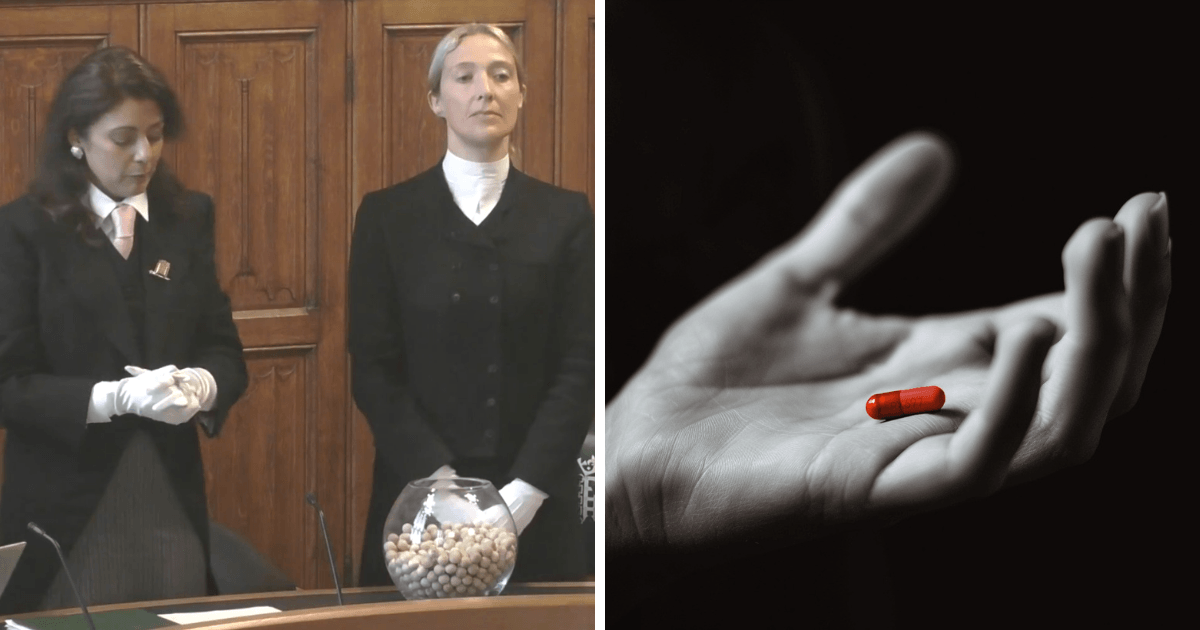
Four MPs who were drawn in the top seven at the House of Commons Private Members’ Bill ballot this morning voted in favour of the assisted suicide Bill in the last parliamentary session, adding weight to fears that the Bill might be brought back.
Private Members’ Bills are bills that can be introduced by MPs who are not Government Ministers. Early in each parliamentary session, a ballot is drawn to decide the names of 20 MPs who can then bring forward a Private Members’ Bill in that session. However, only the first seven ballot bills typically receive sufficient parliamentary time to have the chance to become law.
The top seven MPs in this parliamentary session’s ballot are, in order, Sir Desmond Swayne; Lauren Edwards; Mike Wood; Andrew George; Dr Luke Evans; Sir John Whittingdale; and Jessica Toale.
Of these, Lauren Edwards, Andrew George, Luke Evans and Jessica Toale voted in favour of Kim Leadbeater’s assisted suicide Bill at its Third Reading in the House of Commons, with the remaining MPs voting against it.
Lauren Edwards, commenting after voting in favour of the Bill at Third Reading, said “I believe this Bill is one of the most important, compassionate, and empowering changes to healthcare we’ve seen in a generation”.
Andrew George, writing after the Bill fell in the House of Lords, claimed it showed that “a minority of unelected Peers can deliberately frustrate the will of the democratically elected chamber”, arguing that the entire House of Lords should be converted into “a Citizens’ Assembly, …or a museum”.
According to Lucy McDaid, political correspondent at Sky News, George has said that the assisted suicide Bill is “definitely definitely” on his list of Private Members’ Bills to consider bringing forward.
Assisted suicide campaigners want to force the Bill into law without the House of Lords’ consent
Assisted suicide campaigners have made it clear that they are going to attempt to resurrect Kim Leadbeater’s assisted suicide Bill in the new parliamentary session.
Their plan involves persuading an MP successful in the Private Members’ Bill ballot on 21 May 2026 to bring back the Leadbeater assisted suicide Bill – and then use the Parliament Acts to bypass the House of Lords to force it into law.
Taking the unprecedented route of using the Parliament Acts to bypass House of Lords’ scrutiny of a Private Members’ Bill would be politically explosive and divisive, setting a precedent that may worry many MPs. It would be the first time ever that the Parliament Acts would be used for a Private Members’ Bill.
Assisted suicide campaigners are now likely to focus their efforts on convincing those in favour of assisted suicide who placed highly in the ballot to bring forward an identical version of Kim Leadbeater’s assisted suicide Bill as their Private Members’ Bill of choice.
New polling shows that only 1 in 3 want the Leadbeater assisted suicide Bill brought back
New polling from More in Common has revealed that fewer than one in three (29%) of the general public think that a new assisted suicide bill should be introduced as soon as possible in the same form as the assisted suicide Bill that has failed to become law – as would have to happen should an MP want to use the Parliament Acts to bypass the House of Lords to force the Bill into law.
In contrast, a majority of the public (53%) thought the Bill should either not return or, if it returns, should be introduced with stronger safeguards, which would mean introducing a different Bill, therefore ruling out the use of the Parliament Acts to bypass the Lords.
The polling also found that only 34% of the public polled thought the Lords should not be able to block laws passed by elected MPs if the proposed law was not in the Government’s manifesto.
MPs who supported assisted suicide Bill now oppose it being forced through via the Parliament Acts, suggesting Bill likely to fail if it comes back
Cross-party MPs from the Conservatives, Labour and Liberal Democrat parties who previously voted for the Bill, including former Chancellor of the Exchequer, Conservative MP Sir Jeremy Hunt, have told constituents they oppose it now being forced into law using the Parliament Acts to bypass the House of Lords.
Given that only 12 MPs would need to change their minds should a new Bill be introduced, and any new vote would likely become a referendum on the use of the Parliament Acts as well as on the flawed Bill itself, this strongly suggests any MP picking up the Bill would be defeated.
Former Chancellor of the Exchequer, Conservative MP Sir Jeremy Hunt, who voted for Leadbeater’s assisted suicide Bill at Second and Third Reading, wrote to a constituent opposing the use of the Parliament Acts. He said, “The Bill addresses complex moral issues and bypassing the Lords would likely be challenged so I would not be in favour [of] taking this action”.
Labour MP Deirdre Costigan, who also voted for the assisted suicide Bill at both Second and Third Readings, wrote to a constituent saying, “I do not therefore believe that the Parliament Act should be used if it fails to get through the House of Lords in the required timeframe”.
Liberal Democrat MP for Honiton and Sidmouth, Richard Foord, who voted for the Leadbeater Bill at Second and Third Reading, wrote to a constituent saying, “I do not wish to see the Parliament Acts used to force through this Bill”.
Liberal Democrat MP Will Forster, who voted for assisted suicide at both Second and Third Reading, wrote to a constituent saying, “I do not think the bill can or should be pushed through by using the Parliament Act”.
It is likely that many MPs would not want to bring back a controversial Bill that would cause division and distract from other priorities, while also leading to a backlash from constituents, when it would in all likelihood fail.
This is particularly likely to be the case for Labour MPs, given the current turmoil in the party and when 42% of Labour MPs (160 Labour MPs, including Cabinet Ministers) who voted at Third Reading in 2025 voted against Kim Leadbeater’s Bill. Bringing back the Bill would divide the parliamentary party at the worst possible time for the Labour Party.
Spokesperson for Right To Life UK, Catherine Robinson, said “While it is welcome news that three out of the top seven MPs in the Private Members’ Bill ballot, including the MP in the number one spot, were opposed to the assisted suicide Bill, it gives us pause that the other four voted in favour of Kim Leadbeater’s Bill”.
“Assisted suicide campaigners have made it clear that they want one of these MPs to bring back Leadbeater’s Bill, with the aim of forcing it into law without needing the consent of the House of Lords”.
“The public does not want this, and it is likely that MPs would vote against the Bill too. The past two years have proven just how bitterly divisive the Bill is. It would be much more beneficial for all involved if MPs who were successful in the ballot chose to bring forward a different Private Members’ Bill rather than one on assisted suicide”.