



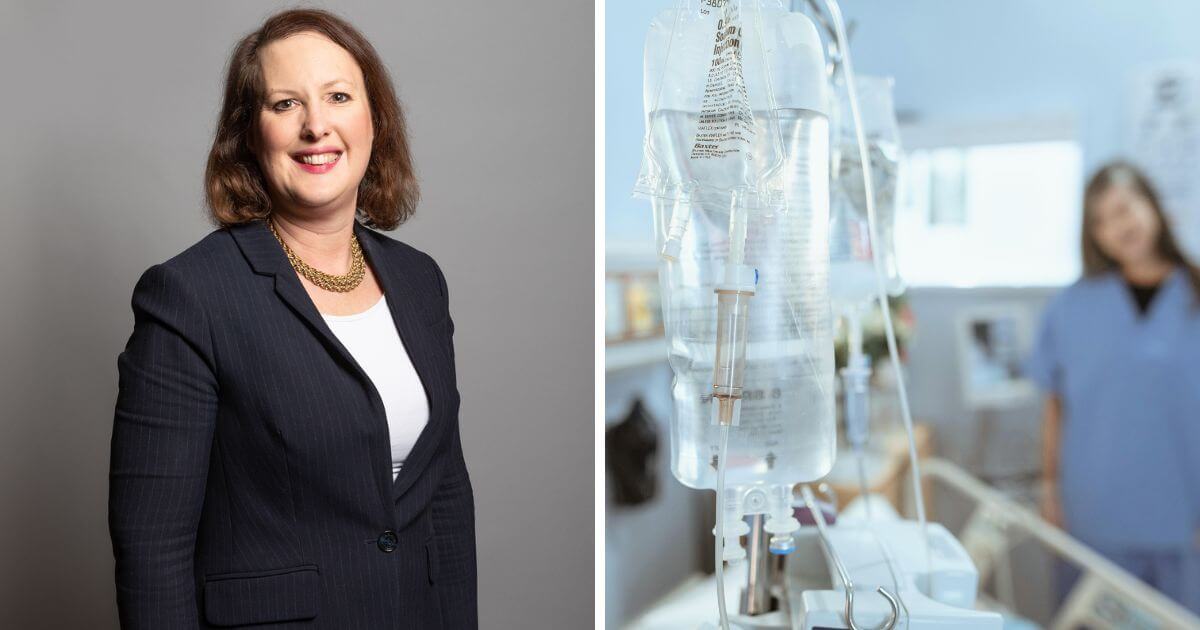
The former Attorney General for England and Wales, Victoria Prentis, who is currently undergoing treatment for cancer, has said that her first-hand experience of radiotherapy has strengthened her views against assisted suicide.
Baroness Prentis, who was also previously a Member of Parliament with tenures as Minister of State for Farming, Fisheries and Food, and Minister of State for Work and Welfare, currently sits as a life Peer in the House of Lords.
Writing for The Independent, Prentis said that her experience of radiotherapy “has made me question how we care for people far more ill than I am”, adding that “the juxtaposition between the mental costs and its all-too-physical toll is what gives me pause about assisted dying”.
On Thursday 21 May, four MPs were drawn in the top seven at the House of Commons Private Members’ Bill ballot who had voted in favour of the assisted suicide Bill in the last parliamentary session. Prentis warned, “Assisted dying campaigners want one of them to reintroduce an identical bill to the one that we have been discussing in parliament recently”.
“I think both sides of the debate accept it is flawed, as do all of the royal colleges that have refused to attest that it is safe”, she said, adding that she is “sure we need a different approach” to alleviating suffering at the end of life.
Royal Colleges have drawn attention to the inadequacies of the assisted suicide Bill
Prentis drew attention to comments made by the Royal College of Psychiatrists and the Royal College of Physicians, who stated that “vulnerable patients (particularly those with remediable mental health or other unmet needs) are not adequately protected by the current bill”.
The Royal Colleges also stated that “the NHS workforce does not currently have the resource required to meet these additional demands” that introducing assisted suicide would bring. Prentis agreed, saying, “We have to understand that introducing assisted dying into an NHS where palliative care is not available to all is not a neutral act”.
“Both my own parents received kind palliative care at the end of their lives, but this was something we had to ask for. I’m seriously concerned that the best service is not available to all”, she stated, adding, “Over 100,000 people die each year without access to specialised end-of-life care, from which they would benefit”.
Prentis continued, “Two-thirds of the public worry that this care will not be there for us when we need it most. This, in my view, is where all our current energy and resources should be focused first – if there is to be choice”.
The former Attorney General remarked that introducing assisted suicide would not provide people with real choice at the end of life, arguing that it would instead push people towards ending their lives in lieu of receiving proper palliative care.
Prentis stated that the health service could also be incentivised to promote assisted suicide to patients over palliative care, saying, “It is as Simon Stevens, former chief executive of the NHS, identified, ‘remarkably cheap’ to introduce assisted dying, while the costs of doing something with palliative care are ‘far greater’”.
Experts agree that assisted suicide should not be introduced while we are in a palliative care crisis
A recent report, published by leading end-of-life charity and provider of hospice care, Marie Curie, highlighted that “nearly one in three people in England die with [an] unmet need for palliative care”.
The report also found that around 170,000 people die each year in England with “both significant levels of unaddressed symptoms and concerns and inadequate access to sufficient care from GP services” – approximately one person every three minutes.
The report also estimates that, in the next 25 years, unmet palliative care needs are expected to rise by 23%, meaning an additional 40,000 people are expected to die with unmet palliative care needs in 2050 compared to 2025.
Professor Katherine Sleeman, the Laing Galazka Chair in Palliative Care at King’s College London, raised concerns about introducing assisted suicide in this context, saying, “Legalisation of assisted death in a context where services are fragmented, and one in three dying people don’t get the care they need, is a huge risk”.
“We risk people choosing assisted dying simply because of lack of high-quality care. That is not what any of us would consider to be a true choice”, she added.
Speaking during the second session of the Terminally Ill Adults (End of Life) Bill select committee in the House of Lords, Professor Mumtaz Patel, President of the Royal College of Physicians, shared her fears that people could choose assisted suicide because of lack of palliative care provision and inequity of services.
“What I really fear is that people are making, sometimes, these choices because of the lack of provision around good palliative care. Going back to the inequity of services, it feels really wrong and a lot of our members and fellows talk about that. Just where the disadvantaged populations are, there is service underprovision and then that inequity and gap is just going to get wider and wider” she said.
Spokesperson for Right To Life UK, Catherine Robinson, said “It is courageous of Baroness Prentis to speak so openly about facing cancer, and using her own experiences to draw attention to the dangers that the public would face if assisted suicide were to be made legal”.
“It is incredibly worrying that we could be in a position where assisted suicide services are fully provided for, but end-of-life care is not being accessed by hundreds of thousands of people each year who desperately need it. It is conceivable that in these circumstances, individuals may choose to end their lives due to unmet end-of-life care needs”.
“Even supporters of assisted suicide should recognise the deeply perverse incentives such a system would create. MPs who placed highly in the Private Members’ Bill ballot should be aware of these dangers and decline to bring forward an assisted suicide Bill”.