



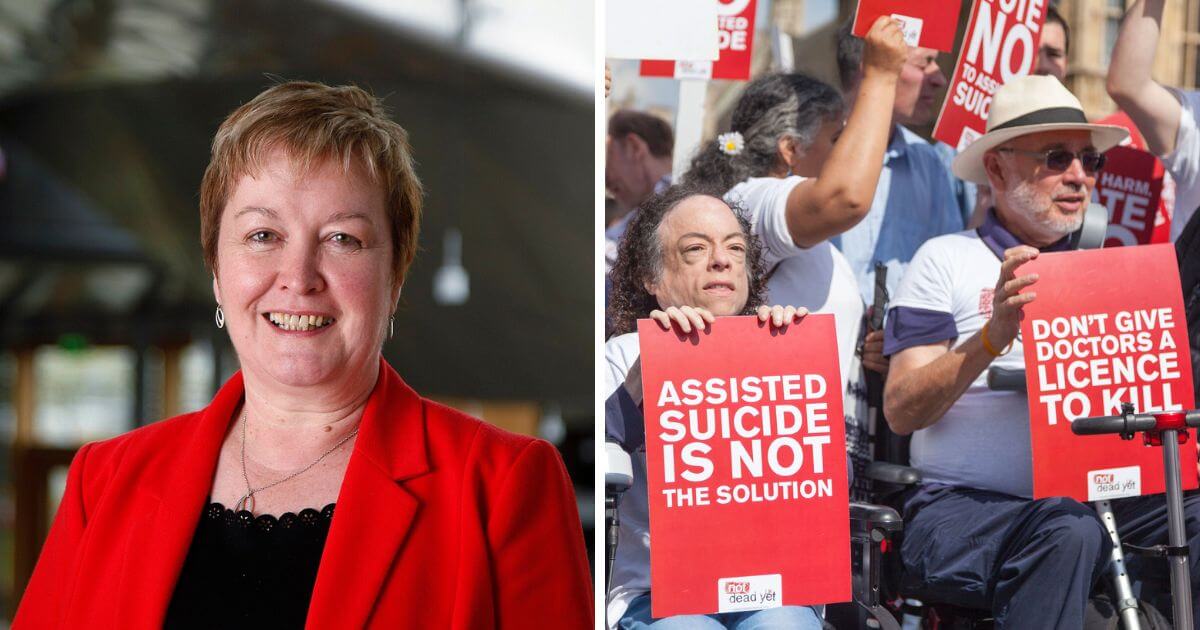
Rhoda Grant, a former Member of the Scottish Parliament (MSP) for the Labour Party, has called for Labour Party MPs to follow the lead of their Scottish colleagues and reject the reintroduced assisted suicide Bill.
The Scottish Bill was defeated in March 2026 by 69 votes to 57, with the Deputy Political Editor of The Scotsman, David Bol, describing the vote as “potentially the biggest decision in the history of the Scottish Parliament”. Now, Rhoda Grant is calling on her Labour Party colleagues in Westminster to follow suit.
In an article for Labour List, Grant explained that she and her Labour Party colleagues in Scotland voted to reject the assisted suicide Bill precisely because of their progressive and left-wing convictions.
The former Labour MSP said that the “Bill risks fuelling tensions within the Labour Party at a particularly sensitive political moment”, adding that the debate in Westminster is caricatured as “compassionate progressives” versus “socially conservative opponents”.
In Scotland, however, Grant said that opposition to the assisted suicide Bill came from Labour values of “solidarity, equality, disability rights, and the protection of vulnerable people”.
Grant argues that the Labour movement was built on the belief that people are not truly free “when crushed by poverty, insecurity, isolation or structural disadvantage”, adding that legalising assisted suicide “risks undermining that principle”.
Choice “does not exist in a vacuum”, she says, explaining that a “choice” made with excellent care is not the same as one made by someone who feels a burden, lacks support, fears loneliness, or thinks their care needs are exhausting their family – all factors that would likely influence people in their decision to end their lives by assisted suicide.
She adds that, in unequal societies, pressure is not always obvious; it is “shaped by economic and cultural pressure rather than overt coercion”, warning that the genuinely progressive answer is not to make death more accessible while leaving suffering unresolved, but to work to reduce suffering through providing better care. “No citizen should ever feel that death is their best option because society failed to provide sufficient care or support”, she said.
As Grant argues, Scotland’s Labour MSPs concluded that assisted suicide sat “uneasily, even irreconcilably, beside the founding values of the welfare state”. She urged MPs in Westminster to follow their lead and support laws that promote “life and hope rather than death and despair”.
Revived assisted suicide Bill on course to be defeated at Second Reading
The revived Leadbeater assisted suicide Bill, introduced to Parliament yesterday by Lauren Edwards MP, appears to be on course to be defeated at Second Reading on Friday 11 September, prompting calls for Edwards to avoid an unnecessary Labour civil war over the Bill and withdraw the divisive Bill before September’s scheduled vote.
Given only 12 MPs would need to change their minds for the Bill to be defeated, and any new vote would likely become a referendum on the use of the Parliament Acts as well as on the flawed Bill itself, this strongly suggests that the Bill is on track to be defeated.
The Parliament Acts 1911 and 1949 provide a rarely-used method of forcing through legislation that has been agreed by the House of Commons without the consent of the House of Lords. Only seven Bills have ever become law under the Parliament Acts, and they have never been used for a Private Members’ Bill – that is, a non-Government Bill – like the assisted suicide Bill. In practice, for the Parliament Acts to be used, it would likely require the Government to adopt the assisted suicide Bill as a Government Bill or to provide time for its passage.
The likely defeat of the Bill has also been predicted by the co-sponsor of the Bill, Peter Bedford, who told a constituent only three weeks ago that he “does not think it will succeed if brought back as a Private Members’ Bill again during this parliamentary session”.
The Times newspaper’s lead article on 17 June similarly described hopes of success for a new Bill as “highly unlikely” and “delusional”, describing the Bill as “shoddy” and “riddled with defects”.
Since MPs last debated the Bill, it has been widely criticised by expert groups at a House of Lords select committee, and Scotland has decisively rejected assisted suicide.
Already, seven MPs from Labour, the Conservatives and Liberal Democrats who had backed the Bill at Third Reading have said they do not support plans to force it into law via the Parliament Acts / bringing back the Bill in this new Parliamentary session (Louise Haigh, Jeremy Hunt, Deidre Costigan, Richard Foord, Alistair Carmichael, Joe Morris and Will Forster).
These seven MPs have been joined by other MPs who have expressed doubts that the Parliament Acts route would be used for the Bill.
These MPs are likely to be the tip of the iceberg and represent views shared by many other MPs.
Spokesperson for Right To Life UK, Catherine Robinson, said “It is heartening to hear Rhoda Grant make the progressive case for rejecting assisted suicide, which her colleagues in Scotland overwhelmingly did in March”.
“Labour MPs should take heed of the advice Grant gives them, and should seek to ameliorate the disunity in the Party by encouraging Lauren Edwards to withdraw her flawed, divisive Bill”.