



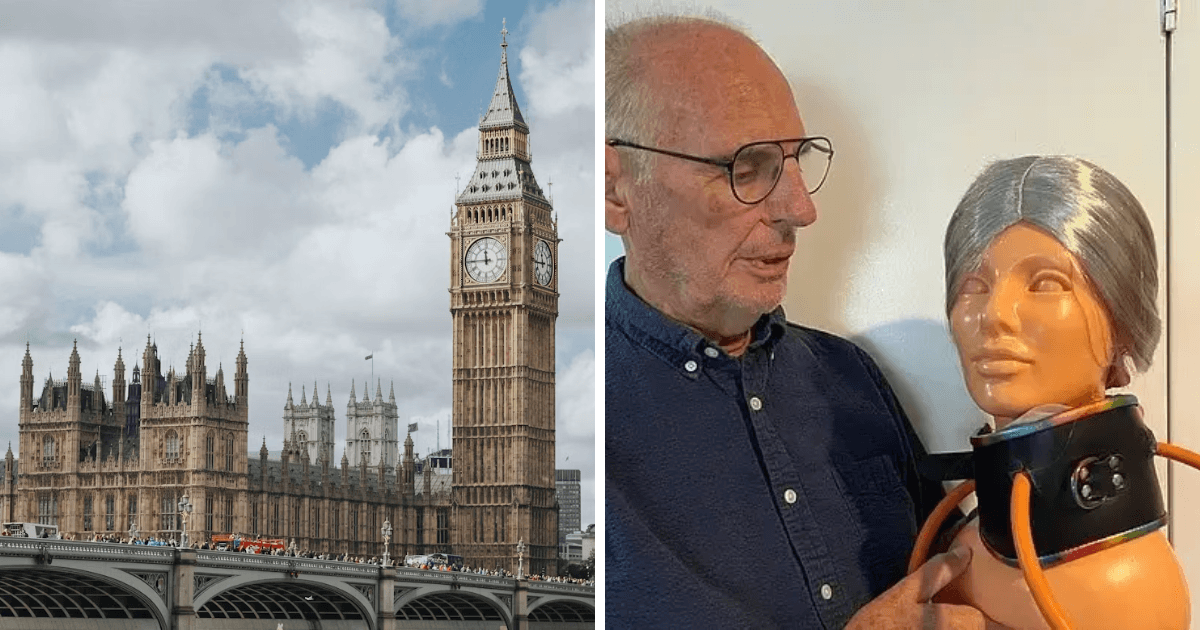
MPs and campaigners have called on the Home Secretary, Shabana Mahmood, to prevent Dr Nitschke from being allowed into the UK to demonstrate his Kairos ‘suicide collar’ device this weekend ahead of the Second Reading vote on the Edwards assisted suicide Bill.
Philip Nitschke, the controversial founder of euthanasia organisation Exit International, nicknamed ‘Dr Death’, plans to bring his ‘suicide collar’ device to London to demonstrate at a booked-out event this Saturday, 5 September – just six days before MPs vote at Second Reading on Lauren Edwards’ revived assisted suicide Bill.
The collar, called “Kairos”, consists of two balloons that exert pressure on the carotid artery, leading first to unconsciousness and then to death.
Earlier this year, Nitschke said that he would conduct the first assisted suicide using the collar on a woman in Switzerland who would be his first “test subject”.
Suicide devices could be legal to use for assisted suicides here if new assisted suicide Bill passes
Labour MP Lauren Edwards has tabled a new assisted suicide Bill that will be voted on by MPs at Second Reading on Friday 11 September. The new Bill is near-identical in form to Kim Leadbeater’s assisted suicide Bill from the previous parliamentary session that failed to become law.
The ‘suicide collar’ is one of a number of suicide devices promoted by Nitschke, which also include the Sarco assisted suicide pod.
Nitschke said that he would look to launch a suicide pod service in the UK had the Leadbeater Bill become law.
Leading legal academics confirmed that the broad wording of Ms Leadbeater’s Bill would make Nitschke’s machine legal in Britain with the Health Secretary’s approval. They predicted that should it not get approval from the Health Secretary, those with swallowing difficulties or needle phobias would likely bring a discrimination challenge under the European Convention on Human Rights (ECHR).
The near-identical new Bill includes the same provision that would make the assisted suicide pods legal in England and Wales.
How the Kairos collar works
Nitschke’s latest project, the Kairos collar, is designed to allow users to end their lives at the press of a button by cutting off blood flow to the brain.
The Kairos collar uses two inflatable balloons that press on key arteries and baroreceptors in the neck, rapidly cutting off blood flow to the brain. The wearer loses consciousness and then dies.
Nitschke has likened the principle to an airbag: you place the collar around the neck, and when the button is pressed, it inflates, blocking the carotid and vertebral arteries, which leads to death.
He has claimed that it is difficult for governments to stop because it can be built at home. This makes it important that he is not allowed to come to the UK to demonstrate his device.
Sir John Hayes CBE MP, former Cabinet Minister and one of Parliament’s longest-serving MPs, said, “It is deeply disturbing that Philip Nitschke wishes to advertise his latest sinister suicide device in this country just days before the nation marks Suicide Prevention Day next Thursday”.
“I am calling on the Home Secretary to urgently review the wisdom of allowing Dr Nitschke into the country for this reason. We should not be promoting suicide”.
“The planned event is also a sobering reminder of how an assisted suicide industry would likely emerge and be promoted should MPs vote next week to change the law in this area”.
Dr Death
Philip Nitschke is an Australian euthanasia campaigner, founder of Exit International, long known for inventing and promoting new suicide methods, from the “exit bag” to gas-based machines, such as the controversial Sarco pod.
He has been nicknamed “Dr Death” and “the Elon Musk of assisted suicide” in the media, and openly markets his inventions as ways to enable people to end their own lives.
Nitschke describes “Voluntary Assisted Dying” as “a fundamental Human Right for ALL rational adults, not just a privilege for the sick”, demonstrating how campaigners would want to expand a UK assisted suicide law if it were initially limited solely to the terminally ill.
He has actively courted publicity for decades and continues to give high-profile interviews about his devices, even after previous controversies and investigations.
A Swiss affiliate linked to his Sarco ‘suicide pod’, The Last Resort, was taken into custody after it was alleged that the first use of the Sarco gas pod in Switzerland did not work and the person was manually strangled to death to complete the death.
The Sarco pod’s failure to work as predicted must cast doubt on Nitschke’s claims that the Kairos collar would lead to a “rapid” and “peaceful” death.
Nitschke has described the Kairos collar in Dutch coverage as a “peaceful and reliable” way to die and has given interviews in European outlets following the Sarco pod incident.
Videos of the team that built the Sarco, and others involved speaking about the suicide device on their website.
Allowing the use of suicide devices is one of many flaws in the Leadbeater Bill that have been retained in the new near-identical Edwards Bill
To enable the use of the Parliament Acts to bypass the House of Lords to force the Bill into law, the Edwards Bill has been brought back in essentially the same form as the Leadbeater Bill that failed to become law, and has retained the same serious flaws in the previous Bill identified by Royal Colleges, professional bodies, and mental health and domestic abuse charities.
This short compilation video provides a snapshot of the breadth of opposition to the previous near idential Bill, including from many groups who are neutral on the principle of assisted suicide.
Groups and experts who have expressed concerns about the dozens of flaws in the Bill or the need for further safeguards to be added include the Royal College of Psychiatrists, the Royal College of GPs, the Royal College of Physicians, the Royal College of Nursing, the Royal College of Pathologists, the Royal Pharmaceutical Society, the Equality and Human Rights Commission, the Children’s Commissioner, the former Chief Coroner, the British Association of Social Workers, the British Geriatrics Society, Hospice UK, Marie Curie, Age UK, the Association for Palliative Medicine, the Mental Health and Disability Law Committee, a coalition of over 350 disability organisations including Disability Rights UK, Not Dead Yet UK and Disabled People Against Cuts, Care England, Mind charity, the National Down Syndrome Policy Group, the Chair in Palliative Care at King’s College London, a Professor of Law and Medical Ethics at Oxford University, Standing Together Against Domestic Abuse, the House of Lords’ Delegated Powers and Regulatory Reform Committee, the Professor of Public Protection at the University of Gloucestershire, more than 1,000 doctors and overseas experts. Since Lauren Edwards’ Bill remains almost identical to the Leadbeater Bill passed at Third Reading, these concerns still apply.
MRP polling shows that in every constituency in Great Britain, a majority of constituents want key safeguards added to the Bill that are missing currently.
The proposed route with the new Bill means that it is not possible for MPs to amend the Bill to fix the suicide device loophole in the Bill
By publishing a near-identical Bill to the much-criticised version that failed in the previous parliamentary session, the Bill’s supporters have made clear their highly controversial intention to use the Parliament Acts to bypass the House of Lords to force the Bill into law should the Lords fail to pass the Bill again.
The ability to use the Parliament Acts not only requires the Bill to be brought back in a near-identical form, but also means that it could not be amended in the House of Commons, making it impossible for MPs to amend the Bill in the House of Commons to fix the dozens of widely publicised and serious flaws in the Bill.
Alisdair Hungerford-Morgan, Chief Executive of Right To Life UK, said, “Just days before MPs vote on Lauren Edwards’ assisted suicide Bill, Philip Nitschke plans to come to the UK to demonstrate his new ‘suicide collar’“.
“We are calling on the Home Secretary to urgently intervene to prevent Nitschke from entering the UK to demonstrate and promote this dangerous device”.
“This is not the first time Nitschke has set his sights on the UK. He previously announced plans to launch a service using his Sarco suicide pod here if the last assisted suicide Bill became law. Leading legal academics confirmed that the broad wording of that Bill would allow the Sarco to be used in Britain if it secured the approval of the Health Secretary”.
“Lauren Edwards’ Bill retains the same provision. It explicitly allows a device to be prepared to enable someone to self-administer a lethal substance, opening the door to Sarco pods being used for assisted suicides here”.
“In its equality impact assessment on the new Bill, the Government has warned that structural pressures such as poverty, inadequate care, neglect and abuse could result in disproportionate numbers of people from ethnic-minority backgrounds opting to end their lives through assisted suicide”.
“Parliament should be focusing on introducing policies that provide care, protection and support for people facing these structural pressures who may feel pressure to end their lives, not passing an assisted suicide Bill that Philip Nitschke has made clear he would seek to use to introduce his suicide devices here in the UK”.
“MPs must reject this dangerous Bill at Second Reading on 11 September”.