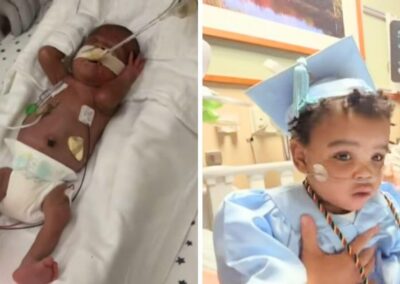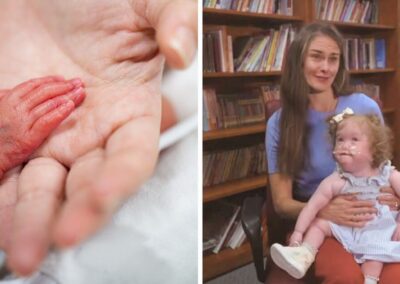




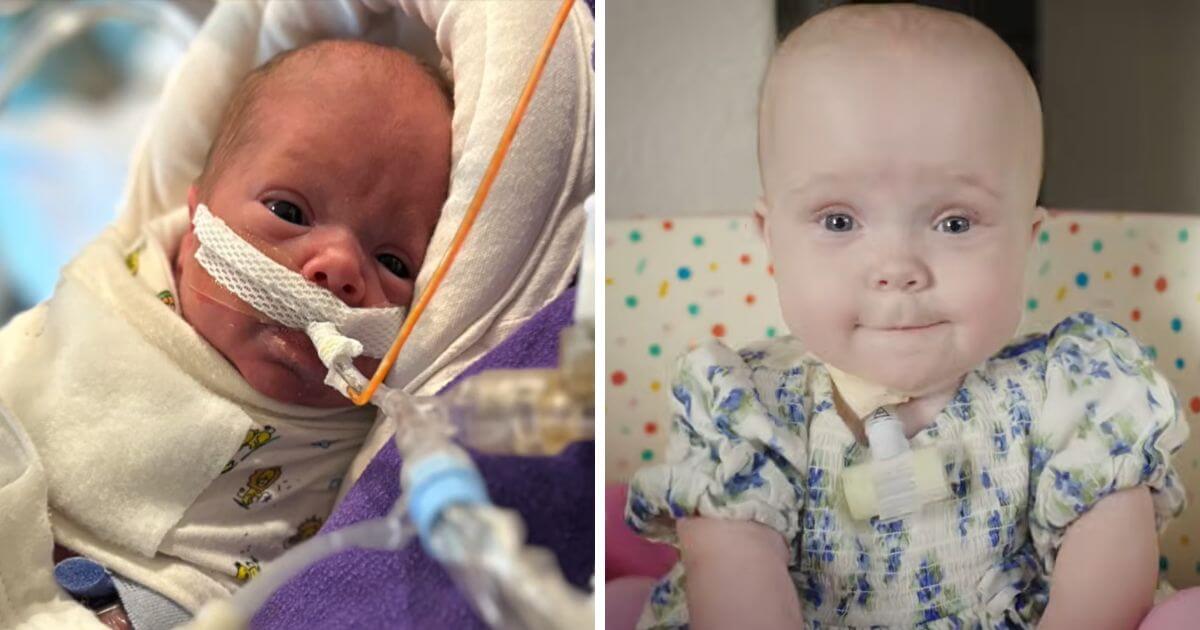
A baby girl born at just 26 weeks gestation and weighing less than 2lbs has defied the odds after surviving multiple life-threatening complications and spending months in intensive care.
Baby Rosemary was born unexpectedly while her family was on holiday. “I went into pre-term labour at 26 weeks and had to have an emergency C-section”, her mother, Brooklynn, recalled. “And Rosemary was here”.
At birth, baby Rosemary weighed just under 2lbs. “You could see through her skin. They said the outcome wasn’t going to be very positive”, Brooklynn remembered. Her father, Jeff, reflected: “She was tiny. And she’d fit in the palm of my hand. But she was actually a beautiful baby”.
As Rosemary’s condition worsened, her parents were told there was little reason for hope. “As the weeks were going on, things just kept declining. I did not see hope for her”, Jeff said.
Brooklynn later received devastating news. She recounted that the medical team “called me and basically said that I needed to come and tell her goodbye because she wasn’t going to make it. So I went and spent the day with her, and, thankfully, she actually got a little bit better”. That improvement made it possible for Rosemary to be transferred to a dedicated children’s hospital.
A tiny baby’s fight for life
When baby Rosemary arrived at the children’s hospital, doctors were faced with an extraordinarily fragile patient. She had a hole in her intestines, a life-threatening infection, and lungs too underdeveloped to function independently. Once they arrived at the children’s hospital, “everything just did a complete turnaround”, Brooklynn said.
Over the following months, baby Rosemary underwent eight or nine surgeries involving her stomach, heart, airways and eyes. “We were here for about eight months”, Brooklynn noted. “It was a very long stay, I spent a lot of nights on one of those couches. It was a lot”.
Even after leaving hospital, baby Rosemary continued to face significant challenges. Rosemary had a tracheostomy, so she breathes through small tube in her neckBrooklynn explained. “There was a lot of things that we had to consider and make changes to when we were going back to our rental”.
During Rosemary’s lengthy stay in hospital, her older siblings were unable to meet her in person because of flu season restrictions. Instead, they saw their baby sister through FaceTime calls, often surrounded by medical equipment. “My son was 6 and he asked if she was a robot”, Brooklynn laughed.
Dr Pamela Griffiths, a neonatologist who cared for baby Rosemary, said caring for babies like her involves supporting both the patient and the family through a long and uncertain journey. “They come to us being very fragile, with severe lung disease, high ventilator settings sometimes, not even sure if they’re going to survive”, she observed. “And then we go through this journey with them, over weeks to months. So being able to be with them through that journey is very rewarding”.
She emphasised that successful outcomes depend on the work of an entire multidisciplinary team, including specialists in neonatology, pulmonology, surgery and cardiology, alongside therapists and social workers.
Today, baby Rosemary is finally home with her family, and she recently celebrated her birthday with her brothers. For Brooklynn, seeing her daughter celebrate milestones once thought impossible remains a source of immense gratitude.
“It’s awesome to see her with her siblings. It’s awesome to see her playing and learning and growing”, she said.
“I almost forget that anything is wrong sometimes, just because she’s so happy, and she makes me so happy. So it’s been really nice to see her grow and know that she’s going to be able to have such a great life”.
Spokesperson for Right To Life UK, Catherine Robinson, said: “Rosemary’s story shows why a grave prognosis should never be treated as a reason to give up on a child. Despite being born extremely prematurely and facing multiple challenges, it is delightful to see that she is now home with her family, growing, learning and enjoying life with her siblings”.