



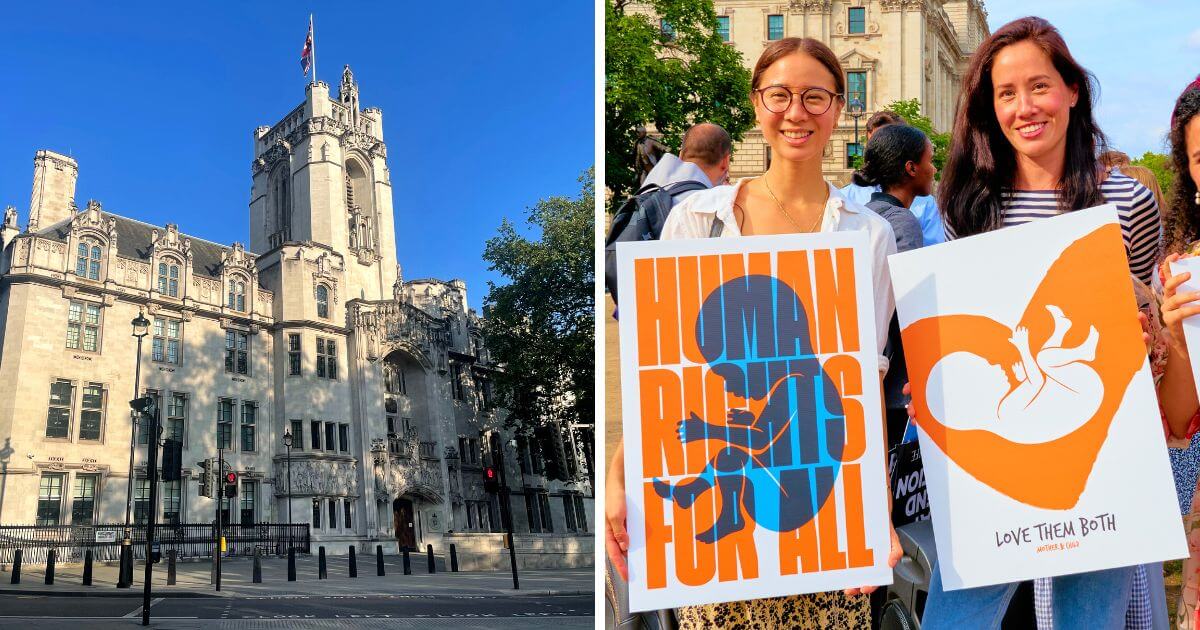
A Bill that criminalises offers of help and alternatives to abortion outside abortion clinics in Northern Ireland does not “disproportionately interfere” with the rights of protesters, the Supreme Court has ruled.
This week, the UK Supreme Court said the abortion censorship zone Bill was lawful. They ruled that the Abortion Services (Safe Access Zones) (Northern Ireland) Bill, which makes it a criminal offence to “influenc[e]… a… person [seeking an abortion], whether directly or indirectly” within “safe access zones”, is “not incompatible” with protesters’ rights under the European Convention of Human Rights (ECHR).
The Bill was introduced by former Green Party MLA, Claire Bailey, who lost her seat in the most recent local elections, and was passed earlier this year. In effect, the Bill will criminalise offers of assistance and prayer within 150m of abortion clinics or hospitals where a censorship zone is in place.
The Bill does not adequately protect the rights of protestors
However, in July, Dame Brenda King challenged the Bill on the grounds that it does not permit a “reasonable excuse” defence.
Counsel for the Attorney General’s office, Tony McGleenan KC, said the Bill did not provide a defence for someone who “did not know and had no reasonable way of knowing a protected person was in a safe access zone”.
Mr McGleenan argued that the current legislation breaches the European Convention on Human Rights (ECHR), specifically in relation to the articles on freedom of religion and expression.
The UK Supreme Court however ruled that the Bill is “not incompatible with the [ECHR] rights of those who seek to express opposition to the provision of abortion”.
Only organisations supporting buffer zones granted permission to intervene
The Court granted permission to the activist group, JUSTICE, to intervene to argue that the Bill was compatible with the ECHR. However, in an unusual move, the legal advocacy group, ADF UK, which was going to argue that the Bill was incompatible with human rights legislation, was denied permission. No reason was given for this decision.
The Judgement made reference to the Royal College of Obstetricians and Gynaecologists’ submission to a 2018 Home Office review into the types of protest that take place outside abortion clinics. The submission paints activity outside abortion clinics in a very negative light, but the Judgement makes no reference to those women who have expressed gratitude that they were offered an alternative to abortion.
With no further legal obstacles, the Bill will be able to proceed and likely come into force next year. The Northern Ireland Bill carries a maximum fine of £500 and gives constables discretion to remove a person from a censorship zone if there are grounds to believe that person “has committed, is committing, or is about to commit an offence under subsection 5(2)”.
Even more draconian legislation currently progressing through UK Parliament
The Abortion Services (Safe Access Zones) (Northern Ireland) Bill in Northern Ireland is more moderate than an amendment to the Public Order Bill, which is currently proceeding through the UK Parliament. The Government has said that this amendment is not compatible with human rights law.
The amendment to the Public Order Bill goes much further than the legislation in Northern Ireland, introducing nationwide buffer zones rather than buffer zones only being introduced around clinics where certain criteria are satisfied, as is the case in Northern Ireland.
The amendment to the Public Order Bill also includes a number of additional offences under which an individual can be charged that are not included in the Northern Ireland legislation.
The Northern Ireland legislation includes a maximum fine of £500, whereas the amendment before the UK Parliament, if passed, would see a person found guilty of “interfering” with a woman’s decision to have an abortion sentenced to up to 6 months in prison and/or an unlimited fine. Further instances could lead to up to two years in prison and/or an unlimited fine.
The Northern Ireland Bill also gives constables discretion to take remedial measures to direct a person to leave or remove a person from a safe access zone where there are reasonable grounds to believe that person “has committed, is committing, or is about to commit an offence under subsection 5(2)”. It is only when a person does not comply with such a direction or resists removal that they commit an offence (clause 6). The amendment before the UK Parliament does not contain similar provisions.
Under the Northern Ireland Bill, the Department of Health is required to maintain a list of all protected premises and publish that list (clause 7), and the Department of Health must publish an annual report. In contrast, clause 9 of the Public Order Bill does not have the same recordkeeping or accountability requirements.
The judgement made no reference to women who have been helped by pro-life vigils
Speaking earlier this year, Alina Dulgheriu, who was herself scheduled to have an abortion but decided to not go ahead with it after receiving help from pro-life volunteers outside an abortion clinic in London, said:
“The day that I turned up to my abortion appointment, a volunteer outside the clinic gave me a leaflet. It offered the help that I had been searching for. I weighed up the two options I had before me, and I chose motherhood. I chose to accept help to get housing, help to find a job and help to obtain a pram, a cot and nappies. It wasn’t easy. But with the support of the group who had given me that leaflet, I couldn’t be prouder of the life my daughter and I have charted out together”.
Right To Life UK spokesperson Catherine Robinson said “Hundreds of women have been helped outside abortion clinics by pro-life volunteers who have provided them with practical support, which made it clear to them that they had another option other than going through with the abortion. The NI censorship zone Bill will deny women that option in the future.”