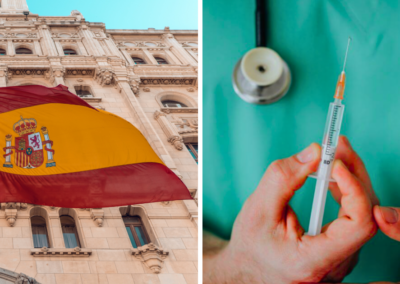





The Spanish Supreme Court has confirmed a ruling from a lower court that found a leading abortion provider in Spain guilty of misleading advertising in its claims that abortion is a practice that does not carry risk.
The Provincial Court in Oviedo had initially ruled that ACAI, a large abortion provider, was guilty of misleading advertising for claiming that abortion is a practice that does not carry any risk.
According to the Spanish legal firm, Abogados Cristianos, ACAI encompasses most of the abortion clinics across Spain.
The president of Abogados Cristianos, Polonia Castellanos, said: “[G]iven the seriousness of the sentence, we will send it to all the ministries of Health of Spain to terminate any contract with the abortion centres involved”.
“We must take away subsidies and public money from these companies that put women’s lives at risk to do business”.
She added: “Justice has finally been done against an organization that, for economic gain, has lied to many women encouraging them to have abortions as if they were free of serious consequences”.
Complications arising from abortion
In England between April 2020 and September 2021, a study found that more than 10,000 women had to receive hospital treatment following the use of medical abortion pills.
Based on data collected from 85 Freedom of Information (FOI) requests to NHS Trusts across England, the study suggests that more than 1 in 17 women who had a medical abortion over the 18-month period needed hospital treatment.
Kevin Duffy, who led the FOI investigation, said: “This is the disturbing truth of abortion care during the pandemic that has not been reported to the government by providers”.
“This investigation exposes the reality of what thousands of women experiencing crisis pregnancies have been through during the pandemic. It demonstrates clearly what needs to change and why the government must not make DIY home abortion telemedicine permanent. The time to end it is now well overdue”.
The report on the FOIs reveals serious reporting problems in how the Department of Health and Social Care (DHSC) records data. It states:
“The official DHSC statistics for 2020 show a 1.1% complication rate for all medical abortions and only 0.3% for medical abortions under 10-weeks”. The footnote on Table 8 says: “Total complications include: haemorrhage, uterine perforation, sepsis and/or cervical tear and are those reported up to the time of discharge. Therefore complications that occur after discharge may not be recorded”.
Importantly, as the report goes on to say, abortion providers and the DHSC do not report medical abortion treatment failure as a complication, despite the fact that at least 5.9% of women having a medical abortion need subsequent hospital treatment.
Right To Life UK spokesperson Catherine Robinson said: “As the evidence suggests, complications from abortions might not be nearly as rare as proponents like to say they are. Every abortion is a tragedy but, at the very least, a woman should know what she is getting into, including the risks involved, before she goes ahead with the abortion”.