

Select Page

Premature twins reunited after one sister’s three-month hospital stay

The parents of premature twin girls have described their experiences caring for one of their daughters at home while the other remained fighting for life in a neonatal intensive care unit.

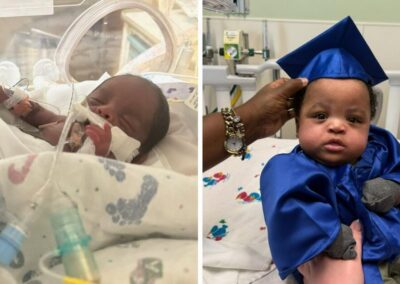
Emily and Hannah Crowe, from Cork in Ireland, were born by caesarean section at 32 weeks. After only a month, Hannah was able to return home, but Emily continued to need intensive care at Cork University Hospital for over three months.

Emily experienced breathing difficulties and was closely monitored by staff. Her mother Jennifer said “It was very unpredictable – there were good and bad days and the situation can change in a matter of hours”.

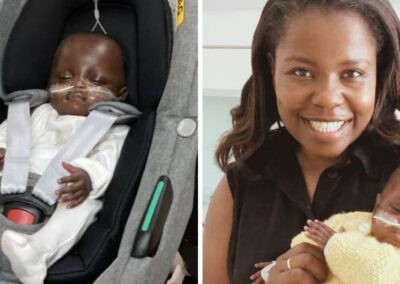
“My hardest day was putting Hannah in the car set and turning my back on Emily. I still get upset about it”, Jennifer said

She added “But Emily was where she needed to be and I would never rush her home. You knew she was in the hands of people saving her life. My whole trust was in them and I will never forget them”.

The girls’ father, Patrick, also said “The staff were like a mother to me. They would say ‘calm down and we will let you know if you need to panic’”.

Emily was discharged from hospital shortly before Christmas

Her mother reported that both her daughters, who are coming up to two years old, are thriving and meeting their milestones.

A recent documentary, Born Too Soon, broadcast on Virgin Media One in Ireland, follows the story of the twins and their family, as well as other premature babies born in the Cork University Maternity Hospital.

Jennifer and Patrick expressed their wish that watching the programme will give hope to parents who are in a similar situation to them, as well as showing viewers how medical advancements have now enabled hospitals to give the best chance to premature and unwell babies.

Jennifer said “If it helps just one other mother I will be happy”.

The producer of the documentary, Sarah Brophy, also experienced the challenge of having twins who required care in a neonatal unit. She said “A lot of people will know in advance their baby will need additional support and [this documentary] will give them hope and a lot of the staff do not get thanked enough”.

Outcomes for premature babies have been improving along with medical advancements

Research published in November 2023 by academics at the University of Leicester and Imperial College London found the number of babies born at 22 weeks gestation who survive to discharge from hospital tripled between 2018-19, before the BAPM guidance was introduced, and 2020-21, after the BAPM guidance was introduced.

According to this research, there were a total of 261 babies born alive at 22 and 23 weeks, before the UK abortion limit, who survived to discharge from hospital in 2020 and 2021. This is compared to the Government abortion statistics, which show that in 2021 alone, there were 1,054 abortions for babies at 22 and 23 weeks gestation.

Spokesperson for Right to Life UK, Catherine Robinson, said “It is wonderful to hear the story of Emily and Hannah and that they were able to be reunited after several long months. This story and those of the other families being explored in Born Too Soon will hopefully fulfil the producer’s wish of giving hope to parents in a similar situation, as well as showcasing the amazing medical care in place for premature children”.


EMERGENCY
APPEAL
to SAVE
lives

Only hours left of the appeal to stop three major anti-life threats.

Only hours left of the appeal to stop three major anti-life threats.

Dear reader,

Thanks to the hard work and dedication of people like you across the UK, the McArthur assisted suicide Bill in Scotland was defeated in March by 69 votes to 57.

Then, in April, the Leadbeater assisted suicide Bill fell in the House of Lords.

Many commentators thought both Bills would become law.

If that had happened, governments in England, Scotland and Wales would now be preparing to roll out assisted suicide services.

Over the coming decades, this would have led to the deaths of many thousands of vulnerable people.

But that is not what happened.

Because supporters like you acted, those Bills were stopped.

Because of you, many vulnerable lives have been saved.

These were two very significant victories. But sadly, they are not the last battles we face this year.

The new Parliamentary session began on Wednesday. We now face three major threats.

  1. Attempts to bring back the Leadbeater assisted suicide Bill and bypass the House of Lords

    The assisted suicide lobby, led by Dignity in Dying, a multi-million-pound pressure group, has made it clear that it is going to attempt to bring back the Leadbeater assisted suicide Bill in the next parliamentary session.

    It then plans to use the Parliament Acts to bypass the House of Lords and force the Bill into law.

  2. Labour Government plans for a major expansion of abortion provision, including financial incentives for ‘lunch-hour’ abortions

    Under these plans, the Government would financially incentivise major abortion providers, BPAS and MSI Reproductive Choices, to provide ‘lunch-hour’ or ‘same-day’ abortions.

    ‘Lunch-hour’ abortion services are walk-in abortion services designed to fit into a woman’s lunch hour.

    Women facing an unplanned pregnancy need time, care and support, not a system that gives abortion clinics a financial incentive to rush them through consultations, scans and abortions on the same day.

    If these plans go ahead, many more lives are likely to be ended by abortion here in the UK.

  3. Extreme abortion up to birth proposals in Scotland

    In Scotland, plans are moving forward to introduce an extreme abortion up to birth law. This would go far beyond the abortion law change recently backed by the Lords for England and Wales.

    A review of abortion law in Scotland, commissioned by Humza Yousaf when he was Scottish First Minister, recommended that the Scottish Government scrap the current 24-week time limit – and abortion be available on social grounds, including for sex-selective purposes, right up to birth.

    The final plans are expected to be brought forward as a Government Bill in the new Scottish Parliament, which began on Thursday.

If these three major threats succeed, thousands of vulnerable lives will be lost.

We cannot allow this to happen.

We can only defeat these three major threats with your help.

We ran our biggest campaigns ever to help defeat the assisted suicide Bills at Westminster and in Scotland.

That work has made a serious dent in our limited resources.

To cover this gap and ensure we can effectively defeat these three major threats in the coming months, we are aiming to raise at least £199,250 by midnight this Sunday (17 May 2026).

We are, therefore, appealing to you to please give as generously as you can.

Every donation, large or small, will make a crucial difference in saving the lives of the unborn and many others. Plus, if you are a UK taxpayer, £1 becomes £1.25 with Gift Aid at no extra cost to you.

By stopping these threats, YOU can save lives during this new Parliamentary session.

Will you donate now to help protect vulnerable lives from these three major threats?

EMERGENCY
APPEAL
to SAVE
lives

Only hours left of the appeal to stop three major anti-life threats.

Only hours left of the appeal to stop three major anti-life threats.