



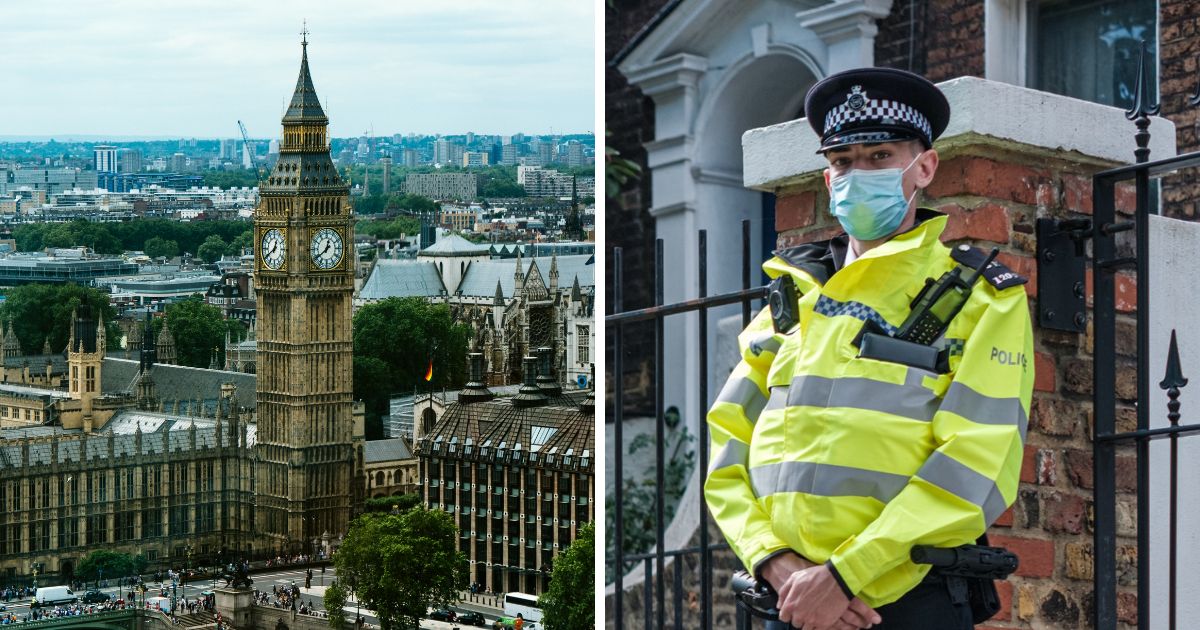
MPs have voted against an amendment that was introduced by a group of MPs led by Andrew Lewer MP to lessen the negative impacts of the buffer zone clause that was added to the Public Order Bill.
The Public Order Bill includes a clause to mandate 150m ‘buffer zones’ around abortion facilities nationwide. The clause makes “influencing” any person who wants to access abortion services illegal.
Amendment A would have ensured that silent prayer and consensual communication were still permitted outside abortion clinics. Unfortunately, this amendment was rejected in yesterday’s vote, with MPs voting by 298 to 117 against it. Another amendment (B), which would have required a review to take place before buffer zones came into force, was not taken to a vote.
The majority of MPs who spoke on the amendment (13) spoke in favour of Andrew Lewer’s proposal, arguing that the buffer zone legislation in its current form would result in the introduction of draconian ‘thoughtcrime’, while only 10 spoke against it.
It appeared that the majority of the MPs who voted down Andrew Lewer MP’s amendment were not in the chamber to hear these speeches during the debate, and only arrived in the chamber when the division on this amendment was called.
The Home Secretary, Attorney General and two Liberal Democrat MPs, including the party’s former leader Tim Farron, were among those who voted in favour of Lewer’s amendment. No Labour MP voted for his amendment.
Information on how individual MPs voted is available on the Where Do They Stand voting record platform.
Consensual communication will be banned by the state
Opening the debate, Andrew Lewer MP outlined the reasons for his amendments and the dangerous precedent that buffer zones set for freedom of speech.
“I have tabled my amendment because the Bill, in its current form, has a problem. The part of the Bill it deals with is leading us into the territory of thought crimes and creates unprecedented interference with the rights to freedom of speech and thought in the UK”.
“The Lords amendment extends something that is already disturbing, as we see in some of the video instances that have taken place. These zones would be the only place in the UK where consensual communication is banned by the state—simply saying that sentence makes this seem such an absurdity”.
“Censorship is a notoriously slippery slope. It might not be our thoughts that are being criminalised today, but we should be careful not to open the door to that happening tomorrow to other opinions that people might hold about something else”.
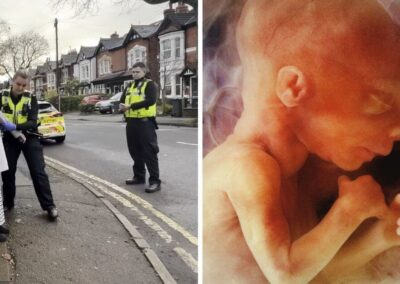
He also warned that the danger of buffer zones was made evident by the case of Isabel Vaughan-Spruce who has now twice been arrested for silently praying outside an abortion clinic in Birmingham. The MP for Northampton South urged fellow MPs to vote in favour of his amendments, arguing that the unamended bill would conflict with “fundamental human rights”.
During Mr Lewer’s speech, several MPs voiced their support for his amendments.
Noting the sinister nature of buffer zones, Sir Desmond Swayne MP asked “Are we not really in Orwellian territory of thought crime?”
Alexander Stafford MP pointed out that sufficient laws against genuine harassment already exist “This extra [buffer-zone] amendment is not necessary, because local authorities already have the powers [to deal with harassment]”.
Ian Paisley MP expressed his concern regarding the effect that buffer zones will have on the reputation of the police, warning that they “will turn the police into a laughing stock”.
Eddie Hughes MP welcomed the amendments and argued that ‘buffer zones’ are a slippery slope. “When Isabel Vaughan-Spruce was arrested, the clinic was not even open… if we continue down this line… anybody can be arrested for anything”.
Sir Julian Lewis MP similarly pointed out “Surely the point that we have to be careful about is the use of words… such as ‘impede’. Thinking and praying is not impeding”.
“It is unthinkable that… what people think has become a matter of police interest.”
Rising to speak in support of Andrew Lewer’s amendments, Sir John Hayes MP argued that it was dystopian that an individual can be arrested for praying, as in the case of Isabel Vaughan-Spruce.
“It is unthinkable that we should be living in a society where what people think has become a matter of police interest. But more than that, it is not merely a matter of police inquiry, for the lady concerned was arrested, charged and went to court. Of course, in the end, she was acquitted, but that is not the point. The very fact that she could be arrested for what she thought or prayed for is – in a much-overused word – chilling”.
He also argued that buffer zones set a dangerous precedent for censorship and argued that such legislation could be a slippery slope.
“Once this is allowed and the police are permitted to apprehend people for what they think and what they are praying about, why not arrest them in other public places? Why does this have to apply only to abortion clinics? Once we open this door, why would the police not arrest people outside mosques or temples, or in any other public space where they are praying to illustrate an opinion”.
David Davis MP indicated his support for Andrew Lewer’s amendments and commended him on his speech.
“My Honourable Friend the Member for Northampton South made one of the best speeches I have heard in this House for a very long time on something as fundamental as the right to prayer without intercession by the state. That is an issue that is thousands of years old, and he was absolutely right”.
“You cannot pray silently in public”
Welcoming the amendments, Ian Paisley MP argued that harassment must be tackled where it exists. He said that the Home Office review published in 2018 found that many ‘protestors’ “were simply praying, sometimes displaying banners and sometimes distributing literature” and that nationwide buffer zones banning prayer and consensual communication was a disproportionate response.
“Is the proportionate response to that [silent prayer and distributing literature] introducing a law that essentially says, “You cannot pray silently in public”? That seems to be what the Government are saying today.”
He went on to argue that a ban on silent prayer must be excluded from the Bill to indicate “that the liberty of freedom of thought, of the freedom to have an opinion in one’s head, will be allowed”.
Mr Paisley subsequently condemned the arrest of a pro-life volunteer for silent prayer and argued that the harassment she experienced was a curtailing of the freedom of thought and opinion.
“The arrest of Isabel Vaughan-Spruce was atrocious. It sends out a terrible message to women and to anyone who wishes to engage in silent prayer in this nation. I am glad that that attempt at a conviction was overturned by the court and thrown out. It is unfortunate that she has been arrested again today by another police officer saying, ‘What are you thinking? What are you praying?’ That is wrong, and we need to stand up against that sort of harassment”.
“We are making a momentous step”
Speaking in support of Lewer’s amendments, Danny Kruger MP argued that introducing buffer zones without protection for silent prayer and consensual communication was a “momentous step”.
“When we criminalise prayer, private thought or, indeed, consensual conversations between two adults, we are doing something of enormous significance in our country and our democracy”.
He went on to say that the buffer zone legislation in its current form sets a very dangerous precedent for the country, asking “where does this lead and what we are doing by saying that people should not be allowed to pray quietly on their own?”
Kruger emphasised what was at stake and urged MPs to vote in favour of Lewer’s amendments.
“We need to send a clear signal of the intention of Parliament through this amendment… If [Members] vote against it… they are voting to ban private prayer”.
Women might want somebody to turn to
Nick Fletcher MP explained how some women are indeed helped by the presence of a volunteer outside abortion clinics. “If somebody is being coerced… to have a forced abortion, that [volunteer] could be somebody… who is actually there to help.”
Sir Edward Leigh MP complained that the Public Order Bill had “been hijacked by people who want to stop completely silent peaceful protest” and brought up the case of Livia Tossici-Bolt who was told by council officers in Bournemouth that she would be fined for holding up a sign that said “Here to talk if you want”. Sir Edward argued that women may be denied crucial help, particularly in cases of coercion. He urged MPs to support Lewer’s amendments.
“We must not criminalise such peaceful activity. Where are we going? Where will this stop?…this is an entirely worthwhile, harmless, moderate amendment, and I hope that Members will support it”.
Robin Millar MP stressed that the “question of necessity and proportionality is an important one” and indicated support for Andrew Lewer’s call for a review of the need for buffer zones, given that a previous government review in 2018 concluded there was no need for such provisions nationwide.
“Our freedom to think, our freedom to speak and our freedom to act… is a statement about our society… what we have seen…is an interpretation that says that we do not have freedom of thought.”
The Government Minister for policing, Chris Philp MP, admitted that, while the Government itself did not hold a position on Andrew Lewer’s amendments, he would himself be voting in favour of them.
Carla Lockhart MP attempted to interject during Rupa Huq’s speech in order to speak in favour of the amendments, but the MP for Ealing Central and Acton, who has recently had the Labour whip restored, refused to give way to the DUP MP.
Right To Life UK spokesperson, Catherine Robinson, said “This is a tragic day for women facing unplanned pregnancies and for unborn children”.
“Hundreds of women have been helped outside abortion clinics by pro-life volunteers who have provided them with practical support”.
“This change in the law will mean that the vital practical support provided by such volunteers outside abortion clinics will be removed and many more lives will likely be lost to abortion”.
“Thank you to everyone who wrote to their MPs asking them to oppose the buffer zone clause in the Public Order Bill”.
“A large number of MPs spoke in the debate against the introduction of buffer zones and in support of the above amendments”.
“Sadly it appears the majority of the MPs who voted against this amendment were not in the chamber to hear these speeches during the debate, and only arrived in the chamber when the division on the amendment was called”.