



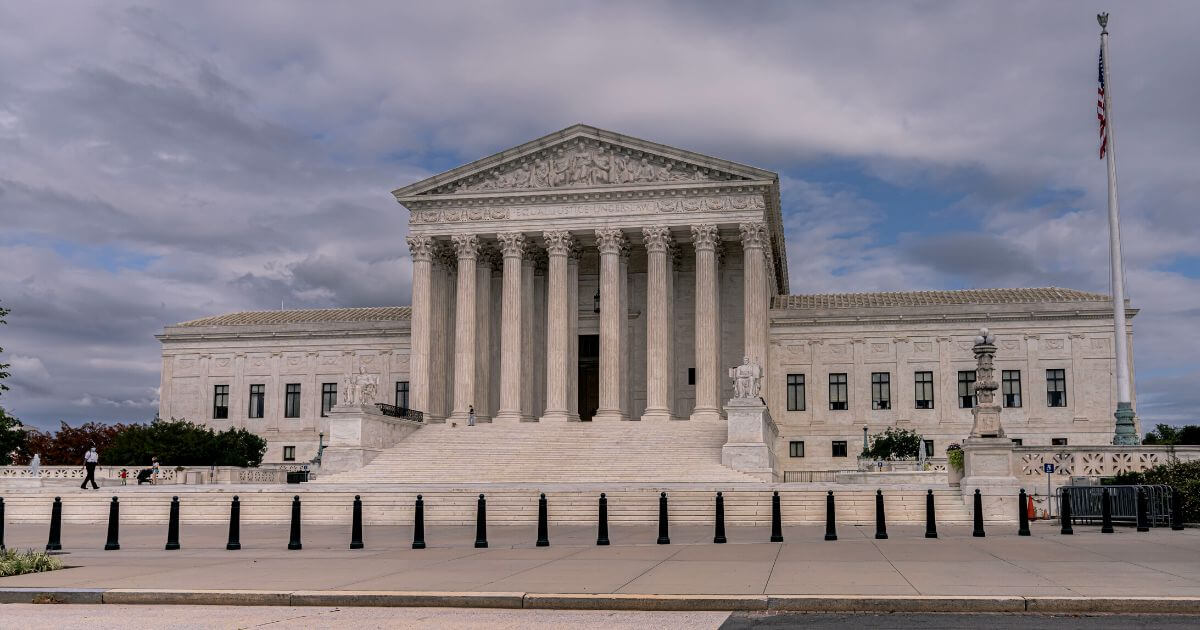
The US Supreme Court has struck down the Roe v Wade decision that previously legalised abortion across the United States in 1973.
The 6-3 decision in ‘Dobbs v.s. Jackson Women’s Health Organization’ followed the early May leak of a draft opinion indicating that the Justices would overturn Roe v Wade.
Abortion law in the US is principally governed by both the 1973 Roe v Wade decision and the 1992 Planned Parenthood vs Casey decision, which created a right to abortion out of the right to privacy. Both have been overturned by the decision released on Friday.
Has this decision banned abortion throughout the United States?
As a senior Daily Telegraph columnist, Tim Stanley, outlined on Twitter: “Overturning Roe does not ban abortion, it hands the matter back to the states…”.
The matter of abortion legislation has been returned to individual states. This has not introduced a total ban on abortion throughout the United States, instead, individual states will decide their own abortion legislation.
In practice, this will likely result in liberal States, such as New York, having very permissive abortion laws, and a number of conservative States having abortion laws that will include full protections for unborn children.
According to pro-abortion think tank Guttmacher Institute, 16 states and the District of Columbia have laws that explicitly protect the “right” to abortion to varying degrees, meaning abortion would likely continue to be available in these states.
The pro-abortion think tank, which was previously the research arm of abortion provider Planned Parenthood, also indicates that 26 states are “certain or likely” to introduce restrictions that would protect unborn children from abortion.
Nine states have pre-Roe restrictions on abortion that could potentially now be enforced, and 13 states have what abortion advocates have labelled as “trigger bans” in place, meaning that abortion restrictions will be in place now that Roe has been overturned.
For the remaining states, there will soon likely be new legislation proposed by both pro-abortion and pro-life advocates to change abortion legislation in each of these individual states. Which legislation is passed will depend on the make-up of each state’s legislature and public demand for changes in legislation from people in that State.
Where do US women stand on abortion?
Recent polling shows that 69% of women believe that there should be significant restrictions on abortion.
The polling found that 69% of women believe that abortion should be available, at most, during the first three months of pregnancy, allowed only in cases of rape, incest, or to save the life of the mother, or never permitted.
The polling showed that 37% of women believed that abortion should only be legally permitted in cases of rape, incest, or to save the life of the mother. A further 21% of women believed that abortion should not be legal after the third month of pregnancy.
The polling also found that a majority of those who call themselves pro-choice (52%) believe that abortion should be available, at most, during the first three months of pregnancy, allowed only in cases of rape, incest, or to save the life of the mother, or never permitted.
In addition to this, 82% of American women think that it is possible to have laws that protect both the health and well-being of a woman and the life of her unborn child. 76% of people who consider themselves pro-choice and 79% of people who identify as Democrats agree.
How have pro-abortion activists reacted to the decision?
Pro-abortion activists have engaged in violent demonstrations following the Supreme Court’s decision to allow individual states to make their own abortion laws.
Since the Supreme Court leak in May, violence from pro-abortion extremists has increased dramatically in the United States. In addition to the vandalism and arson attacks on pro-life pregnancy centres that provide support to pregnant women, protests outside of the private homes of the Justices, and an apparent assassination attempt against Justice Brett Kavanaugh have resulted in increased security measures around the Justices and their families, as well as the Supreme Court building itself.
Justices Alito, Roberts, Kavanaugh and, most recently, Barrett, have all been subject to protests outside of their family homes. Members of the ‘Rise Up 4 Abortion Rights’ campaign rallied outside Barrett’s home with their hands and mouths taped, wearing blood-stained trousers and carrying dolls.
On 10 May, the pro-abortion group, Jane’s Revenge, published a communique demanding the “disbanding of all anti-choice establishments, fake clinics, and violent anti-choice groups within the next thirty days”. The group threatened violence if the demand was not met.
The group claimed responsibility for throwing Molotov cocktails into the Wisconsin Family Centre, in Madison, on 8 May, causing severe fire damage. A Christian pregnancy centre in Buffalo, New York was firebombed on 7 June. The message ‘Jane was here,’ was scrawled across the building’s exterior.
On 14 June, the group published a follow-up letter, claiming responsibility for attacks in Madison, Wisconsin; Ft. Collins, Colorado; Des Moines, Iowa; Hollywood, Florida; Denton, Texas; and Washington, D.C.; Portland, Eugene and Gresham in Oregon, along with Olympia, Lynwood and Vancouver in Washington state, and Reisterstown and Frederick in Maryland.
How have pro-life groups reacted to the decision?
President of the American pro-life organisation the Susan B. Anthony List, Marjorie Dannenfelser, has welcomed the decision:
“Today marks an historic human rights victory for unborn children and their mothers and a bright pro-life future for our nation. Today the Supreme Court, in line with modern science and overwhelming public consensus, recognized the truth in every mother’s heart and that pro-life advocates have argued all along: unborn children are human beings, deserving of protection. Every legislature in the land, in every single state and Congress, is now free to allow the will of the people to make its way into the law through our elected representatives”.
“An entirely new pro-life movement begins today. We are ready to go on offense for life in every single one of those legislative bodies, in each statehouse and the White House. Over the next few years we will have the opportunity to save hundreds of thousands, even millions of lives by limiting the horror of abortion in many states. In this mission of justice and mercy, we redouble our commitment to women and families – building on a pro-life safety net that includes 2,700 pregnancy centers nationwide and initiatives like SBA Pro-Life America’s Her PLAN, as well as a growing number of state Alternatives to Abortion programs, in order to love and serve both mother and child”.
Right To Life UK spokesperson, Catherine Robinson, said: “Last Friday’s decision sees the overturning of an unjust law that has led to the deaths of over 62 million babies since 1973”.
“This decision removes the imposition of an extreme abortion law across the United States. It returns policy decisions around abortion to the states where they can be decided by the democratic process”.
“This decision was based on whether the law in Mississippi would be upheld. That state chose to protect unborn children from 15 weeks gestation, which is consistent with what the majority of countries in the EU already do. In fact, the median time limit for abortion on demand or on broad social grounds among EU countries is 12 weeks gestation. As a result of Friday’s decision, many US states will likely align themselves more closely with the European approach to gestational time limits on abortion”.
“The pro-life movement in the US will now be working to build consensus for the strongest protections possible for unborn children and women in every legislature. Alongside this, they will continue their existing work to support pregnant women and children in need. There are thousands of pro-life pregnancy centres and maternity homes across the United States. The pro-life movement in the United States will continue to grow to meet the needs of these women and their families”.
“Importantly, this law change does not actually ban abortion or prevent anyone from having an abortion. Rather, it makes abortion law a matter for states to decide. Some states will allow abortion without restriction and others will likely provide robust legal protection for unborn children throughout pregnancy”.
How have MPs and Peers in the UK reacted to the decision?
Following the overturning of the Roe v Wade legal decision and the return of abortion law to individual states, Dame Diana Johnson MP put forward an Urgent Question to ask if the British Government will do all it can to ensure abortion is made available in the US and across the world.
On behalf of the Government, the Minister of State for the Foreign, Commonwealth and Development Office, Amanda Milling MP, stated that such matters are a concern for the US authorities.
A number of ‘pro-choice’ MPs spoke out against the decision, but there have been other MPs who spoke in favour of allowing individual states to decide their own abortion legislation.
This included Carla Lockhart MP who pointed out that abortion is not a human right in any binding international law and said: “Would the minister not agree that giving legal protection to the unborn is arguably a clear recognition of the unborn life, and America have done just that, and I welcome the [decision]”.
MP Ian Paisley drew attention to the abortion law in the United States saying that it had seen the end of 62 million lives and suggested that it was a good thing that such laws were “now subject to state democratic control and not to one single group of judges”.
The debate in the Commons was followed by a debate in the House of Lords where a repeat of the same urgent question from the House of Commons was debated.
Baroness O’Loan, Baroness Hoey and Lord Cormack spoke out against the suggestion that the UK Government should interfere on this matter of domestic policy for the United States.
Media coverage and further reading
NHS doctor and research associate at the University of Oxford, Dr Callum Miller, has spoken on a number of broadcast news channels regarding the decision. Some of these segments are included below:
Further reading
The Critic
- Lord Alton– Reversing a tragic half century of lost lives
- Rakib Ehsan – Does Sadiq Khan think he’s living in America?
- Lord Alton – American judges have chosen life — so should Britain
- Lizzie Francis – The tide has turned on abortion
The Telegraph
The Spectator
- Freddy Gray – The truth about the Roe v. Wade abortion ‘ban’
- Douglas Murray – What America gets right about the abortion debate
- Melanie McDonagh – Roe v. Wade and Britain’s non-existent abortion debate
- Sam Ashworth-Hayes – Revoking Roe v. Wade is not an assault on democracy
- Raymond Wacks – The real mistake of Roe v. Wade
- Charles Moore – The truth about Roe vs Wade
Wall Street Journal
- Peggy Noonan – The End of Roe v. Wade Will Be Good for America
- Adam J. White – Roe v. Wade Must Go for Precedent’s Sake
- The Contradictions of Abortion Polling
UnHerd
Conservative Home
LA Times
Washington Post
- Marjorie Dannenfelser and Chuck Donovan – The road beyond Roe for the pro-life movement
- Robert P. George and Josh Craddock – Even if Roe is overturned, Congress must act to protect the unborn
Newsweek
Fox News
Washington Examiner
- Zachary Faria – Democrats mislead voters about what happens if Roe is overturned
- Timothy P. Carney – There is no valid defense of Roe. That’s why that side resorts to threats
- Jor-El Godsey – Threats, attacks, and vandalism won’t stop us from helping women choose life
Washington Times
MercatorNet