



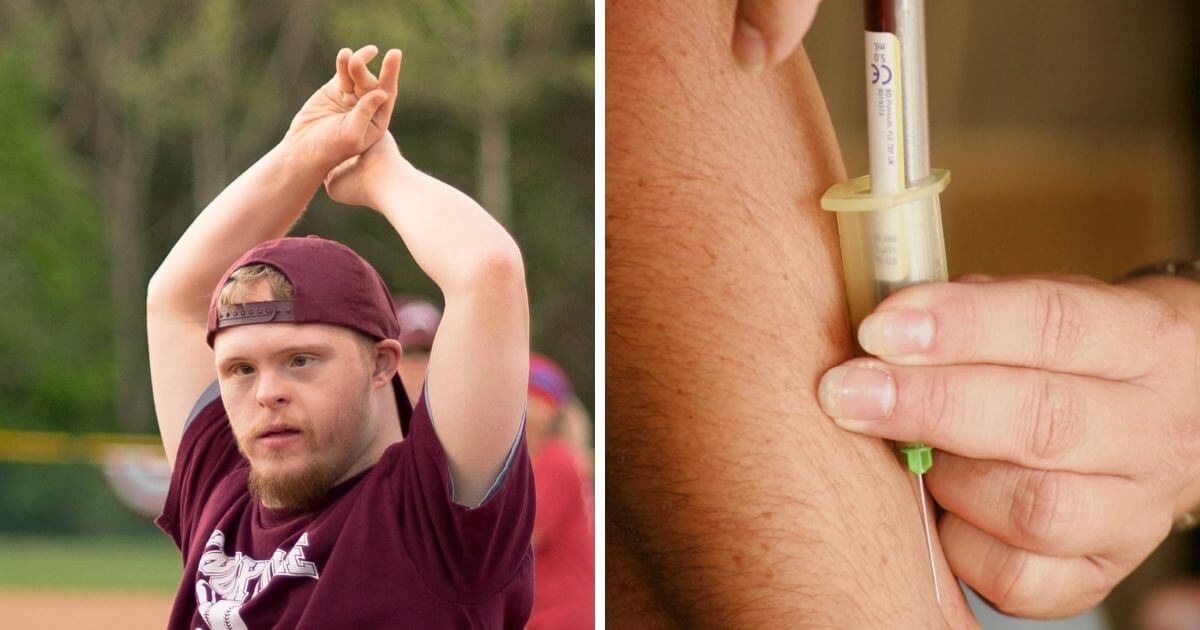
Scientists have found that the number of British children born with Down’s syndrome has fallen by more than fifty percent according to the latest figures, as increasing numbers of parents opt for a controversial prenatal screening test for Down’s syndrome.
The study, published in the European Journal of Human Genetics, by Gert de Graaf of the Dutch Down Syndrome Foundation, Frank Buckley of Down Syndrome Education International, and Dr. Brian Skotko of Massachusetts General Hospital found that the number of infants born with Down’s syndrome in the UK fell by 54% between 2011 and 2015, a period that saw the arrival of non-invasive prenatal testing (NIPT) to the UK in 2012.
The study is based on information spanning from 2011 to 2015, which has been sourced from a number of registries and databases in every country in Europe. The researchers took three years to calculate how many babies were being born with Down’s syndrome and the overall number of babies with the condition. Where there were gaps in data in a particular country, statistical models were applied.
Dr Skotko said: “These data are as close to accurate as possible”.
“People with DS were being counted sporadically, inconsistently, or not at all, depending on the country”.
“But without an accurate estimate, it’s impossible for policymakers and advocacy organisations to determine how many resources and support services are needed for its Down’s syndrome population”.
“Countries that are grappling with funding decisions for NIPS [non-invasive prenatal screening] should certainly be having deep discussions about its impact on the country’s Down’s syndrome population”.
Pressure to abort
This study, released in December 2020, comes at the same time as the The Royal College of Obstetricians and Gynaecologists (RCOG), the Royal College of Midwives and the Society and College of Radiographers admit that women who receive a pre-natal diagnosis of Down’s syndrome, Edward’s syndrome, or Patau’s syndrome, are sometimes pressured to have an abortion by medical professionals.
These medical bodies have released guidelines which stress that the results of prenatal testing should be given and discussed in a “non-directive” manner. This means that whether a test indicates that a baby has Down’s syndrome or not, no parent should feel pressured into a decision about whether or not to have an abortion.
The guidelines note that some parents who decide they do not want an abortion were “being asked repeatedly if they want further diagnostic tests or an abortion”.
“[These parents] report having their decisions challenged and being pressured into changing their minds”.
The guidelines go on to state: “This should not happen”.
“Parents should have the scope to change their minds, but not be pressured into doing so – their decisions should be accepted and respected at all times”.
The RCOG admission has been independently confirmed as multiple women attest to the fact that despite their clear refusal of abortion, they were nevertheless offered it multiple times.
The actress Sally Phillips, whose son has Down’s syndrome, fears that even more babies with Down’s syndrome will be aborted as a result of this test. She has spoken of the joy of being the mother of Olly, a child with Down’s syndrome. She said that Olly had made the lives of her and her husband “more meaningful and happy”.
Spokesperson for Right To Life UK, Catherine Robinson, said: “Campaigners are right to be concerned that further use of NIPT will likely lead to fewer babies being born with Down’s syndrome. The data presented in this study makes this trend perfectly clear and it appears that things will sadly continue in this direction”.
“ New screening, coupled with negative stereotypes about people with Down’s syndrome as well as the pressure that many women experience upon receiving this prenatal diagnosis, make a lethal combination for babies with Down’s syndrome”.
“This active discrimination against people with Down’s syndrome and disabilities more generally however, is being challenged in the High Court. Heidi Carter, a brave 25-year-old woman with Down’s syndrome, and Máire Lea-Wilson, whose eighteen-month-old son Aidan also has the condition, both believe this is “deeply offensive” and have joined forces to challenge the law”.