



A Welsh mother has expressed her gratitude for the work of a paramedic crew in helping her twins when they were unexpectedly born at home at just 29 weeks gestation.
When Catherine Johnson, 36, started going into labour, her friend Sally made a 999 call for an ambulance.
Sally said “We hadn’t been in the house long when she started to have contractions. They were getting closer and closer so we went upstairs to gather some things for hospital. The next thing I know, she had dropped to her knees on the floor”.
Catherine’s eldest daughter Megan, 17, had to step up and started helping her mother prepare for the ambulance’s arrival too.
Catherine’s labour was faster than expected
Within a couple of minutes of the paramedics’ arrival, Catherine’s waters had broken, and barely a minute later, her eldest twin baby, Aneira was born.
The first paramedic on scene said “Every 1° drop in body temperature below 36.5°C will increase the risk of mortality in newborn babies by 28 per cent, so priority number one was keeping them warm”.
“We put baby skin-to-skin with Catherine to enable delayed cord clamping, which allows time for extra blood to flow from the placenta into the baby”, she went on to explain. “This is important for all babies – especially pre-term babies – as it helps with the transition from life inside to life following birth. We also wrapped the babies in plastic bags and blankets to prevent their temperature from dropping”.
Baby Aneira was quickly taken to hospital by a paramedic, who spent the 15-minute journey trying to keep her warm.
Meanwhile, Catherine’s second baby, Carreg, was born 50 minutes later.
Both babies and mother required medical care after birth
Dr Ian Bowler, a critical care consultant, was also sent to the house to offer support. He said “Once both babies were born, our attention turned to mum, who had a post-partum haemorrhage. Mum became the patient at that point, and it was about trying to stem the bleeding. It was a really well-managed scene and the paramedics there were brilliant”.
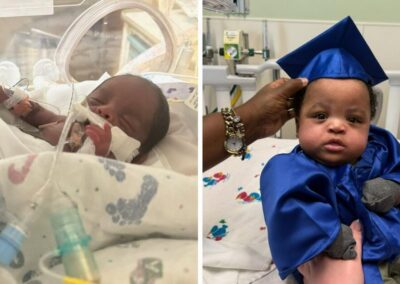
Carreg and Aneira weighed 3 pounds, and 2 pounds 12 ounces respectively, and required eight weeks in hospital following their birth.
Bethan Jones, Local Safety Champion for Maternity and Neonatal Care, said “We worked closely with the Trust’s Learning and Development Team to develop an online training package and mandatory training on thermoregulation just a couple of weeks prior to the call for Catherine. Without a doubt, the skills and knowledge the crew had acquired supported the twins with their transition at birth”.
Steven Magee, Consultant Paramedic and Regional Clinical Lead, added “Without that additional training, which was fresh in everyone’s minds, it could have been a very different story”.
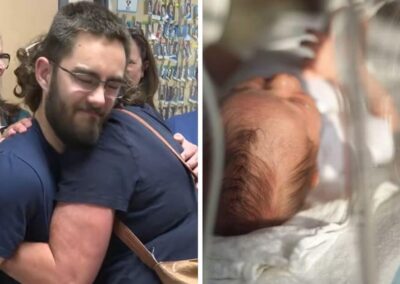
Several months later, the family was reunited with the crew who supported the birth
The twins’ mum said that she couldn’t “thank [the paramedics] enough for what they did”.
The twins’ father, Mark Grice, said “Their professionalism was out of this world. There was no panicking – they knew exactly what to do”.
He added “The whole thing was a massive blur, but we’re just so grateful for everything that everyone did. We can’t thank them enough”.
Medical advancements are improving premature babies’ outcomes
Just as Carreg and Aneira’s treatment was aided by the recent specialist training of the team supporting them, many premature infants are increasingly surviving due to medical developments.
A number of key studies in recent years have documented the improving outcomes for these extremely premature babies. A 2004 Swedish study found that neonatal survival outcomes between 22 and 25 weeks gestation significantly improve when neonatal hospital staff take a proactive approach in the care of premature babies.
A 2008 study based on a neonatal intensive care unit in London also found that neonatal survival rates at 22 and 23 weeks gestation had improved. In 1981-85, no babies who were born at these gestational ages survived to discharge. However, by 1986-90, 19% did and this increased to 54% in the period 1996-2000.
A study in 2022 found almost four out of five babies born prematurely between 22 and 28 weeks gestation survive to discharge from the hospital. It found that from 2013 to 2018, with infants born between 22 and 28 weeks gestation, “survival to discharge occurred in 78.3% and was significantly improved compared with a historical rate of 76.0% among infants born in 2008-2012”.
Spokesperson for Right To Life UK, Catherine Robinson, said “This is another amazing story exemplifying how medical advances are supporting premature babies to survive. Congratulations to the paramedic team who supported the family through this unexpected home delivery”.