


PRESS RELEASE – FOR IMMEDIATE RELEASE
Press release – A tribute to Ann Widdecombe, pro-life champion and defender of unborn children, at her memorial service
Photos from the memorial service are available here. The photos are free to reuse.
26 November 2026 – Pro-life veteran and former Minister and MP, Ann Widdecombe, received a memorial service at Westminster Cathedral, London, today, 26 November, following her tragic death in July this year.
During her long and distinguished career in Parliament, she was a leader in the public fight for protections for unborn children at the beginning of life and the elderly and vulnerable towards the end of life.
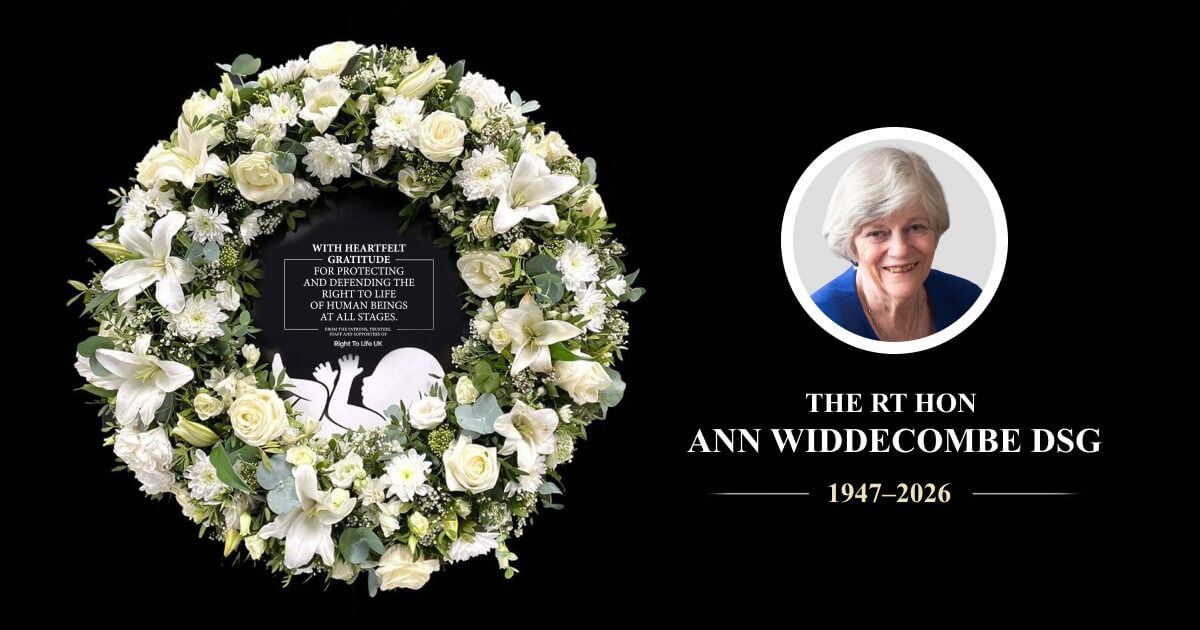
As a patron of Right To Life UK for many years, her strong and consistent pro-life voting record serves as an example and aspiration for younger pro-life politicians entering the world of being a publicly pro-life politician. The Right To Life UK senior team attended the memorial service and brought a wreath on behalf of their patrons, trustees, staff, and supporters. Its message read, “With heartfelt gratitude for protecting and defending the right to life of human beings at all stages.”
The Prime Minister, as well as three former Prime Ministers, joined MPs, Peers and other public figures at the service to remember Ann and give thanks for her life.
In his tribute at Westminster Cathedral earlier today, Lord David Alton of Liverpool recalled Widdecombe’s love of Mother Teresa of Calcutta’s prayer on the value of life. “Ann totally dedicated herself to that fight for life,” he said. He praised her “courage and tenacity”, saying she threw “every last morsel of energy into the causes she embraced”.
The full transcript of Lord Alton’s tribute to Ann Widdecombe can be found at the end of this press release
Ann Widdecombe was 78 when she was killed at her home in Haytor, on Dartmoor. She was found there on 9 July 2026, after an employee who had been unable to reach her went to the house. On 20 July, a man was charged with her murder.
On 12 August, family, friends and former colleagues gathered for her funeral at Buckfast Abbey, where she had regularly worshipped. She had called the abbey her “safe haven”. Those who knew her there remembered her warmth and the depth of the Catholic faith that shaped her public life.
First elected as a Conservative MP for Maidstone in 1987, she held her seat until leaving the Commons in 2010, during which time she held two posts as Minister of State, including at the Home Office with responsibility for prisons and immigration. She was the only Prison Minister to have personally visited every prison in England and Wales.
She returned to frontline politics in 2019 as a Member of the European Parliament until January 2020.
Widdecombe was a steadfast defender of unborn children
During her time in politics and after, she consistently voted in favour of greater protections for unborn children and against attempts to legalise assisted suicide. As early as 1988, as a newly elected MP, Widdecombe served on the committee scrutinising David Alton’s Abortion (Amendment) Bill. Alton recalled that the two travelled around the UK, speaking at public meetings about why MPs from different parties had joined forces to protect unborn children.
In 1989, Widdecombe moved the Second Reading of the Abortion (Amendment) Bill to give MPs another opportunity to vote on restrictions on late abortions. In a separate Commons debate, she pressed the case for compensation for women who had agreed to an abortion after being wrongly told that their unborn child had a severe disability.
Additionally, in the same year, Widdecombe questioned the Solicitor General and later secured a Commons debate about a baby reported to have shown signs of life after an abortion in Carlisle. She pressed ministers on what legal protection such a child had and what recourse the parents could seek.
In his speech earlier today, Lord Alton made referenced this incident saying Ann had been “deeply shocked by the Carlisle baby case”. He recalled her question to the Commons: “How can one accept, when a child has been breathing without the aid of artificial equipment, has a pulse rate and has survived for three hours, that that was not a live birth? Under what circumstances do we call a person an unperson?”
The following year, in a debate on the Abortion Act 1967, she argued that abortion should not be treated as any other medical intervention and that existing protections for unborn babies should not be eroded further.
In the same year, when debating amendments to the then Human Fertilisation and Embryology Bill, Widdecombe insisted that unborn children not be left out of the discussion, arguing that, due to medical advances, the abortion limit should be lowered.
In another debate in the same year, Widdecombe raised concerns that an amendment to abortion legislation, allowing the Health Secretary to designate “a class of places” as suitable for abortions, would inadvertently pave the way for at-home abortions.
However, the author of the amendment, Robert Key MP, dismissed Widdecombe’s concerns and accused the then Conservative MP of speaking from “the whip issued by the pro-life group” and misleading Parliament.
The Health Secretary at the time, Kenneth Clarke, then assured MPs that the legislation was not intended to legalise home abortions and that the abortion pill would only be “administered only in closely regulated circumstances under the supervision of a registered medical practitioner”.
30 years later, Ann Widdecombe’s then-dismissed concerns have become a reality in the form of pills-by-post abortion, which, as of 2023, accounts for 72% of all abortions in England and Wales.
In 2003, Widdecombe tabled a motion defending Muslim applicants to medical school who objected to abortion or the legalisation of euthanasia. She asked the Government and the General Medical Council to ensure that admissions procedures respected applicants’ conscientious beliefs.
In 2007, she supported a Bill that would have required parents to be informed if their child under 16 had an abortion.
In 2008, she voted in favour of a series of amendments to the Human Fertilisation and Embryology Bill, including an amendment to lower the abortion limit for abortions performed under Section 1(1)(a) of the Abortion Act to 12 weeks. She took the campaign for a lower abortion time limit to a public meeting in London as part of her ‘Passion for Life’ speaking tour.
The following year, Widdecombe tabled a Commons motion calling for the withdrawal of the Director of Public Prosecutions’ guidelines on assisted suicide. She argued that the guidance put vulnerable people at risk and that any change in the law was for Parliament to decide.
While appearing on Strictly Come Dancing, she was guest of honour at Right To Life UK’s first fundraising dinner in London. The event drew 120 supporters, and the campaign group Abortion Rights called a demonstration against her appearance.
Her campaigning appears to have carried a political cost. The Guardian’s obituary attributed the slow start to her ministerial career partly to her outspoken support for Alton’s abortion campaign. She received her first ministerial appointment in 1990.
Thirty years after questioning ministers about abortion pills being taken at home, she signed a High Court witness statement in 2020 supporting Christian Concern’s challenge to the Government’s authorisation of at-home abortions. She set out the assurances MPs had received in 1990 and explained why she believed the change required a parliamentary vote.
Widdecombe continued to keep abreast of recent expansions in abortion law. In 2023, writing in The Critic, she opposed the proposed buffer zones around abortion clinics. She described the experience of a woman who wanted to keep her baby and had been offered accommodation, food vouchers and baby clothes after meeting a volunteer outside a clinic.
Opposition to assisted suicide and protection of the vulnerable
Widdecombe also served in a senior role in the All-Party Parliamentary Pro-Life Group and fought against attempts to make assisted suicide legal in 1997, 2000 and 2004.
Widdecombe backed practical alternatives to assisted suicide to reduce suffering at the end of life. In April 2006 she signed a Commons amendment opposing Lord Joffe’s Bill that also called for expanded hospice provision and research into progressive supranuclear palsy, the condition of a woman whose assisted death had featured in the debate.
She did not just talk the talk though. Earlier today, Lord Alton recalled how Ann brought her mother, Rita, to live with her in London in her final years. He said that just as her mother “had cared and prayed for her when she came into the world, she would care and pray for her beloved mother as she left this world for the next”.
Ann Widdecombe’s fight for life did not end after she left Parliament
Even after leaving the Commons, she continued her vocal opposition to assisted suicide. In 2006 she strongly opposed the notion, advanced by Dignitas founder Ludwig Minelli, that clinically depressed people should be assisted in suicide. “It is absolutely ludicrous. The answer to clinical depression is to get people help not to end their lives”.
“I think this is one very dangerous man and one very dangerous organisation”.
In 2012, Care Not Killing named her as a speaker for its Westminster rally calling for better palliative care and opposing assisted suicide and euthanasia.
In the debate over Kim Leadbeater’s then Lauren Edwards’, assisted suicide Bill, Ann Widdecombe was a powerful and consistent voice in the media opposition to this legislation because of the negative effects it may have on the vulnerable.
In the months before Leadbeater launched her Bill, Widdecombe warned that, if assisted suicide were made legal, “it is impossible to introduce adequate safeguards to protect the mentally ill, disabled and the frail elderly”.
She later described the assisted suicide Bill as “riddled with horrors”, saying that “Appeals [in cases of assisted suicide under the Leadbeater Bill] work only one way: one can appeal against a refusal but a relative, concerned about suspected coercion, for example, cannot appeal against an affirmative decision and coroners cannot investigate”.
Chris Whitehouse, a Right To Life UK Trustee, said:
“For 40 years, Ann was to me a personal and family friend, a political mentor and a remarkable heroine of the pro-life cause. To have known her was a pleasure and a privilege, if sometimes a challenge. She was unflinching in her politics, constant in her friendships and steadfast in her defence of the principle of the right to life, both for the unborn and for those approaching the end of their lives”.
“May the choirs of angels come to greet her, may they speed her to paradise, may the Lord enfold her in His mercy, and may she find eternal life and rest after a lifetime of pro-life endeavour”.
Friend and former colleague of Ann Widdecombe, Lord Alton, said:
“Ann’s forthright views – whether you agreed with her or not – were always trenchantly, intelligently, and honestly expressed – and never with malice”.
“Beyond the well-known public figure, there was also a less well-known private person, capable of great kindness in responding to people facing personal challenges and tragedy. As they will attest, she was never a fair-weather friend”.
“At a time when the national debate needs respectful disagreement and intelligent debate, Ann’s voice will be missed”.
“I will not be alone in mourning her passing”.
ENDS
- For additional quotes and media interviews contact 07774 483 658 or email press@righttolife.org.uk
- For further information on Right To Life UK visit www.righttolife.org.uk
***
Full transcript of Lord Alton’s tribute to Ann Widdecombe during her Memorial Service today at Westminster Cathedral
The Rt Hon Ann Widdecombe DSG – A Tribute.
Five years ago this week, we met in this Cathedral, honouring the life of the murdered parliamentarian, Sir David Amess MP.
Five years ago, the profoundly moving eulogy was delivered by the Rt.Hon. Ann Widdecombe DSG.
Although deeply honoured to have been asked by the Reverend Roger Widdecombe to deliver a eulogy today, celebrating Ann’s contribution to public life, I remain shocked to the core to have lost another close personal friend to such vicious savagery; and know that no words of mine can even begin to do justice to a truly unique, wonderful woman.
Roger has reminded me that he and I first met in 1988 when he was a student.
His father, Ann’s brother, the Reverend Malcolm Widdecombe, vicar of St Philip and St Jacob’s church, in Bristol – “Pip n Jay” – had invited Ann and me to speak about our controversial prolife Bills to reduce the upper time limit for abortion.
A packed church was surrounded by hostile protestors who had laid siege to the meeting – even breaking some of the windows of the church. Roger became part of the cordon which surrounded Ann and me to get us safely away and en route back to London for a ten o’clock vote, on an important Government policy (and, on which, we would be voting in different lobbies).
It’s a small story but tells you quite a lot about what you need to know.
Ann was a dedicated, hardworking and greatly respected Member of Parliament.
She had courage and tenacity, throwing every last morsel of energy into the causes she embraced – doing so without fear or favour, following her conscience, passionate about free speech, and putting her beliefs and her country before other interests.
But the story also illustrates her ability to make unlikely alliances and enduring friendships – memorably telling me after one ding dong disagreement that I remained her “favourite bleeding-heart Liberal.”
Ann Noreen Widdecombe was born in Bath, Somerset, on the 4 Oct 1947. She was the only daughter of her West Country parents, Rita and James Murray Widdecombe, a Ministry of Defence civil servant based for some years in Singapore – where Ann attended the Royal Naval School and then Bath’s La Sainte Union Convent School.
Her passion for politics was honed as a student and her acclaimed debating skills, fashioned in the Oxford Union, where her speeches were articulated with the intelligence and passion of an undergraduate studying philosophy, politics, and economics, and who already had a first degree in Latin.
After university she worked for Unilever and the University of London – and began the task of chasing Conservative Party nominations, one of which was in 1979 at a by election in Liverpool Edge Hill. Frank Field sought the Labour Party nomination. Mercifully, neither of them was selected – as I am not sure our subsequent friendships would have survived that campaign.
Instead, Ann fought the 1979 General Election in Burnley and, in 1983, Plymouth Devonport, against David Owen, before being selected for Maidstone where she served as Conservative MP from 1987 until 2010 – winning in 1987 with a majority of 10,364.
In 1990 Sir John Major appointed Ann to her first ministerial post– becoming the first Prisons Minister to personally visit every prison in the country, publicly arguing for more rehabilitation and educational opportunities for prisoners.
In 1997 she was appointed to the Privy Council, later serving under William Hague as Shadow Health and Shadow Home Secretary.
She stood down from the Commons in 2010, and it remains a great regret to me that
she was never appointed to the House of Lords.
On changing her mind about the European Union, Ann became a prominent
Eurosceptic, joining the Brexit Party and Reform UK.
In 2019, never to be accused of half measures she stood and was elected to the European Parliament for South West England declaring that “Both major parties need a seismic shock,” and, in her own inimitable way, arguing in her Maiden Speech in Brussels for a swift withdrawal.
Having forged a strong partnership with Nigel Farage, in 2023 he asked Ann to serve as Reform’s spokesperson on immigration and justice.
Notwithstanding deeply held beliefs on controversial political issues, I have been struck, following her appalling murder, how, right across the political divide, there has been rare agreement about Ann’s gifts and the way in which she articulated her politics.
The Prime Minister, Andy Burnham, says “I crossed swords with Ann many times in the Commons and on TV. While we disagreed on much it didn’t stop me recognising a politician at the top of her game. She was a formidable opponent but a courteous one – a truly remarkable woman who brought conviction, wit and personality to public life over many years. She will be missed and remembered for her huge contribution to national life.”
The Leader of the Opposition, Kemi Badenoch, has called Ann a “formidable politician who was never afraid to speak her mind”;
Nigel Farage says “Our nation is a much poorer place without Ann. We need Ann Widdecombes more than ever.”
Sir Ed Davey, describes her as “a woman of deep faith who devoted her life to public service.” with Sir Keir Starmer, calling Ann a “distinguished politician over many, many years with many achievements
I first met Ann in 1988, in the immediate aftermath of the successful House of Commons Second Reading vote on my prolife Private Members Bill.
After the vote, the Chamber cleared and a lady walked across the floor to congratulate me and lost no time in telling me that I would need some strong support in Committee. I discovered this was the MP for Maidstone. She joined the Standing Committee and proved every bit as good as her word.
Ann had been deeply shocked by the Carlisle baby case – a baby aborted at 21 weeks gestation – and she asked the Commons: “how can one accept, when a child has been breathing without the aid of artificial equipment, has a pulse rate and has survived for three hours, that that was not a live birth? Under what circumstances do we call a person an unperson?”
We took that question and that fight into the country and spoke at many public meetings explaining why, despite other political differences, we were united by our belief in the right to life.
We filled the Royal Albert Hall and stood silently as millions of white petals were dropped from the high concave ceiling. We sang “Who Can Sound the Depths of Sorrow?” a hymn written at the time of our Bills by Graham Kendrick reflecting on sorrow, lament, and the heart of God.
Ann was stirred by words which have a special resonance today:
“Who will stand against the violence?
Who will comfort those who mourn? In an age of cruel rejection, who will build for love a home? Come and shake us into action, come and melt our hearts of stone: upon your people, upon your people have mercy, Lord!”
Recall too that she loved Saint Teresa of Calcutta’s prayer entitled LIFE which includes the words “Life is an opportunity, benefit from it; Life is beauty, admire it.; Life is a challenge, meet it; Life is a duty, complete it; Life is sorrow, overcome it; Life is a struggle, accept it; Life is a tragedy, confront it; Life is an adventure, dare it; Life is too precious, do not destroy it; Life is life, fight for it.”
Ann totally dedicated herself to that fight for life.
And as often happens in politics, a cause held in common forged friendships – with Ann becoming close to my family and Godmother to my youngest son.
As she recalled during the eulogy she delivered for David Amess, the three of us were joined by Ken Hargreaves MP – with three musketeers becoming four and sharing with Alexandre Dumas the belief that we needed to “Never fear quarrels but seek hazardous adventures” and to be “All for one and one for all” because “united we stand divided we fall.”
And there was far more to Ann than some of her detractors understood.
In 2010, after leaving Westminster, Ann combined her active engagement in political causes with the fiery pen of a weekly columnist. And her writing expanded beyond her newspaper columns into autobiography and five fine novels – beginning with The Clematis Tree.
Her fiction explored intense family dilemmas, moral crises, and societal issues while, her TV appearances – notably in Strictly – confounded the caricatures of Ann and she thoroughly enjoyed the laughter, the fun, the costumes, and the theatrics.
Against all expectations – and the judges’ votes – she lasted 10 weeks in her partnership with Anton du Beke – with the public willing her on. And it didn’t end there.
In 2012, I travelled to High Wycombe with David Amess, to see her star with one of the Strictly judges, Craig Revel Horwood, as she played the role of “Widdy in Waiting” in the production of Snow White and the Seven Dwarfs.
By now, Ann had become something of a national treasure – and that, in turn, gave her new platforms for her causes, which included her great love of animals.
She accepted the Presidency of Societies caring for donkeys in the Holy Land; for hedgehogs; and to rescuing stray cats: Pugwash and Carruthers being two of the most notable.
One evening, driving her to a meeting in the North of England, she suddenly ordered me to stop the car. My passenger had spotted a stranded hedgehog, which, like the cats, she rescued and took to safety.
Ann also passionately opposed fox hunting and came into conflict with some of her local party who tabled a hostile motion at a constituency AGM.
I secured a supportive statement for her from the then Duke of Norfolk, a retired General, who wrote to her party members: “I fought the Mau Mau and she’s exactly the person I would have wanted standing alongside me.”
She successfully saw off the motion.
Like CS Lewis, Ann believed that if you are cruel to other species, it wouldn’t be long before you are cruel to human beings too.
In more recent times, when she was up in London from Devon, I would get a last-minute call to see if I was up for a late-night curry at her favourite restaurant in Kennington. There was never any shortage of subject matter and although she despaired of some of my views that made our suppers so much more enjoyable.
We both agreed that the inability to disagree in a civil way and the toxic cancel culture endanger free speech and democracy; that more interesting than left versus right was right versus wrong; that intolerance of alternative or opposing views had become a curse; and that if someone in political life had no causes – simply their own advancement – it probably told you all you needed to know about them.
In 1999, that intersection of personal conviction and political life, the defence of free speech, concepts of citizenship, and public service, were at the heart of a well-received Roscoe Lecture which I invited Ann to give in front of hundreds of people in Liverpool.
We were still discussing these themes in June of this year, during our final tandoori masala, just a month before her murder. But we also shared concerns about the UK’s lack of preparedness as we are confronted by the “deadly quartet” of foreign dictatorships threatening our freedoms, and the patriotic need for greater commitment to the first duty of all governments – the defence of its citizens.
There were many sides to this good woman.
Behind the sometimes-gruff exterior was a principled, extraordinarily articulate, intelligent woman – not easily deterred –generous and kind, too.
She brought Rita, her mother, to live with her in London, saying that just as her mother had cared and prayed for her when she came into the world, she would care and pray for her beloved mother as she left this world for the next.
After Sir David Amess’s death, she remained close to Julia, his widow, showing practical and continuing care, and celebrating David’s life when we attended the unveiling of his statue in Southend.
Since her death many have spoken of the quiet acts of kindness that the public did not see. Ann was not a fair-weather friend. She mentored and supported innumerable people. Unlike many these days who are performative and public in their charity, Ann was neither.
Those who knew her understood that what made Ann Widdecombe tick were the twin pillars of her Faith and Patriotism, insisting that we must use our lives to the full: “we get one go this side of eternity, one go. Life is not a dress rehearsal.”
Her faith was in her DNA.
It manifested itself in her causes; through support for charities including those for the persecuted; the vulnerable; the poor; the work of Right to Life UK; the Leprosy Mission; Aid to the Church in Need; the St Vincent de Paul Society and The Grace Charity for M.E. In 2013, in recognition of all of this, Pope Benedict named her a Dame of St Gregory the Great.
To conclude.
Against the savagery of the murders of Ann, David and Jo Cox, and the threats to the safety of parliamentarians and their families, Ann would be telling us not to be afraid to search for the truth and not to be frightened to express our beliefs.
Five years ago, Ann said Sir David Amess “was indefatigable and uncompromising;” that he should be remembered “not for the way he died, but for how he lived and the causes he fought for.” That is also true of Ann.
Ann was true to herself and gave politics and politicians a good name.
When, in 1993, Ann became a Catholic, she chose the hymns which were sung that evening in the parliamentary crypt chapel of Our Lady Under Croft, the last of which was Faith of Our Fathers. It concludes with challenging words which now have a prophetic resonance:
“…we will love
Both friend and foe in all our strife,
And preach thee, too, as love knows how
By kindly words and virtuous life.
Faith of our fathers! holy faith!
We will be true to thee till death!”…
In life and in death Ann was always true to herself and to her beliefs.
We honour and uphold her memory.
May she now rest in peace and rise in glory.