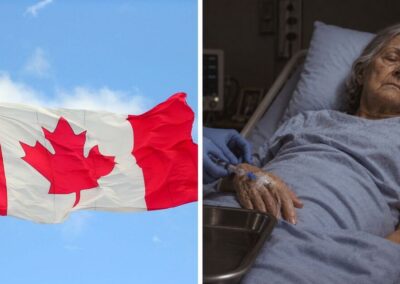





A Canadian woman suffering from parathyroid disease has revealed that she is considering assisted suicide because she cannot get the surgery she needs.
Jolene Van Alstine, from Saskatchewan, suffers from a rare form of parathyroid disease, which results in extreme bone pain, nausea and vomiting. She requires surgery to remove a remaining parathyroid, but no surgeons in Saskatchewan are able to perform the operation.
In order to be referred to another province for the operation, Van Alstine must first be seen by an endocrinologist, yet no Saskatchewan endocrinologists are currently accepting new patients.
Van Alstine commented that the pain has become so unbearable that she has applied and been approved for Canada’s euthanasia and assisted suicide programme, with the ending of her life scheduled to take place on 7 January 2026. Van Alstine said, “My friends have stopped visiting me. I’m isolated. I’ve been alone lying on the couch for eight years, sick and curled up in a ball, pushing for the day to end”.
“I go to bed at six at night because I can’t stand to be awake anymore”.
Jared Clarke, the Shadow Minister for Rural and Remote Health in Saskatchewan, has attempted to persuade Health Minister Jeremy Cockrill to help Van Alstine “get her the surgery she needs”, saying that Van Alstine is “at a breaking point” and her “suffering has become unbearable”.
Clarke commented, “Nobody should be forced to choose between unbearable suffering and death. No family should be put in this position”. “I feel like I’m at the end of the road”, Van Alstine said.
Worrying example could be the reality in England and Wales if assisted suicide becomes law
As assisted suicide is making its way through the House of Lords, there are worries that cases like Van Alstine’s could become the reality in England and Wales.
Hundreds of hospice beds have been cut across England, and the majority of hospices are now operating in deficit, according to a major report – raising serious criticism that while palliative care services are undergoing a financial crisis, Parliament has committed to ensuring assisted suicide receives the financial support needed for its implementation, should it become legal.
Responding to the report, Sam Royston, executive director for research and policy at Marie Curie, said “The NAO report echoes what we witness every day: palliative and end-of-life care is in crisis”.
The Guardian raised concerns about assisted suicide being introduced alongside underfunded hospices. Describing the report as “dismal news” in an editorial, they said “The prospect of a state-funded assisted dying service sitting alongside a cash-strapped hospice sector is deeply disquieting”.
Baroness Berger said the report “should concern us all”.
“Hospice funding has fallen in real terms by nearly 10% over the past 2 years, with hospices cutting both jobs and services. How can we consider assisted [suicide] when the crisis in palliative care means so few people face a real choice?”, she added.
Spokesperson for Right To Life UK, Catherine Robinson, said “The troubling account of Jolene Van Alstine illustrates the further negative consequences of introducing assisted suicide for vulnerable people when it is done in a context where there is a lack of funding or access to healthcare, such as surgery for people like Jolene”.
“Vulnerable people such as Jolene need assistance to live, not to die”.