



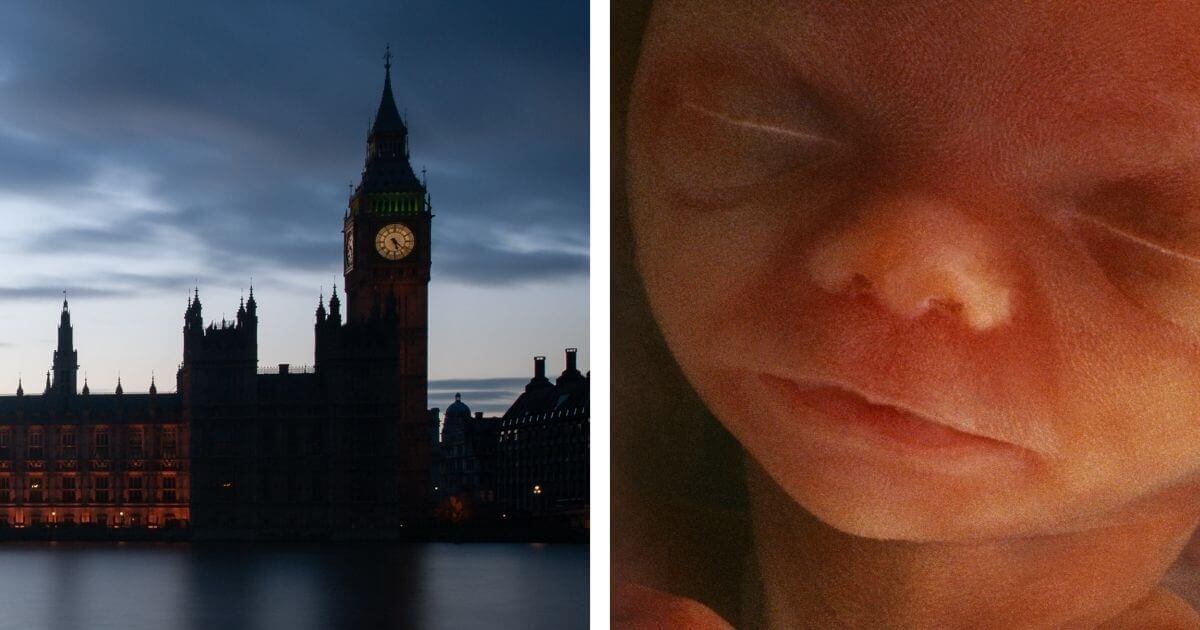
Today marks the 54th anniversary of the Abortion Act receiving royal assent.
Since then, a staggering 9,789,238* unborn babies have lost their lives to abortion across England, Wales and Scotland — in 2020, more than one baby was lost to abortion every two and a half minutes; 25 lives were ended every hour.
Over 1 in 4 (25.2%) pregnancies in England and Wales now end in abortion, according to the most recent Government statistics.
The number of abortions in England and Wales reached a record high with 210,860 taking place in 2020, while the number of terminations performed in Scotland was the second-highest on record at 13,815.
Record abortion figures will likely increase
This significant rise in abortions has accompanied Governments introducing a temporary measure in March 2020 allowing ‘DIY’ home abortions in England and Wales, and Scotland.
New and radical abortion legislation in Northern Ireland, imposed upon the region by the Government in Westminster, allows sex-selective abortion, de facto abortion on demand up to 24 weeks and disability-selective abortion right up to birth – including for Down’s syndrome, cleft lip and club foot.
In July it was revealed that 1,624 terminations have already taken place under the new regime, despite the fact that the Northern Ireland Department of Health has not officially commissioned abortion ‘services’.
The number of abortions taking place in Northern Ireland is now set to increase, with the Conservative Government announcing that it has introduced regulations to Parliament that will give the Northern Ireland Secretary new powers to enable him to force Stormont to expand abortion access across Northern Ireland, through the commissioning of abortion services.
Abortion statistics released by the Department of Health and Social Care show that 209,917 abortions were performed for English and Welsh residents in 2020.
This is 2,533 more than in 2019, which was, until now, the highest number on record.
An unsafe industry
The increase in abortion numbers has coincided with a rise in the number of safety abuses and other significant scandals with UK abortion providers, placing women at risk.
Early last year, it was revealed that over 60% of England’s abortion clinics are rated inadequate or requiring improvement when it comes to safety.
Over the past two years, the Care Quality Commission (CQC) has released alarming reports detailing health and safety abuses at two of the largest abortion clinics in the UK. Inspectors found an abortion clinic in London that specialises in late-term terminations was putting the lives of women at risk and, in November 2019, the CQC handed BPAS Merseyside the worst rating of any private abortion provider so far.
The situation may be significantly worse too. Despite the damning reports, the CQC announced in March 2020 that it would be suspending safety inspections during the COVID-19 pandemic, and only resumed inspections again this past spring.
In their absence, an undercover investigation found evidence of abortion providers putting women at significant risk by not carrying out basic checks before sending them ‘DIY’ home abortion pills.
The investigation also discovered ‘DIY’ home abortion pills can easily be obtained and administered to others, potentially in a coercive manner.
In May 2020, it was revealed UK police were investigating the death of an unborn baby after its mother took ‘DIY’ home abortion pills while 28 weeks pregnant.
In addition, abortion provider BPAS said they were investigating a further eight cases of women taking ‘DIY’ home abortion pills beyond the 10-week limit, raising questions over what checks are being conducted to ensure the law isn’t being broken and dangerous late-term abortions aren’t happening.
More recently, a nurse in the UK has shared how she was left fearing for her life and needing emergency surgery. She said MSI Reproductive Choices denied her proper counselling and pressured her to take abortion pills at home, rather than under the supervision of a doctor in a clinic.
A lucrative industry
Despite the significant rise in safety abuses and other scandals, abortion providers and their bosses continue to be well compensated by the UK taxpayer through Government contributions, with abortion provider MSI Reproductive Choices’ chief executive earning £434,500 in 2018.
The accounts also show the abortion provider had an income of almost £300 million from operations here in the UK and overseas, receiving over £48 million in 2020 from the Foreign, Commonwealth & Development Office (FCDO), formerly the Department for International Development (DfID), who remain the single largest donor.
35 of MSI’s employees were paid more than £100,000 in 2020.
A discriminatory industry
The abortion industry continues to unjustly and disproportionately target unborn babies diagnosed with a disability.
This year, it was revealed the number of abortions performed in 2020 on unborn babies with cleft lip and palate in England and Wales has increased 105.88% since 2019.
Meanwhile, the latest available figures show that 90% of children diagnosed with Down’s syndrome before birth are aborted. There were 3,083 disability selective abortions across England and Wales in 2020, with 693 of those occurring following a prenatal diagnosis of Down’s syndrome, an increase of 5.64% from 656 in 2019.
The UN Committee on the Rights of Persons with Disabilities has made a key recommendation that the UK change its abortion law on disability so that it does not single out babies with disabilities for abortion, right up to the point of birth.
An industry on limited time?
Currently in England, Scotland and Wales, the law singles out babies with disabilities such as cleft lip, club foot and Down’s syndrome, and allows terminations right up to the point of birth. However, there is a 24-week time limit for most abortions that are carried out when a baby does not have a disability.
Heidi Crowter, a 26-year-old woman with Down’s syndrome, and Máire Lea-Wilson, whose two-year-old son Aidan also has the condition, both believe this is “deeply offensive” and recently joined forces to challenge the law.
Heidi’s legal challenge generated widespread support from those with first-hand experience of Down’s syndrome, disability advocates and more, with over 5,000,000 people watching Heidi tell Channel 5 the current law is “deeply offensive”.
Last month, the High Court rejected the legal challenge, but despite this, Heidi has vowed to take her case against the Government to the Court of Appeal.
Analysis of the 2019 General Election, conducted by pro-life charity Right To Life UK, revealed the number of pro-life MPs has increased while the pro-abortion lobby has lost a large number of MPs.
This played a part in the failure of an attempt to hijack the UK Government’s flagship Domestic Abuse Bill with two extreme abortion proposals, in July 2020.
Majority want safeguards for unborn babies
Opinion polls repeatedly show that the public wants increased protections for unborn babies and the number of abortions reduced – rather than the wholesale removal of legal safeguards around abortion.
Only 1% of the UK population want abortion to be available up to birth and over 70% of women want the abortion limit to be reduced to 20 weeks or lower.
Only 21% of the population support the introduction of nationwide ‘censorship zones’ around abortion clinics.
Polling from 2019 revealed that over 41% of Londoners believe abortion should be illegal in almost all circumstances.
Polling also revealed that two-thirds of women and 70% of 18-34-year-olds in Northern Ireland did not want Europe’s most extreme abortion law imposed on the province by Westminster.
Lastly, a recent consultation on whether to allow ‘DIY’ home abortions permanently in Scotland, revealed that only 17% of submissions supported this change.
‘National tragedy’
A spokesperson for Right to Life UK, Catherine Robinson, said: “The UK’s abortion law is failing both women and unborn babies. It is a national tragedy that 9,789,238 lives have been lost since the 1967 Abortion Act first received royal assent, each one a valuable human being who was denied the right to life”.
“Every one of these abortions represents a failure of our society to protect the lives of babies in the womb and a failure to offer full support to women with unplanned pregnancies”.
“We are always looking at how we can save more lives by ensuring that protections for unborn babies are introduced and safeguards are strengthened to protect both mothers and babies”.
*This figure is a projection for England, Wales and Scotland through to midnight on 27/10/21 and has been calculated based on the following assumptions:
- The number of abortions per day in England & Wales will remain the same in 2021 as in 2020.
- The number of abortions per day in Scotland will remain the same in 2021 as in 2020.
- The rate of abortions throughout the year is evenly distributed.
- Please note, we have not included data for abortions that have occurred in Northern Ireland since 2020 because it has not been made clear on which day abortions began being performed in Northern Ireland and it is therefore unreliable to model a projection for the remainder of the year using this.