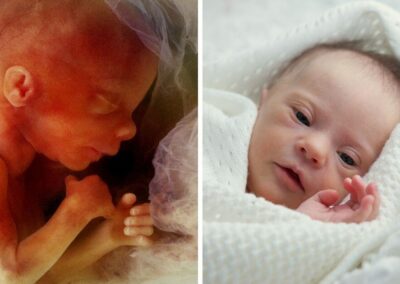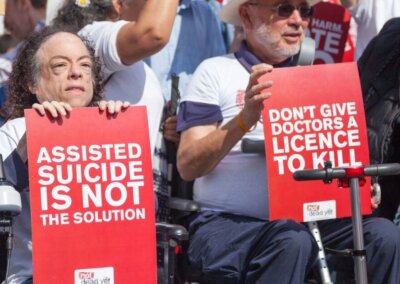




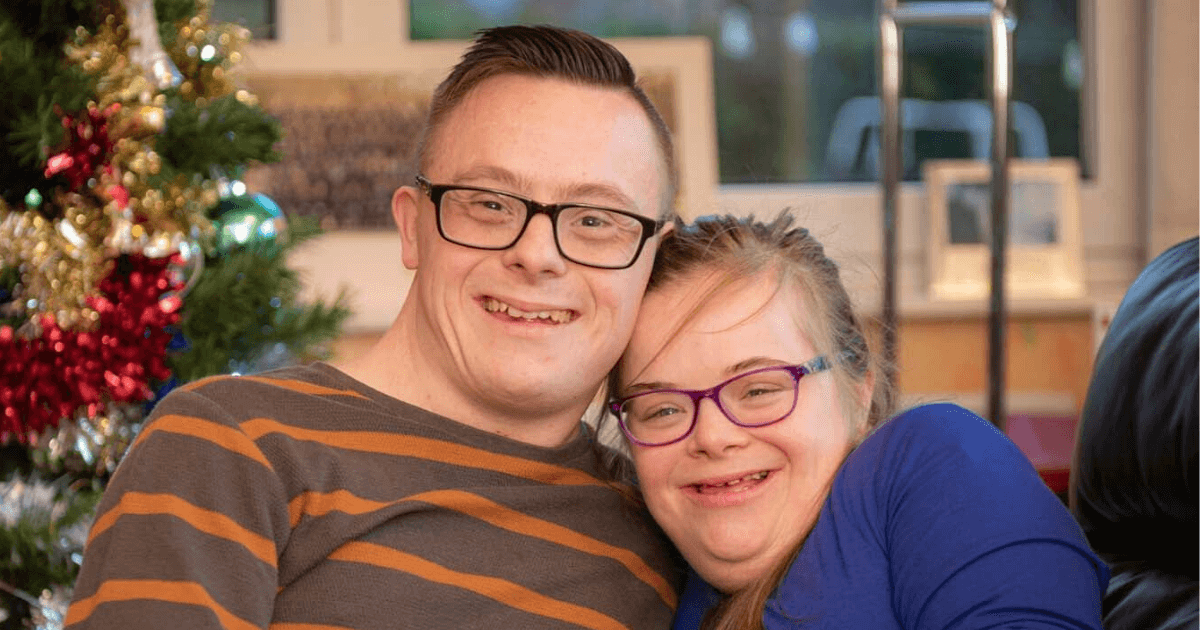
A 24-year-old woman who has Down’s syndrome has launched a landmark case against the UK Government over the current discriminatory abortion law that singles out babies with disabilities allowing abortion right through to birth for conditions including Down’s syndrome, cleft lip and club foot.
Heidi Crowter has joined with Cheryl Bilsborrow from Preston, whose two-year-old son Hector has Down’s syndrome, to bring forward the case.
Currently, abortion is available up to birth in England, Wales and Scotland if the baby has a disability, including Down’s syndrome, cleft lip and club foot whereas if the baby does not have a condition, there is a 24-week time limit.
The United Nations’ Committee on the Rights of Persons with Disabilities’ concluding observations on the initial report of the United Kingdom of Great Britain and Northern Ireland made a key recommendation that the UK change its abortion law on disability so that it does not single out babies with disabilities. However, the Government has decided to ignore this recommendation.
The Disability Rights Commission (now the Equality and Human Rights Commission) have said that this aspect of the Abortion Act “is offensive to many people; it reinforces negative stereotypes of disability…[and] is incompatible with valuing disability and non-disability equally”.
The 2013 Parliamentary Inquiry into Abortion for Disability found the vast majority of those who gave evidence believed allowing abortion up to birth on the grounds of disability is discriminatory, contrary to the spirit of the Equality Act 2010 and that it affects wider public attitudes towards discrimination. The Inquiry recommended Parliament reviews the question of allowing abortion on the grounds of disability and should consider repealing section 1(1)(d) of the Abortion Act which allows for it.
Disabled peer Lord Shinkwin has previously had a Bill in the House of Lords that would have repealed section 1(1)(d) of the Abortion Act – the Bill was undefeated but unfortunately ran out of time. Lord Shinkwin’s Bill was supported by Disability Rights UK.
Boris Johnson Government is currently deciding on the abortion framework that they will introduce to Northern Ireland ahead of March 31st. The proposed framework that the Northern Ireland Office has consulted on would allow abortion up to birth for disabilities including Down’s syndrome, cleft lip and club foot. 1875 people with Down’s syndrome and their families have signed a letter to Boris Johnson urging him to ensure that selective abortion for Down’s syndrome is not introduced to Northern Ireland.
Polling has shown that the majority of people in England, Wales and Scotland feel that disability should not be a grounds for abortion at all, with only one in three people thinking it is acceptable to ban abortion for gender or race but allow it for disability.
There were 3,269 disability-selective abortions in 2018 and 618 of these were for Down’s syndrome. This represents a 42% increase in abortion for Down’s syndrome in the last ten years with figures rising from 436 in 2008.
Mothers whose children were born with a cleft lip and palate have recently spoken out in horror against the current law in England, Wales and Scotland and that the proposed abortion framework that the Conservative Government is contemplating imposing on Northern Ireland will allow babies with the condition to be aborted up to birth.
In England and Wales, the number of abortions performed on unborn babies with cleft lip and palate has accelerated in recent years.
Official figures show that the number of terminations for those with the condition has more than tripled, from 4 in 2012 to an all-time high of 15 in 2018.
Since 2011, 75 unborn babies have been aborted because they had a cleft lip and palate.
However, findings from a European register have revealed that abortions for cleft lip and palate can be over ten times more common than what is being reported.
Eurocat, which was set up to register congenital abnormalities across 23 countries, found that 157 unborn babies, with the condition, were aborted in England and Wales between 2006 and 2010. The Department of Health only recorded 14 such abortions.
Joan Morris, national coordinator for Eurocat and professor of medical statistics at Queen Mary, University of London, said the group also found the number of babies aborted in 2010 for Down’s Syndrome was nearly double that recorded officially – 886 compared to 482.
The discovery suggests that the number of unborn babies being aborted because of a perceived disability is significantly higher than what is being reported.
The Department of Health confirmed in a 2014 report that some disability abortions had been wrongly recorded.
Heidi Crowter, from Coventry, who has Down’s syndrome said:
“At the moment in the UK, babies can be aborted right up to birth if they are considered to be ‘seriously handicapped’. They include me in that definition of being seriously handicapped – just because I have an extra chromosome! Can you believe that?
“What it says to me is that my life just isn’t as valuable as others, and I don’t think that’s right. I think it’s downright discrimination!
“The United Nations Committee on the Rights of Persons with Disabilities recently said that the United Kingdom should change its abortion law to make sure that people like me aren’t singled out because of our disabilities.
“Sadly, the Government decided to ignore their recommendations and didn’t change the law. So now, I am going to take the Government to court with other members of the Down’s syndrome community to make sure that people aren’t treated differently because of their disabilities.”
Paul Conrathe, the claimant’s solicitor from Sinclairslaw, said:
“This case addresses a matter that is fundamentally offensive and discriminatory- that unborn babies with a disability, and in this case Down’s syndrome, should be aborted up to birth. The current law reinforces negative stereotypes and attributes lesser value and dignity to people with disability.
“In bringing this landmark case the claimants seek judicial ruling that the Abortion Act 1967 impermissibly violates the dignity of people with disabilities.“
Lynn Murray, a spokesperson for Don’t Screen Us Out, said:
“By stating that disability is grounds for termination, section 1(1)(d) of the Abortion Act, promotes inequality. It would be totally condemned if a country’s abortion laws singled out babies on the ground of gender or skin colour, but because it’s a disability such as Down’s syndrome, that’s somehow ok? This is inequality, sanctioned, sponsored and funded by the state.
“This provision in the Abortion Act is a hangover from a time when we had totally different attitudes to the inclusion and contribution of people with disabilities. You only have to look at the discriminatory language used by all sides of the debate in Parliament when this was discussed in 1967 and 1990 to realise how far attitudes have changed. Society has moved on but the law hasn’t. It’s time it did.
“We live in a society which proclaims that we want to empower those with disabilities, and that regardless of your background, you deserve a fair and equal chance at life. We believe that our laws must reflect this narrative.”