




The pro-life charity Right To Life UK has welcomed the announcement that the “two-child benefit cap” is to be scrapped, as evidence suggests it has been a significant factor in many women’s decisions to have an abortion.
This evening, it was announced that Chancellor of the Exchequer, Rachel Reeves, is set to lift the two-child benefit limit in the November budget.
The two-child benefit cap was introduced in 2017, affecting households that had a third or subsequent child born on or after 6 April 2017, but it is likely that awareness of its introduction began to influence women’s decision to have abortions earlier in that year.
An analysis of official abortion statistics for England and Wales shows that between 2016 and 2021, the number of abortions had by women who had previously had two or more births resulting in a live or stillbirth (this includes the population of women affected by the two-child benefit cap) increased by 25.96%. At the same time, the number of abortions had by women who had previously had one or no births resulting in a live or stillbirth (this includes the population of women not affected by the two-child benefit cap) increased by only 9.89%.
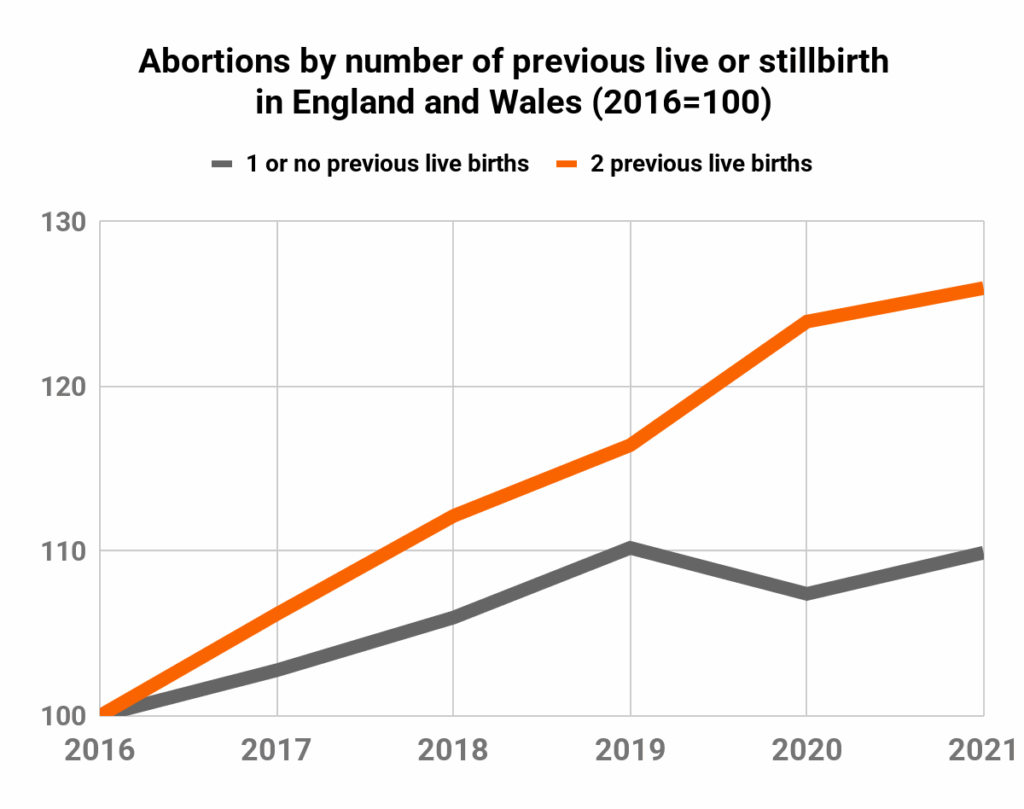
This data shows there has been a disproportionately large increase in abortions among mothers with two or more other children over this period.
The results of a survey suggest that the two-child benefit cap was a significant factor in many of these mothers’ decisions to have an abortion.
The abortion provider BPAS surveyed 240 women with two or more children who had had an abortion between March and November 2020. Of these, 59% said they were aware of the two-child benefit cap prior to their abortion.
Of those in receipt of tax credits or universal credit, and therefore most likely to be affected by the two-child benefit cap, 57% “said that the policy was important in their decision-making around whether or not to continue the pregnancy”.
Among those women surveyed, one said “I did something I never imagined I would ever do… But at the back of my mind all I kept thinking is how would I have managed financially… I had to do this”.
Another said “[The two-child limit] was a big factor for me. My husband has lost his job so we are on a very tight budget and when we looked at our finances we realised we couldn’t afford to have another baby”.
Similarly, another woman said “If there was no two-child limit I would have kept the baby, but I couldn’t afford to feed and clothe it … I’ve really struggled to come to terms with [my decision]”.
Cabinet ministers support change
The two-child policy was introduced in 2017 and “prevents parents from claiming child tax credit or universal credit for more than two children”.
The announcement of the scrapping of the two-child benefit limit came after cabinet ministers and Whitehall officials tasked with exploring ways to reduce child poverty reportedly recommended lifting the cap as the most effective method.
The Institute for Fiscal Studies (IFS) estimates that the cost of removing the two-child limit to the taxpayer would be £3.4 billion. However, they say “this is equal to roughly 3% of the total working-age benefit budget; it is also approximately the same cost as freezing fuel duties for the next parliament, or cutting the basic rate of income tax by half a penny”.
According to The End Child Poverty Coalition, the loss of benefits as a result of the two-child benefit cap is worth £3,514 per child impacted in 2025/26. Government data shows that in April 2025, 469,780 Universal Credit households were affected by the two-child limit policy.
Alisdair Hungerford-Morgan, Chief Executive Officer of the charity, Right To Life UK, said “We welcome the announcement from the Government that it will be scrapping the two-child benefit cap. This is a significant step in the right direction in terms of improving support for pregnant women.”
“When women discover they are pregnant, they should be met with the practical help and support they need to continue their pregnancy, not told that they will receive less financial support for their next child than for their previous children.”
“The two-child benefit cap was introduced in 2017, affecting households that had a third or subsequent child born on or after 6 April 2017, but news of its introduction likely began to influence women’s decision to have abortions earlier in that year.”
“Official data from the Department of Health and Social Care shows there has been a disproportionately large increase in abortions among women with two or more previous children compared to women who had one or no children between 2017 and 2021.”
“The results of a survey of women with two or more children who had had an abortion suggest that the two-child benefit cap was a significant factor in many of these women’s decisions to have an abortion.”
“Of those in receipt of tax credits or universal credit, and therefore most likely to be affected by the two-child benefit cap, 57% ‘said that the policy was important in their decision-making around whether or not to continue the pregnancy’.”