

Thank you for your support in 2025.
Because of supporters like you, we have just reached a remarkable milestone: our 250,000th supporter has joined our mission to build a pro-life society where every life is valued, from conception to natural death.
This is an amazing milestone. Below, you can find some of the key ways your support has made a real difference this year – in Parliament, in the media, online and in local communities across the UK.
Looking back, this has been one of the most challenging and busiest years ever for the team at Right To Life UK. We have faced the biggest battles on the abortion and assisted suicide fronts in over 50 years!
Thanks to your support, we have been able to help mount a strong, coordinated response in Parliament, in the media and among the wider public.
Alongside this, we have also seen important progress and reached key milestones. You can find an overview of the year below, with some of the many things we have been able to achieve, and to thank you for the part you have played in each one.
None of this would have been possible without you.
1. Major milestone reached – 250,000 grassroots supporters covering every constituency in the UK
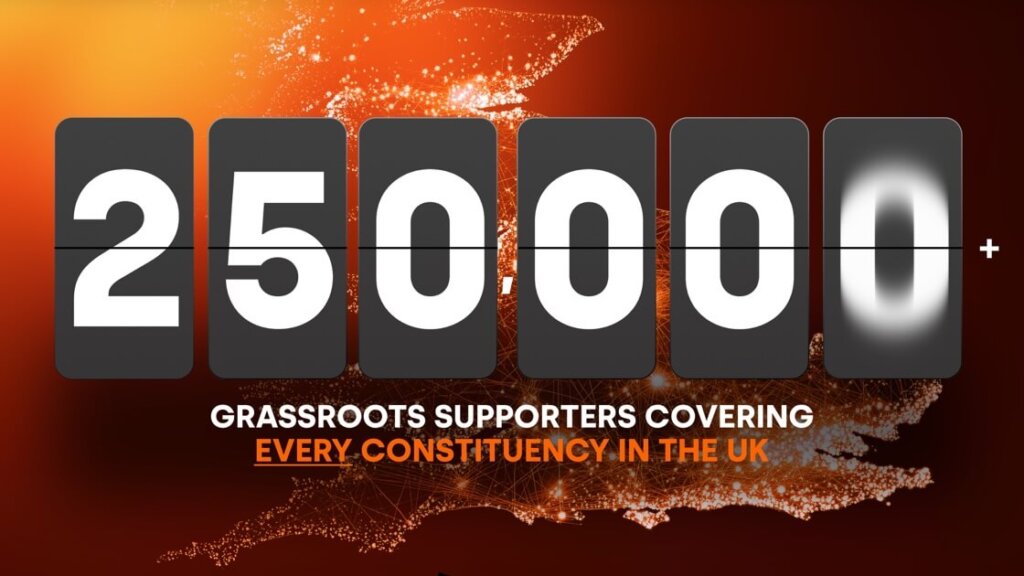
Thanks to supporters like you who have encouraged and inspired friends and family to get involved, we have now reached a quarter of a million supporters.
Right To Life UK supporters are people who join our database as part of our grassroots community from constituencies around the country, who take actions to help us build a pro-life society.
They email their MPs, get involved in our campaigns, speak to people in their local communities about life issues, and support our work in a variety of ways.
When it comes to pro-life organisations solely focused on life issues, it is the largest grassroots supporter database in the UK and Europe, and one of the largest in the world.
Reaching this milestone means we now have many more people in constituencies across the United Kingdom ready to take grassroots action. This significantly increases the positive impact we can have.
On the front line in Parliament, this means that when a challenge or opportunity arises that needs constituents to act, we can quickly mobilise supporters around the country to contact their MPs.
This sends a clear message to MPs that their constituents strongly oppose abortion and assisted suicide, encouraging them to vote the right way on these issues. For pro-life MPs, it demonstrates that they have significant support in their constituencies, enabling them to speak out on life issues in Parliament with confidence.
In terms of changing the broader culture on life issues, this growing network of grassroots campaigners has also been equipped with the resources they need to spread the pro-life message – not only to their local MPs but also to their friends, families, and local communities.
Change to our laws on abortion and preventing assisted suicide doesn’t happen in a vacuum. Lasting change can only happen alongside a shift in the wider culture.
As one of our 250,000 supporters, you are a vital part of effecting change in Parliament, along with a wider change to our culture.
2. Growing our digital strategy to make our website the second most viewed website of any pro-life organisation in the world and reach 100 million views across social media platforms
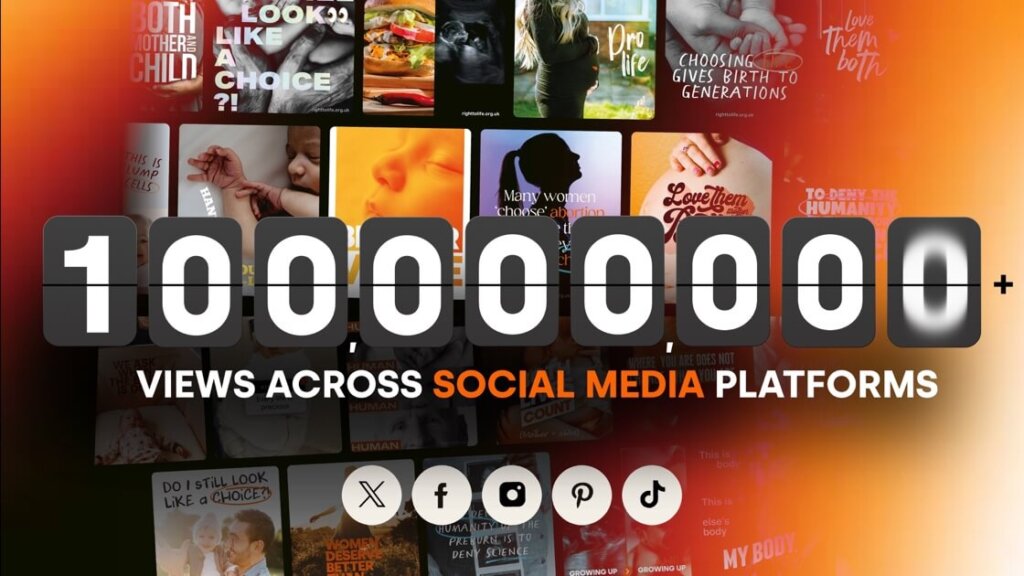
During 2025, we have worked on further growing our digital strategy, developing smart, engaging and viral-focused content to reach a much larger audience online.
As an organisation, we are relentlessly focused on ensuring that we have the greatest possible impact, and on carefully measuring that impact so we know what truly helps us reach more people and change more hearts and minds.
Alongside hitting the 250,000 supporter milestone, we have greatly expanded the number of people we reach online. Our website is now the most visited site of any pro-life organisation solely focused on life issues in the UK and Europe, and the second most visited such website in the world.
Our website sits at the centre of a wider digital strategy across major social media platforms.
Thanks to people like you sharing our content, our posts and videos on social media have been viewed over one hundred million times in the last year.
This includes beautifully produced videos, imagery, news articles and resources, designed by our team from the ground up to change hearts and minds on life issues.
It has also involved our team live-posting key video highlights and commentary during the large number of parliamentary debates that have taken place on abortion and assisted suicide this year. This has helped shape the narrative around the issues being considered in real time as the debate has unfolded.
We have also further developed our in-house digital video capacity to respond to the rapid growth of short-form video online. This has allowed us to produce a series of world-class videos that we have rolled out in our campaigns and on social media.
All of this content has been produced by our own digital team at a far lower cost than hiring top-tier creative and digital agencies.
This strategy has enabled us to reach a new generation of people on a large scale through our growing presence on Facebook, X, Instagram, YouTube, Pinterest, LinkedIn, Bluesky and TikTok.
The approach that took us to 100 million views was delivered by our in-house digital team for a tiny fraction of the cost of what would be needed to achieve the same reach through traditional advertising. This ensures that every pound given by our generous supporters has as much of an impact as possible.
3. Growing momentum to defeat assisted suicide bills in the UK and Scottish Parliaments
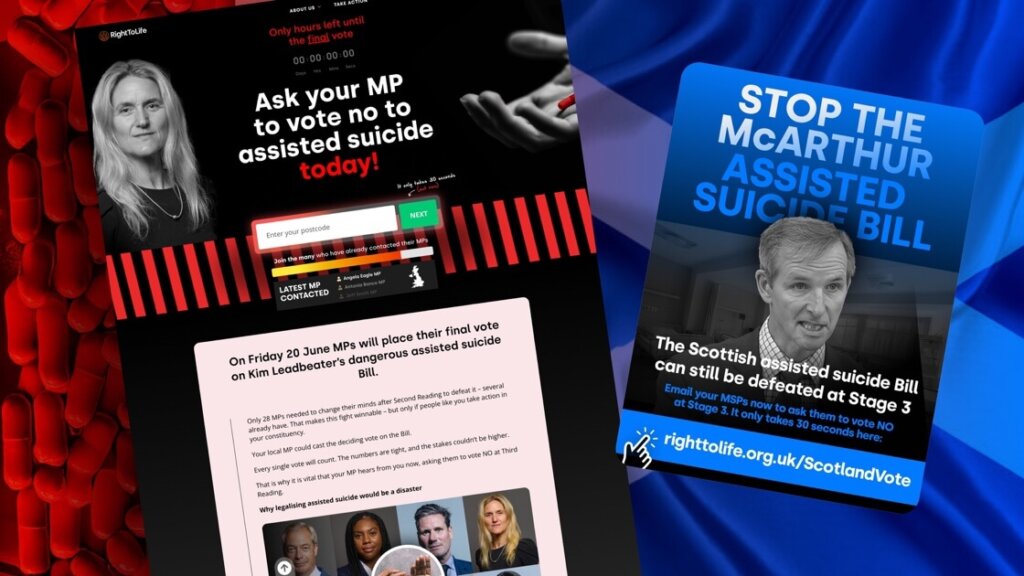
This year, we have worked with a wide range of prominent experts, commentators and organisations representing some of the most vulnerable people in our society, who are deeply concerned about the dangers of legalising assisted suicide.
Together, we have helped mount the largest campaigns against assisted suicide ever run in the United Kingdom, across two major fronts: the Leadbeater assisted suicide Bill in the UK Parliament at Westminster, and the McArthur assisted suicide Bill at Holyrood in Scotland.
In Westminster, although the Leadbeater assisted suicide Bill passed its Third Reading on 20 June, it did so by just 23 votes (314–291), a sharp drop in support after it passed Second Reading with a 55-vote majority.
This collapse in support was one of the largest proportional drops between those two stages in modern parliamentary history, and it happened in what is widely regarded as the most liberal UK Parliament on social issues ever.
That dramatic swing happened because you, and many thousands of people nationwide, spoke out. You showed MPs that this dangerous proposal would put vulnerable people at risk and could lead to many lives being ended through assisted suicide.
Had just 12 more MPs changed sides, the Bill would already be history.
This left the Bill limping into the Lords with a very narrow majority.
Because it is neither a Government Bill nor part of any manifesto, the Lords are fully entitled to heavily amend, time-out or outright reject this dangerous Bill.
This means the Leadbeater assisted suicide Bill can still be defeated. Given its tiny majority, that outcome is now far more realistic than it would have been without the significant shift in MPs voting against it.
There is now growing momentum to defeat the Bill in the House of Lords.
At Second Reading in the House of Lords, a record number of Peers spoke, and of those who took a position, around two-thirds opposed the assisted suicide Bill.
That is more than double the number who supported it.
Our side also secured a significant win, with the establishment of a dedicated Lords Select Committee, which went on to further scrutinise the Bill’s proposals – with a large number of expert witnesses highlighting major issues with the Bill.
The Bill has now moved on to Committee Stage, where increasing numbers of Peers are speaking against it.
At day one of Committee Stage two weeks ago, of the Peers who made speeches and took a position on the Bill, 72% spoke in opposition. By day two, that figure had risen to around 86%.
Similarly, in Scotland, while the assisted suicide Bill proposed by Liam McArthur passed its first hurdle at Stage 1, the vote was far closer than many commentators expected.
Analysis from our Public Affairs team, published in The Telegraph, indicates that more than 20 MSPs who initially voted for the Bill have suggested they could vote against it at the final Stage 3 vote.
If just seven of these MSPs switch their stance and vote against the Bill, it will be defeated at the Stage 3 vote. This shows that this is a battle that can very much be won.
Stage 2 of the Bill is currently taking place. Thanks to the remarkable response from people across Scotland who are engaging with their MSPs, there is growing momentum towards defeating the Bill at Stage 3.
4. Building opposition to extreme abortion proposals in England/Wales and Scotland
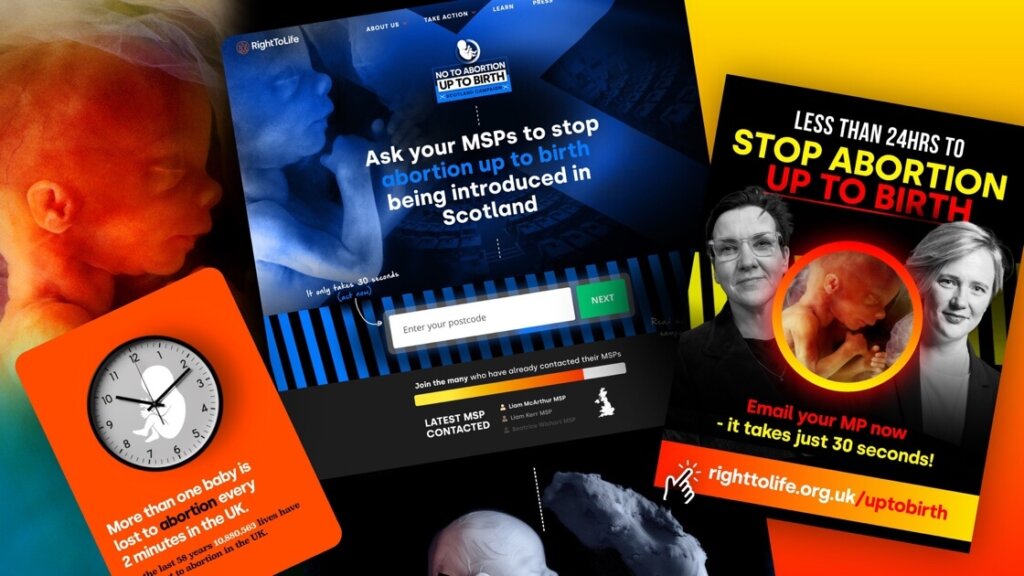
We have also been fighting proposals to introduce extreme changes to abortion laws in England and Wales, as well as more recent and even more radical proposals in Scotland.
The Antoniazzi abortion up to birth amendment, which passed in the House of Commons in June, is moving through the House of Lords as part of the Crime and Policing Bill.
If the Antoniazzi amendment becomes law, it would no longer be illegal for women to perform their own abortions for any reason – including sex-selective purposes – at any point up to and during birth.
While we ran a very large campaign against the amendment in the House of Commons, it unfortunately passed, but the other, even more extreme law change, tabled by Stella Creasy MP, did not go to a vote and so will not be able to become law.
If this amendment had gone to a vote and passed, the abortion lobby would have arrived at their end goal all in one go – abortion would have been available in abortion clinics around the country on demand, for any reason, up to birth.
The current time limit, two-doctor rule, and a series of other safeguards provided by the Abortion Act would have been removed.
The UK would have been left with the world’s most extreme abortion law.
In New Zealand in 2020, abortion was decriminalised, and the country saw a 43% increase in late-term abortions in 2020.
The law change Stella Creasy proposed was more extreme than the law in New Zealand.
This would have likely led to a very large increase in later-term abortions. Along with this, because the other safeguards provided by the Abortion Act that help save lives would have been removed, this would have likely led to a large increase in abortions at all gestations.
While it is good that this amendment did not pass in June, it shows where the abortion lobby ultimately wants to go with our abortion laws.
After the Antoniazzi amendment passed in the Commons, we worked with influencers on platforms such as X, prominent commentators and with media outlets to generate as much backlash as possible around this extreme change to the law.
This helped vastly increase awareness of how extreme the law change was, with, for example, 91% of respondents to a poll of 28,000 Telegraph readers saying that they opposed the law change. A large number of prominent commentators – including many who have previously taken a pro-abortion stance – also spoke out against the amendment.
We have now moved on to fighting this battle in the Lords, where we are running the next phase of our No To Abortion Up To Birth campaign.
Ahead of Committee Stage of the Crime and Policing Bill, Baroness Monckton has tabled an amendment to overturn the abortion up to birth amendment (clause 191).
If Baroness Monckton’s amendment passes, clause 191 will be removed from the Bill and will not become law.
Baroness Stroud has joined other Peers in tabling another amendment that would ensure that women have an in-person consultation with a medical professional before taking abortion pills at home.
At this consultation, medical professionals would have the opportunity to accurately assess, in person, any likely health risks for a woman taking abortion pills, her gestational age and the possibility of a coerced abortion.
This would help protect women from the health risks involved with performing a late-term abortion, along with identifying many other health risks that can be accurately assessed with an in-person consultation.
It would also protect babies from having their lives ended in late-term home abortions.
Polling shows widespread public support for the law change that had been proposed by Baroness Stroud’s amendment, with two-thirds of women supporting the reinstatement of in-person appointments and only 4% in favour of the status quo.
In Scotland, moves are underway to attempt to introduce an even more extreme abortion law there.
An “expert group” undertaking a review of abortion law in Scotland, commissioned by Humza Yousaf when he was Scottish First Minister, has released sweeping recommendations for major changes to Scotland’s abortion laws.
They have recommended that the Scottish Government scrap the current 24-week time limit for abortion – and abortion be available on social grounds right up to birth in Scotland.
Unborn babies could legally have their lives ended throughout all nine months of pregnancy – right up to when the baby is about to be born.
This law change would also make sex-selective abortion legal – allowing a baby to be aborted simply because she is a girl.
The proposed changes in the law in Scotland go far beyond the already extreme current proposals to change abortion law in England and Wales, which would be limited to amending the law for women performing their own abortions.
Scotland would be left with one of the most extreme abortion laws in the world.
Following the announcement, we launched our No To Abortion Up To Birth Scotland campaign to stop the extreme proposed change to the law.
Thanks to everyone who took action, MSPs have had their inboxes flooded with emails from constituents horrified by these proposals, who are calling on them to oppose them.
In fact, this has been the largest number of emails that MSPs have ever received in Scotland on the abortion issue.
Alongside this major grassroots response, there has been a very strong reaction online and in the media, with many people particularly horrified by the suggestion that sex-selective abortion could become legal in Scotland.
A number of prominent commentators have also published op-eds and taken to the social media platform X to condemn the extreme proposals.
There is still much work to do, but for now, we are deeply grateful to all of you who have contacted MSPs, encouraged friends and family to act, and shared our press releases and articles online to spread the word.
5. Helping shape the media narrative on the life issues with messaging featured in over 1,000 media pieces
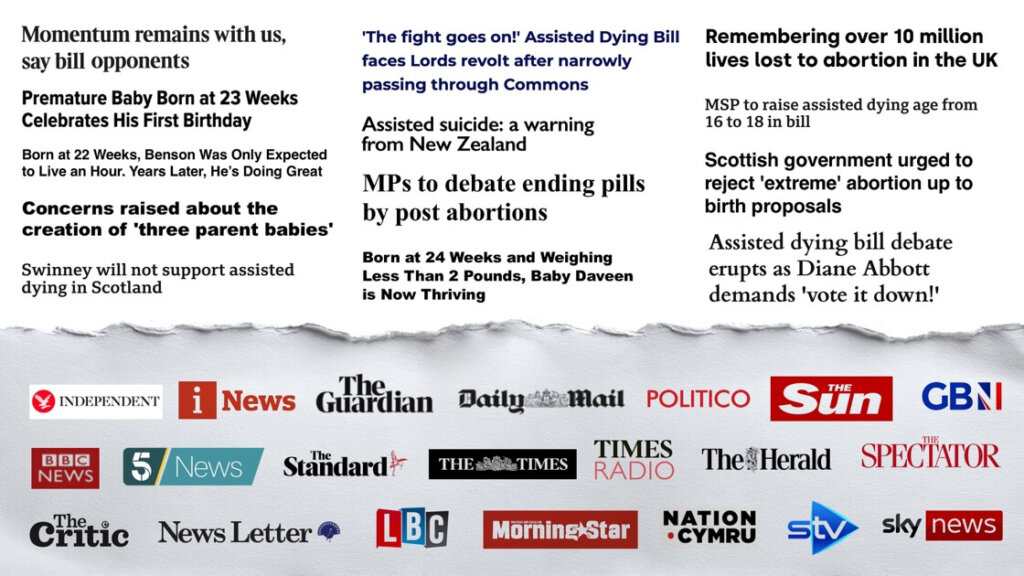
As mentioned earlier, significant policy change on life issues in Parliament can only happen if it is supported by a broader change to the wider culture.
A crucial part of our work in changing the wider culture on these issues is ensuring that pro-life messaging is regularly heard in the media.
During 2025, we have developed new relationships with senior journalists across a large number of media outlets, which has helped our carefully crafted pro-life messaging feature in over 1,000 print, digital and broadcast media pieces.
We have further expanded our media reach with a specific emphasis on getting positive pro-life messaging regularly featured in the mainstream media.
Our focus on mainstream media is vital because this allows us to reach a large middle ground of people, with a focus on areas where research shows the majority of people are very receptive to seeing positive political and cultural change in relation to our abortion laws.
This can be challenging, as many parts of the media are cautious or even hostile towards the right-to-life point of view. However, we have found there are several key areas where public opinion is clearly on our side, such as concern about our current late abortion time limit, sex-selective abortion, and abortion on grounds of disability, including Down’s syndrome, cleft lip and club foot.
We have been able to target these areas to effectively shape the debate towards a wider recognition of the right to life of the unborn child and the need to support mothers who are dealing with unplanned pregnancies.
On the assisted suicide front, this year we have worked directly with mainstream media outlets to build momentum against the Leadbeater assisted suicide Bill at Westminster, and the McArthur assisted suicide Bill at Holyrood.
Wherever possible, we have ensured that the spokespeople we deploy as the voice on these issues in the media are most likely to connect with mainstream audiences. This has included women who have been personally affected by abortion, people who could be directly affected by the introduction of assisted suicide, and medical experts.
6. Building relationships with MPs and Peers so that the case for protecting life is clearly presented in Parliament
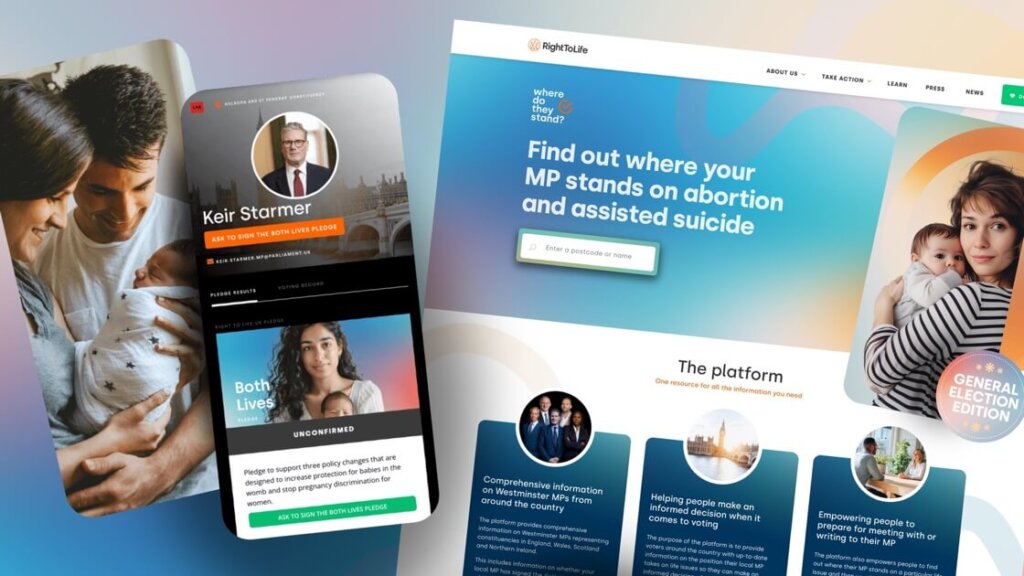
During 2025, our Public Affairs team has worked to offer support to a large number of pro-life MPs and Peers, and support them to grow their network further.
This has built on the already large number of MPs and Peers we have a direct relationship with and has enabled us to work with them to make the case in Parliament to prevent extreme changes to our abortion legislation and build momentum for positive pro-life changes to our laws.
This work in Parliament is supported by providing vital information to the public through digital resources such as our Where Do They Stand voting record platform. This gives up-to-date information on where MPs stand on life issues, along with a full account of their voting records.
We have combined this with regular updates to our EasyAction MP contact tools to make it even easier for people from around the country to contact their MPs with well-researched pro-life messaging that helps make the pro-life case for positive change to our laws to MPs.
Thank you to everyone who has either emailed or visited their MPs throughout this year. You have played an important part in ensuring MPs feel that they have the backing of their constituents when it comes to courageously speaking out in Parliament in support of the unborn child and pregnant women – and protecting the vulnerable by preventing the introduction of assisted suicide.
7. Development of Right To Life News to reach even more people and keep them informed with news on life issues
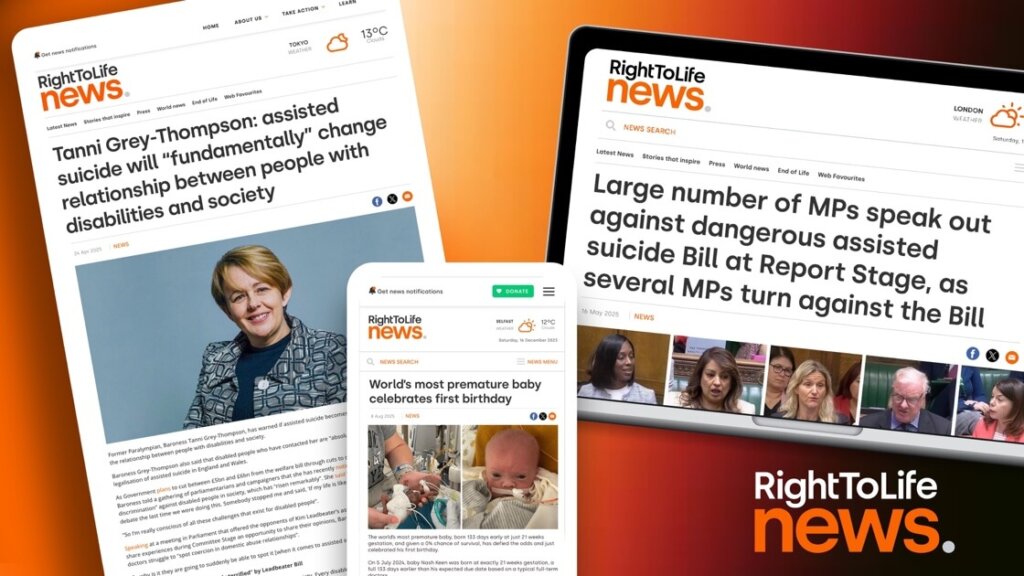
Over the last year, we have expanded the Right To Life News digital news platform, reaching a wider audience with pro-life news and helping to move more hearts and minds towards a culture of life.
Our digital team has built the platform from scratch to provide visitors with a world-class, user-driven design experience that rivals those of major global media outlets.
We have strong direct relationships with senior journalists in several mainstream media outlets, which ensures that we get to regularly comment in the media. However, we can’t always guarantee that these articles will include all the crucial points that the public needs to be aware of regarding a specific issue.
Right To Life News ensures that the public have a trustworthy platform where reliable pro-life news is accessible to everyone in the UK and beyond. This ensures that we are not constrained by what editors in major newspapers decide to publish.
A big thank you to the many supporters who have consistently used the news service and shared the articles. You have played a big part in the growth and success of this service.
In the year ahead, we plan to roll out new features to reach even more people with well-crafted, helpful content through Right To Life News and our wider website. This will help ensure we reach many more people.
8. Our education and training programmes are developing a new generation of pro-lifers
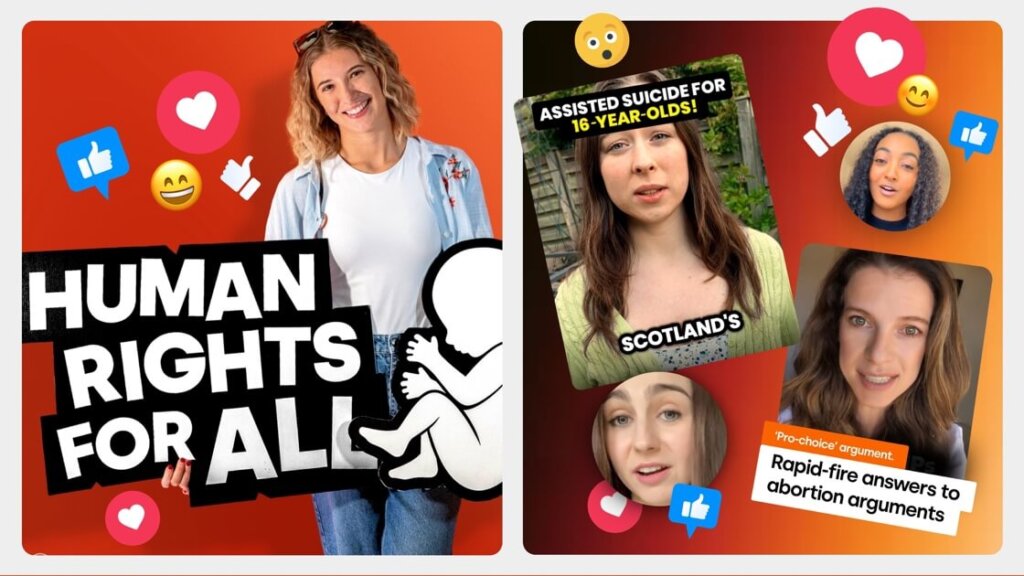
Our education and training programmes are helping to develop a new generation of pro-lifers who are armed with the knowledge and skills to effectively communicate an evidence-based case for positive change on life issues.
Our Internship Programme immerses student right-to-lifers and new graduates in the world of the right-to-life movement and its work spanning media, politics, education, and grassroots involvement.
We also train young pro-lifers on how to effectively communicate on pro-life issues in the media. This has equipped these young people with the skills and techniques they need to deliver strong interviews, handle difficult and hostile questions and deliver an authentic pro-life perspective on life issues.
In conjunction with our extensive digital outreach, we’ve been able to educate and develop a new generation of young people who are committed to driving positive change on life issues. In the year ahead, we plan to further expand our education and training programmes.